Treating nasal spray addiction starts with understanding that it doesn’t resemble drug addiction, but it is real in its effect: a person unable to sleep or work without spraying their nose every few hours, because the nose blocks more whenever they try to stop. The known medical explanation is “rebound nasal congestion”,
meaning the decongestant that began as a temporary solution has become the cause of the problem. The good news is that this cycle usually breaks with a clear medical plan and patience through two difficult weeks, with no need for a rehab center. This article explains how you know you are in it, how doctors treat it, and when the psychological side becomes part of treatment.
Is it addiction in the medical sense?
Honesty requires distinguishing between two things. Decongestant nasal sprays don’t cause a high or cloud the mind, and no one pursues them for “enjoyment”. What happens is physiological dependence in the mucous membrane itself, supported by a strong behavioral habit. That is why doctors call it a “medication-induced congestion disorder”, not a substance use disorder. Even so, people rightly use the word “addiction” when compulsive behavior appears: secret spraying at night, a bag or pocket never without the bottle, and real panic at the idea of it running out. This behavior deserves the same seriousness we give any habit that has slipped out of its owner’s control.
How does the rescuing spray become a problem?
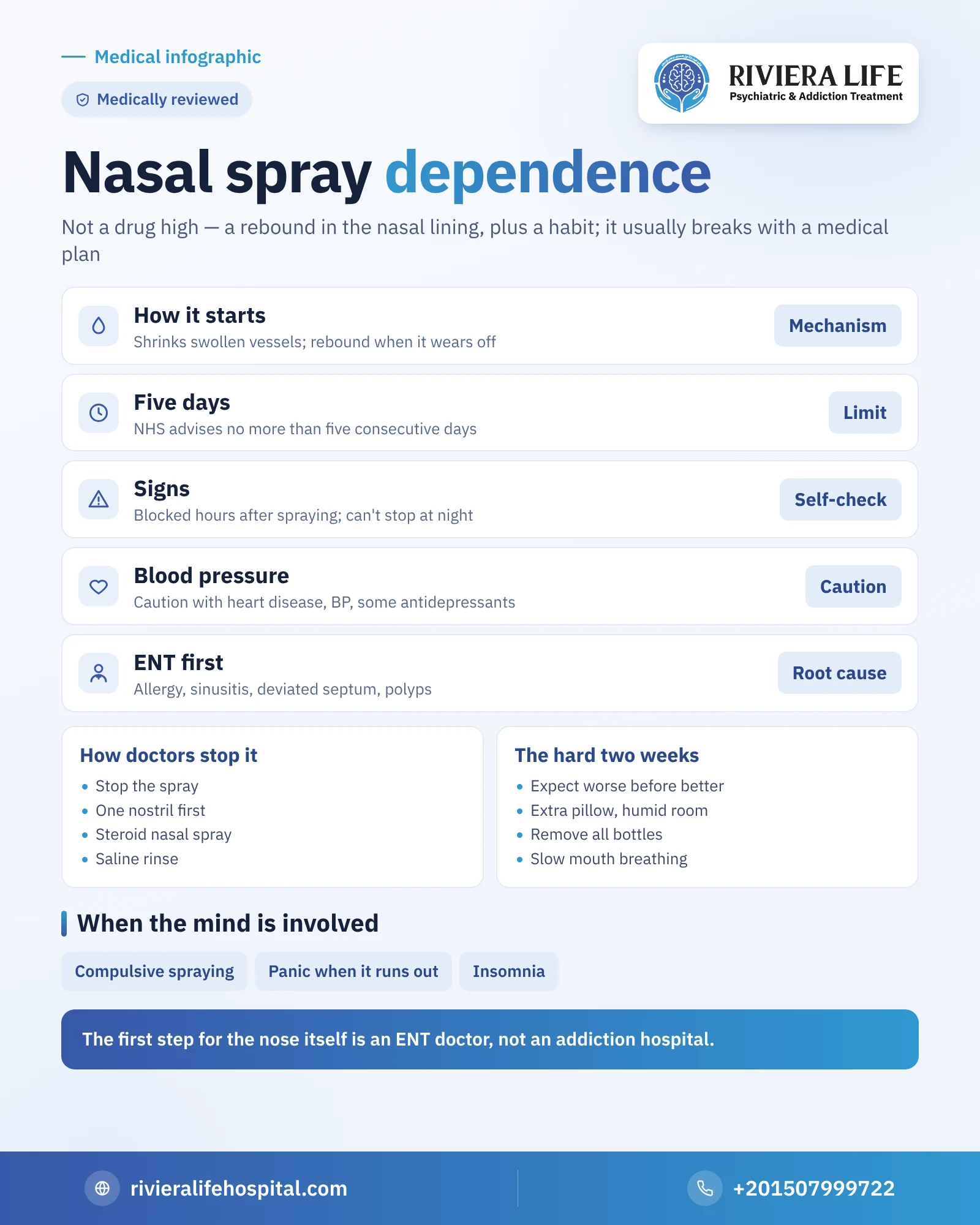
These sprays work by narrowing the swollen blood vessels in the lining of the nose, so the airway opens within minutes. The problem is that the lining adapts to continuous use. When the effect wears off, the vessels widen more than they were, so the blockage returns more strongly, and the need for a new spray seems urgent.
The cycle usually starts after a few days of consecutive use, and may be delayed in some people to weeks. The UK’s NHS guidance states that these products shouldn’t be used for more than five consecutive days because overusing them makes the blockage worse. That is why the common saying “the more you spray, the more it blocks” is an accurate description of what goes on inside the nose.
Who is most at risk?
- Those with seasonal or chronic nasal allergy who haven’t received suitable preventive treatment.
- People with a deviated nasal septum, polyps or adenoids, because their blockage is mechanical so it returns with every episode.
- Those who get frequent colds or sinusitis and use the spray “just in case”.
- Those who suffer from anxiety or insomnia, as the feeling of suffocation at night doubles attachment to the bottle.
- Smokers and those exposed daily to dust and exhaust fumes.
Signs that tell you you’re in the cycle
Ask yourself honestly: have you been using the spray for more than a week without a break? Does your nose block just a few hours after the last spray? Do you spray before sleep even if your nose seems clear? Have you tried to stop and gone back the same night? If the answers are yes, you are most likely facing rebound congestion. You may also notice dryness and burning in the nose, repeated slight bleeding, a reduced sense of smell, and morning headaches from sleeping with your mouth open.
What happens to the nose with long use?
Chronic use may dry out the lining and make it fragile and prone to ulcers and bleeding, and weaken its ability to humidify and filter air. These substances are absorbed into the blood to a small degree, and may affect blood pressure and heart rate in some people. That is why patients with high blood pressure, heart disease, diabetes, an enlarged prostate or an overactive thyroid are advised to consult a doctor or pharmacist before using them. The NHS also warns that combining them with some antidepressants may raise blood pressure dangerously, so tell your doctor everything you take.
Treatment starts with a question: why does your nose block in the first place?
The common mistake is to treat the spray alone and neglect the original cause of the blockage. That is why the plan starts with a visit to an ear, nose and throat doctor. They examine the nose, look for allergy, sinusitis, a deviated septum or polyps, and determine whether treatment needs medicine or later surgical intervention. If this cause is left untreated, the spray returns weeks after recovery, however strong your willpower.
How do doctors stop rebound congestion?
The cornerstone in medical references is stopping the offending spray, which may be done all at once or gradually depending on the case. Some doctors ask for it to be stopped in one nostril first so the patient can still breathe through the other, then follow with the second. The doctor may prescribe a corticosteroid nasal spray that calms inflammation of the lining, and recommend a saline rinse that moisturizes and eases dryness, and in severe cases may turn to a short course of oral cortisone under their supervision. These decisions, their doses and their timing are for the doctor alone, so don’t start any of them on your own or change a plan prescribed for you.
The two hardest weeks: what to expect?
Expect the blockage to get worse before it gets better. This isn’t a sign of failure, but proof that the vessels are readjusting themselves. The time differs from person to person; relief usually starts after days and then progresses over weeks. A simple plan eases the suffering:
- Saline rinse or warm steam as the doctor directs.
- Raising your head with an extra pillow when sleeping, and humidifying the room air.
- Removing the bottle from the bedroom, bag and car, as the decision is easier when it isn’t within reach.
- Scheduling the first two hard nights for days off where possible.
- Slow breathing through the mouth at the moment of panic, remembering that the suffocation you feel is a feeling, not a danger.
When anxiety is what sprays the bottle
For some people the nose isn’t the only problem. Someone who sprays many times knowing they don’t need to, or who panics at the thought of the bottle running out, may suffer from anxiety or an obsession that feeds on this habit. Here cognitive behavioral psychotherapy helps dismantle the link between feeling distressed and spraying. If this coincides with insomnia or panic attacks, read about panic attacks and sleep disorders. The same lesson applies to eye drops, as in our article on Mydrapid eye drops: a legitimate medicine that turns into a habit when used without need.
What if the nasal damage is caused by a drug?
If congestion, bleeding and pain in the nose are accompanied by using any substance through the nose, the problem is completely different and you must tell the doctor frankly, because the treatment and the risks are different. For help with this point you can read cleaning the nose after cocaine.
How do you prevent a return?
- Agree with your doctor on a plan for future bouts of congestion instead of going back to the spray.
- Treat allergy or inflammation regularly, and don’t wait for symptoms.
- If you have to use it for a cold, don’t exceed the period written on the leaflet or set by the doctor.
- Don’t share your bottle with anyone and don’t keep spare bottles everywhere.
- Watch out for “combination” products that contain a decongestant inside tablets or syrup.
How can Riviera Life help you?
The first step for treating the nose itself is with an ear, nose and throat doctor, not an addiction hospital. But if anxiety, obsession, insomnia or the use of other substances lies behind compulsive spraying, a psychological assessment at Riviera Life helps you understand what drives the habit and treat it. The first consultation is free and completely confidential, and you can call +201507999722.
Read also
- Panic attacks: symptoms and treatment
- Sleep disorders: their types and signs
- Mydrapid eye drops: medical use and the risk of misuse
- Cleaning the nose after cocaine
Questions many people ask
It isn't addiction in the sense known with drugs, as they don't cause a high. But they cause dependence in the nasal lining known as rebound congestion, which may be accompanied by compulsive spraying.
The UK's NHS advises not to use topical decongestant sprays for more than five consecutive days. Rebound may start in some people after a few days or be delayed for weeks.
Many do, but some doctors prefer tapering, such as stopping it in one nostril first. Ask your doctor about the most suitable method for you and don't start a substitute medicine on your own.
The blockage may return, and with it the urge to use the spray, even after stopping. That is why an ear, nose and throat doctor checks for allergy, sinusitis or a deviated septum.
When spraying is compulsive or linked to panic attacks or insomnia, or when you can't stop despite following the nasal plan. A psychological assessment helps understand the anxiety or obsession behind the habit.