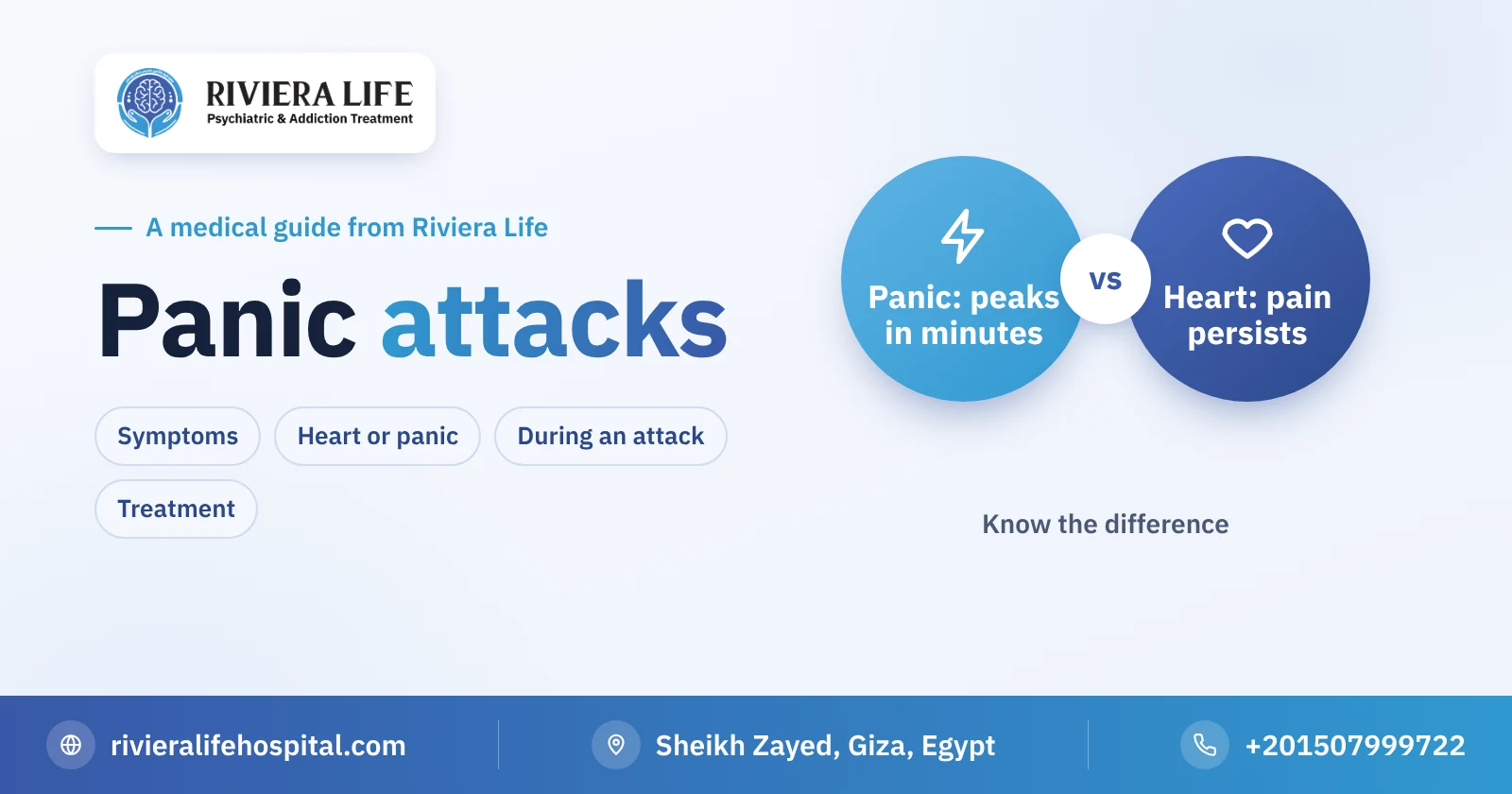
Panic attacks are sudden, violent waves of fear that peak within minutes, accompanied by palpitations, shortness of breath, trembling and a feeling that death or madness is near. They are terrifying for the person living through them, but in a healthy heart they cause no physical harm, and usually end within minutes to about half an hour. The question that preoccupies most people who have had one: is this a panic attack or a heart attack? And what do I do if it happens again? This article answers that practically: how to recognize the attack, when to go to the emergency department without hesitation, what triggers it, how to act during it, and what treatment prevents it from returning.
What does a panic attack feel like from the inside?
Imagine an employee in a crowded microbus on his way to work. Suddenly, for no clear reason, his heart starts pounding, he feels there isn’t enough air, his hands go numb, and he is flooded with a strange certainty that something terrible is about to happen right now. He asks the driver to stop and gets out in a hurry. Twenty minutes later everything calms down, leaving severe exhaustion and a frightening question: what was that?
This description is close to what many live through. A panic attack usually combines several of these symptoms:
- Palpitations or a severe racing of the heartbeat.
- Shortness of breath or a feeling of choking.
- Pain or pressure in the chest.
- Sweating, trembling and waves of heat or cold.
- Dizziness or a feeling of being about to faint.
- Numbness in the limbs or around the mouth.
- Nausea or stomach cramps.
- A feeling that the place or the body isn’t real.
- Fear of losing control, going mad or dying.
A panic attack or panic disorder?
The difference between the two terms matters, because the first is an experience that may happen once in a lifetime, and the second is a disorder that needs treatment. A single panic attack is common, and can happen to anyone during a period of severe stress, after staying up late or after a large amount of caffeine.
Panic disorder, however, is diagnosed by the psychiatrist when attacks repeat unexpectedly, and the person then lives for a month or more in constant worry about the next attack, or changes their life to avoid it, such as stopping using public transport or going out alone. Panic attacks may also appear within other disorders, such as social phobia or OCD, and the article on types of anxiety explains where panic disorder sits among the other anxiety disorders.
A panic attack or a heart attack? And when should you go to the emergency department?
The symptoms sometimes overlap to a degree that confuses doctors themselves before examination, so the person shouldn’t settle the matter alone the first time. These are general differences that help understanding, not diagnosis:
| Sign | Usually a panic attack | Usually a heart attack |
|---|---|---|
| Onset | Sudden, sometimes at rest or with a worrying situation | Often with exertion, and may also happen at rest |
| Nature of the chest pain | Sharp or stabbing, or tightness with fast breathing | Pressure or heaviness spreading to the arm, jaw or back |
| Duration | Peaks within minutes and then calms | The pain continues or increases |
| Who is most at risk | Any age, and more common in young people | Older people, smokers, and people with diabetes and high blood pressure |
The safe rule: if this is the first attack, if the pain is different from your usual attacks, or if you have heart risk factors, go to the emergency department. A heart tracing and simple tests settle the matter, and no one blames you for making sure.
Seek urgent help immediately if you see
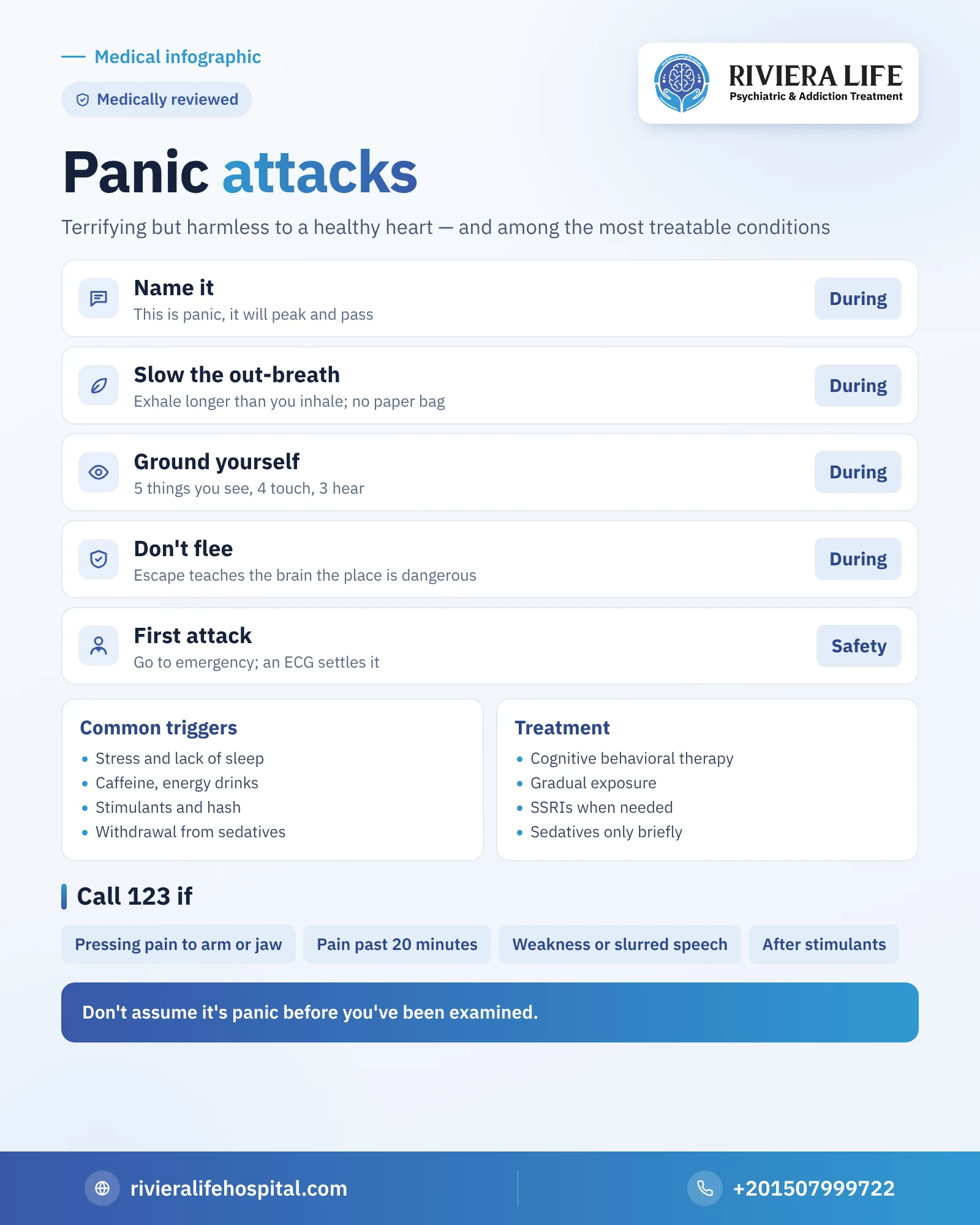
Call an ambulance on 123 or go to the nearest emergency department, and don't assume it is a panic attack before examination.
- Pressing chest pain spreading to the arm, jaw or back
- Pain or tightness that doesn’t calm after about twenty minutes, or gets worse
- Fainting, sudden weakness on one side of the body, or difficulty speaking
- An attack after using a stimulant such as Captagon, cocaine or ice
- An attack with severe trembling and confusion during withdrawal from alcohol or sedatives
- Thoughts of self-harm
What triggers a panic attack?
An attack may come without an apparent cause, but certain factors make it more likely. Behind its physical symptoms is the body’s alarm system, and we explained its role in the article on adrenaline and anxiety. The most common triggers are:
- Stress and exhaustion: periods of exams, disputes or loss, and accumulated lack of sleep.
- Caffeine and energy drinks: large amounts raise palpitations and bring the body closer to the edge of an attack.
- Stimulants: Captagon, cocaine and ice raise the heart rate and may trigger panic and terror attacks, and sometimes real heart problems.
- Hash and bango: may cause panic attacks, especially with high-potency types, in someone trying them for the first time, or in someone predisposed to anxiety.
- Withdrawal: stopping alcohol, sedatives or pregabalin after regular use may cause anxiety and severe panic attacks.
- Medical causes: such as an overactive thyroid or some asthma medicines, which is why the doctor sometimes asks for tests before diagnosis.
What do you do during a panic attack?
The goal isn’t to stop the attack by force, but to get through it with the least fear. The more you resist it in terror, the longer it lasts, and the more you allow it to pass, the more its intensity eases.
Name what is happening
Tell yourself clearly: this is a panic attack, I have been through it before, and it will reach its peak and then calm down. This sentence alone breaks part of the cycle of fear, provided physical causes have been ruled out before.
Slow the out-breath
Fast breathing increases numbness and dizziness. Sit down if possible, take a calm breath in through the nose, then make the out-breath longer through the mouth, as if slowly blowing out a candle. Repeat this for a few minutes. Don’t breathe into a paper bag as is commonly said, as this method is no longer recommended.
Come back to the place around you
A grounding exercise brings attention back from inside the body to the outside: name five things you see, four things you touch, three sounds you hear, two things you smell and one thing you taste. You can also press your feet into the floor or hold something cold.
Don’t flee if you can
Stay where you are until the attack calms if the place is safe. Escaping brings relief in the moment, but it teaches the brain that this place is dangerous, so avoidance grows each time.
How do you help someone having a panic attack?
Stay beside them calmly, and speak in short sentences and a low voice. Don’t tell them “calm down” or “you’re exaggerating”, but say “I’m here, and this attack will pass”. Breathe slowly with them so they copy your rhythm. Move them away from the crowd if possible, and don’t give them any sedative of your own. If signs from the emergency list above appear, call the ambulance immediately.
Fear of fear: how does it turn into a cycle?
The biggest problem with panic attacks is often not the attack itself, but what comes after it. The person begins monitoring their pulse all day, avoids the places where the attack happened, then places that resemble them. It may reach agoraphobia, where leaving the house alone becomes a difficult task. Each step of avoidance reduces anxiety temporarily and widens its circle in the long run, which is why treatment focuses on breaking this cycle.
Treating panic attacks
Panic disorder is among the psychiatric disorders that respond best to treatment, and most patients improve clearly with the right plan.
Cognitive behavioral therapy
It is the main psychological treatment for panic disorder. In it the patient learns to understand the attack’s symptoms instead of interpreting them as danger, and is gradually exposed, under the therapist’s supervision, to the bodily sensations they fear, such as a racing heart, and to the places they have started avoiding, until the fear loses its power.
Medicines
The psychiatrist may prescribe antidepressants from the serotonin reuptake inhibitor class, which don’t cause addiction, and their effect usually appears after several weeks; the doctor alone decides their type and how long to continue them.
Why do doctors warn against relying on sedatives?
Benzodiazepines, such as alprazolam, known by the trade name Xanax, calm the attack quickly, which is why they tempt many. But relying on them alone may cause tolerance and dependence, and anxiety returns stronger as their effect wears off, so the dose is repeated. The article on Xanax addiction explains how this happens. That is why the doctor uses them, if needed, for a short period and under follow-up, and they must not be stopped suddenly after regular use without a plan from them.
Panic attacks and addiction
Some people with repeated attacks look for quick calm in alcohol, hash or sedatives without a prescription. The trick seems to work for days, then the substance itself becomes a new trigger for attacks with withdrawal. In this case the person needs treatment that deals with panic and dependence together, as in the dual diagnosis program.
How can Riviera Life help you?
If your attacks repeat, if you have started avoiding places and activities because of them, or if you rely on a sedative to get through your day, an assessment is a useful first step. The consultant psychiatrists at Riviera Life listen to the details of the attacks, rule out physical causes, then set a suitable psychological and medication treatment plan, with safe withdrawal from sedatives when needed, in complete confidentiality. The first consultation is free.
More from the anxiety guide
- Anxiety: the complete guide
- Anxiety symptoms
- Adrenaline and anxiety
- Anxiety treatment
- Claustrophobia: fear in lifts, MRI scanners and planes, and its treatment
- Depersonalization-derealization disorder and its treatment
- Agoraphobia: fear of places that are hard to escape, and how it is treated
- Psychogenic breathlessness: how to tell it from physical causes and what to do
Questions many people ask
A panic attack doesn't harm a healthy heart, even though it makes you feel death is near. But new or different symptoms need a medical examination to rule out a heart or physical cause.
Yes, some people wake suddenly with palpitations and intense fear without a clear nightmare. If it repeats, it deserves an assessment by a psychiatrist after physical causes are ruled out.
It may, especially high-potency types, on first use, or in someone predisposed to anxiety. Attacks may also appear during the period of stopping it.
Most people with panic disorder improve greatly with cognitive behavioral therapy and/or medicine, and attacks disappear in many. If they return at times of stress, the skills learned are usually enough to contain them.
For the first attack or with new chest pain, start with the emergency department or a cardiologist. If tests are normal and attacks repeat, the psychiatrist is the specialist for treatment.