The short answer
Addiction is a chronic medical condition in which a person loses the ability to control their relationship with a substance or a behavior, so they go back to it again and again even though they see the losses it brings them. It includes drugs, alcohol and prescription medicines, and also behaviors such as gambling and video games. It forms gradually and changes the brain's reward and control circuits, which is why intention alone isn't enough to get out of it. Most importantly, it is treatable when diagnosed early and an integrated medical and psychological plan is followed.
- Loss of controlIs the core of the diagnosis, not the amount used
- Substances and behaviorsDrugs, medicines, gambling and screens
- A treatable diseaseWith a long plan and follow-up after stopping
Addiction is the term many fathers and mothers in Egypt hear for the first time when they find a strip of pills in their son's pocket or notice that the husband's salary evaporates before the middle of the month. In this guide we explain the medical meaning of the word, answer the question of disease and willpower, trace the road a person takes from the first try to dependence, distinguish between its types, and touch on what goes on inside the brain; then we put in your hands the warning signs, the common myths, the road to recovery and prevention, with a map of all the articles in this section.
What is addiction in the medical sense?
Doctors today use the term "substance use disorder" in the American manual DSM-5, and the international classification ICD-11 issued by the World Health Organization uses similar terms. Behind the different names is one idea: compulsive behavior that continues despite harm, with an intense craving that dominates thinking, and sincere attempts to stop that end in failure.
DSM-5 sets eleven criteria for diagnosis, including using a larger amount or for longer than the person planned, spending a long time getting the substance, neglecting home and work, giving up hobbies that used to fill their life, and continuing despite obvious health problems. Meeting two or three criteria means a mild condition, four or five a moderate condition, and six or more a severe condition. These levels help the doctor choose the appropriate level of treatment.
The difference between a habit and addiction is simple to put: a habit you can postpone when it harms you, while addiction gets ahead of your decision. The employee who drinks tea every morning can do without it on a fasting day, while someone who has reached dependence on a painkiller such as tramadol arranges their whole day around the time of the next dose.
Is addiction a disease or a weakness of will?
The American National Institute on Drug Abuse (NIDA) describes it as a chronic, relapsing disorder, relying on brain images that show real changes in the areas responsible for judgment and impulse control. The first decision to try may be a choice, but continuing after dependence is no longer a free choice in the full sense.
This understanding doesn't lift responsibility from the person, but moves it to its right place: their responsibility is to ask for help and stick to the plan. And when the family stops repeating "if he were a man he would quit" and asks instead "what does he need to be able to quit?", the conversation in the whole house changes. We discussed in a separate article whether drugs can be quit without specialist help and when that is a risk.
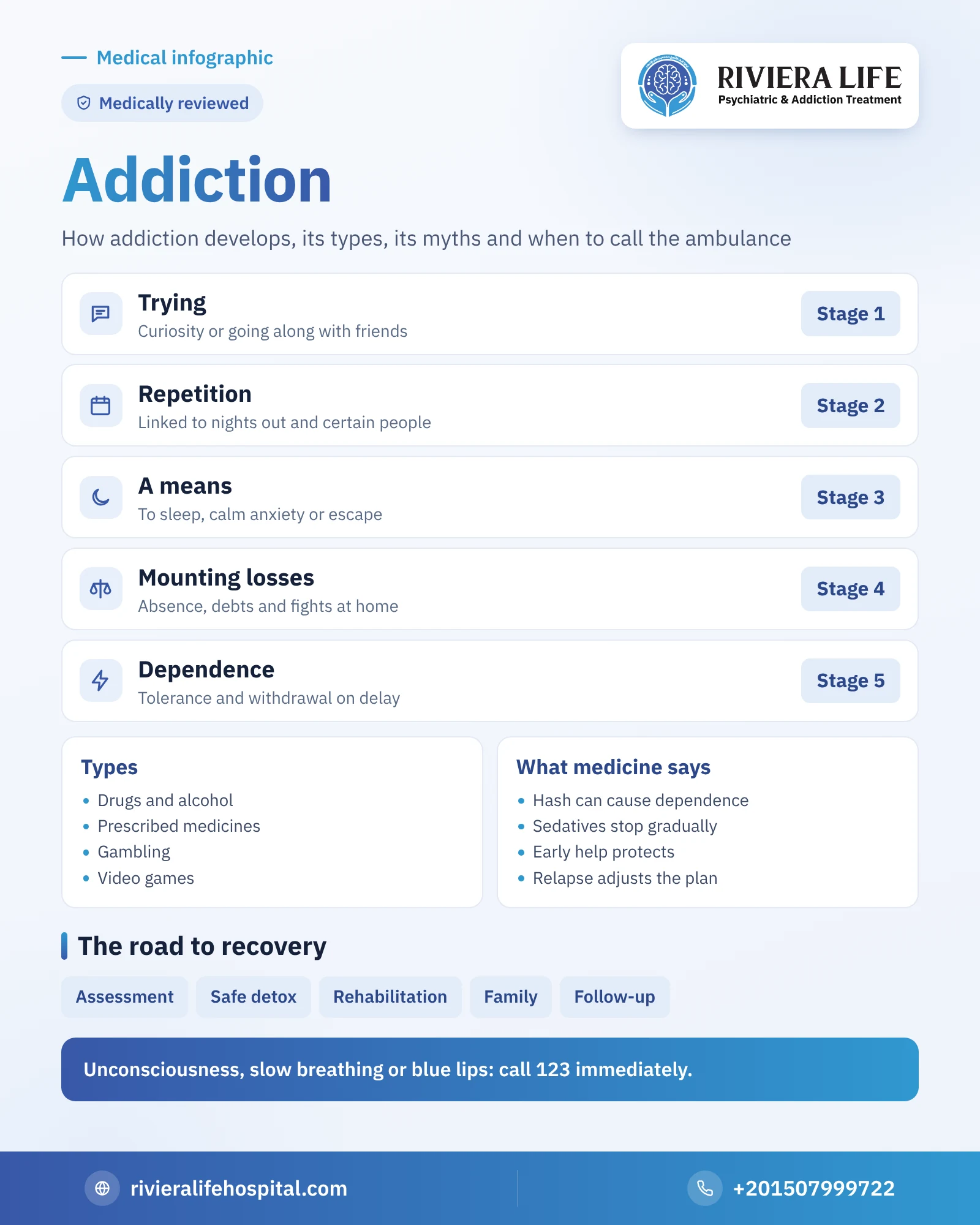
How does use develop from the first try to dependence?
Not everyone who tries a substance will go all the way down the road, but those who reach dependence usually remember similar stops. The pace of these stops differs a lot from one person to another and from one substance to another.
- 1The first approachCuriosity or going along
A hash cigarette on a trip with friends, or a pill that "helps with studying" offered by a classmate. It seems passing and leaves no clear trace.
- 2Repetition on occasionsA false sense of control
Use becomes linked to certain nights out or people, and the person reassures themselves that they can stop whenever they want.
- 3Use as a meansTo sleep or to escape
The substance turns into a tool for calming anxiety, insomnia or boredom, and enters the weekly and then the daily routine.
- 4Mounting lossesHarm everyone sees
Absence from work, small debts, fights at home, and yet the use continues and the justifications multiply.
- 5DependenceTolerance and withdrawal
They need a larger amount for the same effect, and feel unpleasant symptoms if they are late, so use becomes about avoiding pain rather than seeking pleasure.
Some substances such as opioids and ice may shorten these stops to weeks, while with other substances they stretch over years. This also depends on age at the start and personal predisposition, factors we detail in the section The factors that raise vulnerability.
Use, dependence or disease? Three words with three meanings
These words get mixed up in everyday talk, and confusing them unsettles the family and delays the decision. The following table puts the differences side by side.
| The term | What it means | A real-life example |
|---|---|---|
| Use or misuse | Using a substance in a harmful way or outside its medical purpose | A young man who smokes hash only at weekends |
| Physical dependence | The body adapting to the substance, so tolerance and withdrawal appear | A patient taking a painkiller after surgery under a doctor's supervision who needs to stop it gradually |
| Addictive disease | Loss of control and continuing despite harm, with an urgent craving | A person who sells things from the house to buy the substance despite his repeated promises |
The important point is that physical dependence may happen without addiction, as in patients who take certain medicines for long periods under close supervision. And the opposite may happen: there is clear addiction to substances that don't cause violent physical withdrawal. The article The difference between psychological and physical dependence explains this point in more detail.
Types of addiction: substances, medicines and behaviors
Drugs and alcohol
This is the best-known form, and it includes hash, bango, opioids such as heroin and strong painkillers, stimulants such as ice and captagon, synthetic cannabinoids such as strox and shadow, as well as alcohol. Each family has its own nature, and you can get to know them in the guide to types of drugs, while the details specific to drugs you will find in the article Drug addiction: definition, signs and treatment.
Prescribed medicines
It often starts from a genuine prescription: a sleeping pill after a period of insomnia, a sedative from the benzodiazepine family after a panic attack, or a painkiller after an operation. The problem appears when the medicine continues without review, or is bought from the pharmacy without a prescription, or the dose is raised without the doctor knowing. That is why we always stress that any psychiatric medicine or painkiller is used and stopped under a doctor's supervision.
Behavioral addiction
The World Health Organization recognized gambling disorder and gaming disorder in ICD-11, and doctors discuss other patterns such as pornography and compulsive shopping. The mechanism is similar despite the absence of a substance, and we have dedicated to them a section on compulsive behaviors.
What happens inside the brain with repetition?
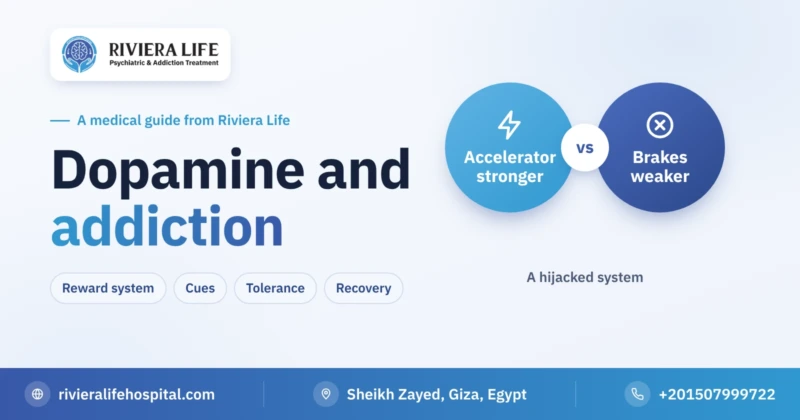
Simplifying the picture helps the family understand: the brain has a reward system that rewards us for eating, company and achievement with bursts of dopamine. Drugs release this substance with a force exceeding natural rewards, so the brain learns that the drug is more important than everything else. With repetition the brain reduces its sensitivity, so ordinary things lose their taste, and the person needs the substance to feel normal.
At the same time, the front areas responsible for judgment and planning weaken, so decisions become faster and less mindful of consequences. That is why you may find a clever young man who fully realizes what he is losing and then goes back the same night. For those who want to go deeper, the article The role of dopamine in the drug's takeover of reward explains this mechanism, the article GABA, sedatives and alcohol covers the other face of brain chemistry, and you will find the complete map of neurotransmitters in the section Brain chemistry.
General signs that deserve attention
No single sign is enough to judge, but several changes coming together and lasting for weeks deserve a calm pause. Here we present only the general picture, and the details for each substance are in the section Signs of drug use.
Changes in the body and routine
- Disturbed sleep, or night and day turned upside down
- A noticeable change in appetite and weight
- Neglect of personal hygiene and appearance
- Red eyes, or wide or narrow pupils for no reason
Changes in behavior and feelings
- Sudden irritability and mood swings
- Repeated requests for money or things disappearing from the house
- New friends and vagueness about places and times
- A decline in study or work and loss of interest
When use comes together with a psychological disorder
It is common for a patient to come with depression, anxiety, bipolar disorder or attention deficit hyperactivity disorder since childhood. Doctors call this dual diagnosis, and NIDA confirms that a large proportion of people with substance use disorder have an accompanying psychological disorder. Sometimes the substance is an attempt at self-treatment of undiagnosed anxiety, and sometimes use reveals a disorder that was latent.
The treatment rule here is clear: treat both sides together, because leaving one of them untreated raises the likelihood of relapse. The article The relationship between depression and use offers an example of this, and the dual diagnosis program explains how the two conditions are managed in one plan.
How does an addicted person think?
Denial is not deliberate lying most of the time, but part of the disease itself. The person convinces themselves that they "use less than their friends" or that they "will stop after the end-of-year exams". They play down the size of the losses, and blame pressures, the wife or the manager. These defensive tricks protect them from a painful confrontation, but they delay treatment.
Understanding this thinking changes the family's way of talking: confrontation with shouting and accusation increases defensiveness, while talking calmly about specific events at a time when the person is sober opens a door. To go deeper, read the article Why an addict denies needing treatment, and if you are looking for practical steps, the article How do I help an addicted person is written for you.
Common myths that delay seeking treatment
What is said at home
- Hash is a "mood" and doesn't cause addiction
- A medicine from the pharmacy is safe however long it is taken
- The addict must hit rock bottom to recover
- Whoever relapses once will never succeed
What medicine says
- Hash can cause dependence, especially when started early
- Sedatives and painkillers need follow-up and gradual stopping under a doctor's supervision
- Early intervention protects health, work and family
- Relapse is a signal to adjust the plan, not the end of the road
Other harmful myths include relying on herbal recipes or "locking him up at home" instead of a doctor, attempts that may be dangerous with alcohol and sedatives in particular. The article The social stigma linked to addiction covers how society's view prevents many from seeking help.
Can one recover from addiction for good?
Yes, recovery is possible and real, but it is understood in a way that resembles other chronic diseases such as diabetes and blood pressure: active treatment at first, then a lifestyle and follow-up that protect what has been achieved. NIDA points out that relapse rates in it are close to what happens in these chronic diseases, which makes follow-up part of treatment, not a luxury.
1
An honest assessment
A medical and psychological examination that determines the substances, the severity of dependence and accompanying illnesses.
2
Safe withdrawal
Detox under a doctor's supervision, especially with alcohol, sedatives and opioids.
3
Psychological rehabilitation
Individual and group sessions that build skills for facing craving and pressures.
4
Involving the family
A program that teaches the family to support without enabling the disease.
5
Extended follow-up
Visits and support after discharge to prevent relapse.
The details of each of these stages belong in the complete treatment journey guide, you will find an explanation of the programs and their types in the treatment programs section, and psychotherapy plays a central role in preventing a return.
Prevention starts at home
The strongest thing the family has is a warm relationship in which the son feels free to talk about his pressures without fear, clear rules everyone knows, and calm follow-up of friends and places. It is useful to delay the first try as much as possible, because the brain continues maturing until about the mid-twenties, and those who start early face a greater risk.
Prevention isn't limited to children; the mother who has taken a sleeping pill for years, and the father who relies on a painkiller for back pain, also need a periodic review with the doctor. The article Ways to prevent drug use by age offers a practical plan for each stage.
Emergencies that can't wait
Some situations linked to use threaten life, and in them it isn't right to wait for the morning or for the person's consent.
Call the ambulance on 123 immediately if you notice
These signs mean the body is in real danger:
- Loss of consciousness or difficulty waking the person
- Slowed breathing or blue lips
- Seizures or severe hallucinations with agitation
- Talk of self-harm or ending life
- For psychological advice: the hotline of the General Secretariat of Mental Health and Addiction Treatment, 16328
The addiction article guide: the brain, substances, medicines and the family
We have arranged the articles of this section into four themes, so you can start with what concerns your situation directly and then broaden.
Brain chemistry and addiction
4 articlesThe neurotransmitters substances hijack
- The reward system and dopamine: how the brain learns to prefer the drug over every other pleasure.
- The calming transmitter GABA and sedatives: why withdrawal from alcohol and sedatives is dangerous.
- The body's natural painkiller and opioids: what happens when the substance replaces endorphins.
- The bonding hormone and addiction research: what recent studies say and their limits.
Medicine and sedative addiction
5 articlesWhen the problem starts from a prescription or a pharmacy
- Dependence on prescription medicines: its beginnings, signs and the road to safe treatment.
- Getting used to sleeping pills: their types and their particular danger to the elderly.
- Dependence on clonazepam (Rivotril): how it forms and when to seek help.
- Alprazolam and how fast dependence on it forms: why it is one of the fastest sedatives to form a habit.
- Getting used to nasal sprays and drops: rebound congestion and how to get rid of it.
Specific substances
5 articlesHow addiction develops with each substance
- The comprehensive reference on drug addiction: definition, signs, causes and treatment.
- From a marijuana cigarette to dependence: the stages of development and who is most at risk.
- Hydroponically grown hash (hydro): what sets it apart, its signs and ways to treat it.
- Smoked cocaine (crack): its symptoms, its effect and why it is hard to stop.
- Ketamine outside the operating room: how use begins and when it becomes a disease.
The mind, society and prevention
6 articlesThinking, stigma, women and protecting the family
- Physical versus psychological dependence: the difference between them and how each is treated.
- The user's mindset and the reasons for denial: why he refuses treatment and how to talk with him.
- Society's view and the stigma of the disease: its effect on treatment and ways to lessen it.
- What is particular about addiction in women: why it differs and how a woman can start treatment confidentially.
- A plan to protect the family from drugs: preventive steps suited to each age.
- Religious families' questions about addiction: what the official fatwa says about the ruling, prayer, divorce and repentance, and what medicine adds.
When should you seek help?
If you notice that you or a member of your family is trying to stop and can't, or that use has started taking from work, home and health, this is the right time for a consultation, and there is no need to wait for further deterioration. At Riviera Life in Sheikh Zayed, licensed by the Egyptian Ministry of Health, consultants in psychiatry and rehabilitation have been receiving people for fourteen years in complete confidentiality, and the first consultation is free. Contact us on +201507999722.
Medical sources and referencesThe information in this article is based on reliable scientific sources