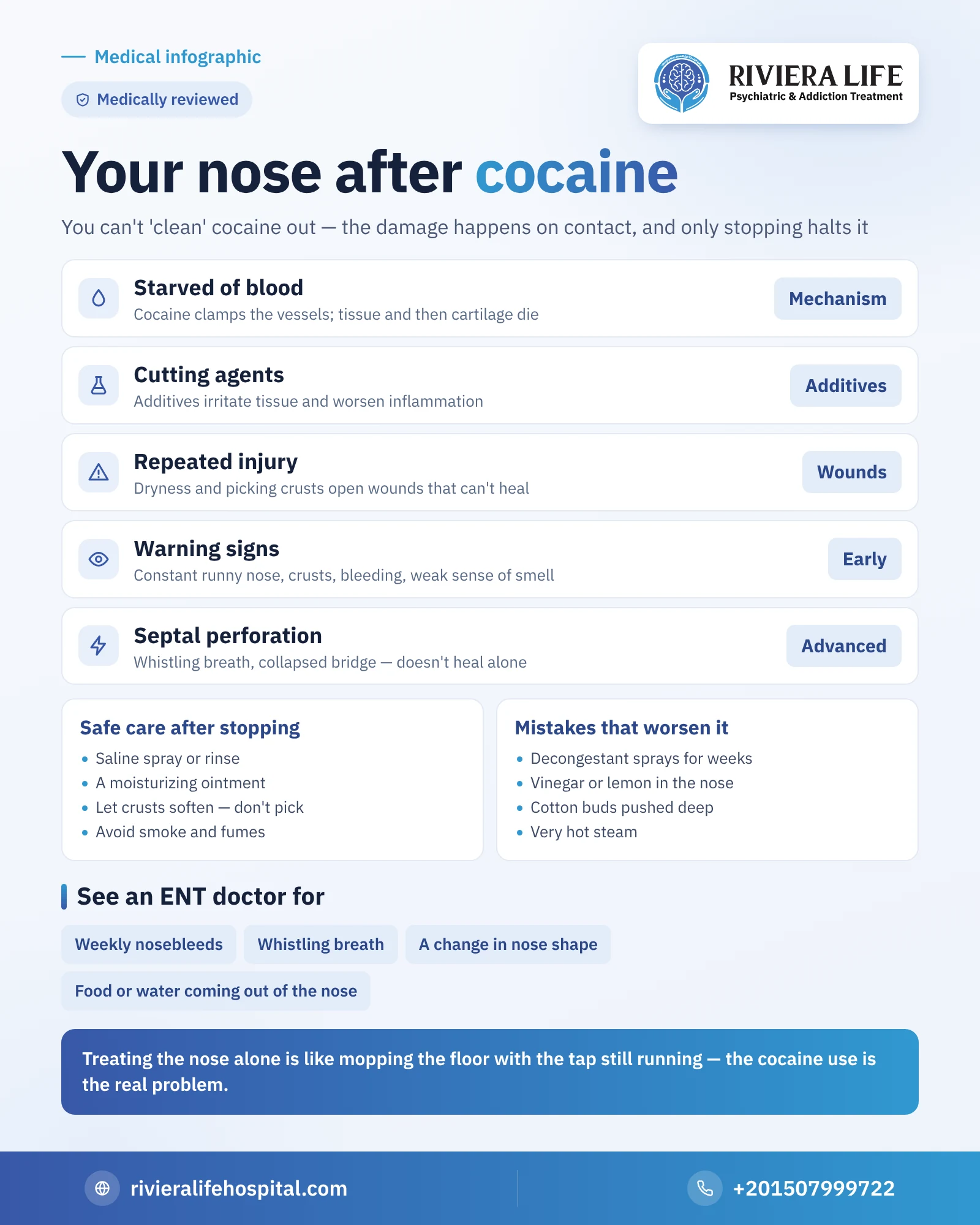
Cleaning your nose of cocaine, in the sense many people are searching for, isn’t possible: the powder is absorbed through the lining of the nose within minutes, and what remains afterwards isn’t the cocaine itself but its effects — inflammation, dryness, crusts and bleeding, which can go as far as a hole in the nasal septum. The only step that stops this damage is to stop snorting. In this article we explain how cocaine damages the nose, the signs that the damage is progressing, how to care for your nose safely after stopping, and when you should see an ear, nose and throat (ENT) doctor without delay.
Can you really clean your nose of cocaine?
Some users believe that rinsing the nose after each use protects it, or that there is a spray that “cleans” away the traces of the substance. This belief is wrong for two reasons. First, the damage happens while the substance is on the mucous membrane, not afterwards: cocaine narrows the small blood vessels in the nose as soon as it touches them, so the tissue is deprived of blood. Second, rinsing changes nothing about what happens in the heart and brain, and doesn’t make use any safer. The care we explain here is for those who have stopped or want to stop, and to soothe the tissue while it recovers.
How does cocaine damage the nose?
Several factors act on the nose at the same time:
- Reduced blood supply: cocaine constricts the blood vessels powerfully, and with repetition the cells of the mucous membrane die, and then the cartilage this membrane nourishes.
- Cutting agents: the cocaine in circulation is rarely pure, and the substances it is mixed with can irritate the tissue or cause more severe inflammation.
- Repeated injury: friction, dryness and picking off crusts with the fingers open wounds that have no time to heal.
- Infection: damaged tissue becomes an easy environment for bacteria and sinus infections.
Signs of nose damage, from mildest to most severe
- A constant runny or blocked nose that resembles a cold but never ends.
- Dryness and crusts inside the nose, and repeated light bleeding.
- A weaker sense of smell, and so a weaker sense of taste.
- A bad smell or pus-like discharge indicating infection.
- A whistling sound when breathing through the nose — a common sign of a hole in the septum.
- A collapse of the bridge of the nose or a change in its outer shape.
- In very advanced cases: a hole in the roof of the mouth that lets food or fluids come out of the nose, or a change in the voice.
Septal perforation: what is it and how is it found?
The nasal septum is the thin wall of cartilage and bone that separates the two nostrils. When it is repeatedly deprived of blood it erodes gradually until a hole appears in it. The hole may start small without obvious symptoms, then grow with continued snorting, bringing whistling, bleeding and thick crusts around its edges. The doctor finds it by direct examination with an endoscope. What is important to know is that the hole doesn’t heal on its own, but stopping snorting prevents it from getting bigger.
When the damage goes beyond the nose
With long-term use, the damage can extend to the sinuses, the surrounding bones and the roof of the mouth — a condition doctors describe as cocaine-induced midline destructive lesions. In appearance it may resemble autoimmune diseases or other inflammatory conditions, so the doctor sometimes needs blood tests or a small tissue sample to tell them apart. Some substances added to cocaine have also been linked to inflammation of the blood vessels that may show in the skin or affect the blood. This whole picture is part of the wider physical and psychological harms of cocaine.
Caring for your nose safely after stopping
After stopping, the tissue begins to recover, and you can help it with simple, safe steps — ideally under a doctor’s supervision:
- Saline: a ready-made saline spray or rinse from the pharmacy moisturizes the nose and softens crusts. If a homemade rinse is used, the water must be boiled and then cooled, or sterile — not tap water straight from the tap.
- Moisturizing: a simple moisturizing ointment prescribed by the doctor, applied gently at the entrance of the nose, with a humidifier in the bedroom, especially in winter.
- Not picking crusts: let the crusts soften with saline and come out on their own; picking them reopens the wound.
- Avoiding irritants: smoking and strong fumes slow the healing of the membranes.
- Drinking fluids: because general dehydration shows up as a dry nose.
Common mistakes that increase the damage
- Using decongestant sprays for more than a few days: they constrict the blood vessels just like cocaine, and with continued use they cause worse rebound congestion.
- Putting vinegar, lemon or any burning household substance inside the nose.
- Pushing cotton buds or fingers deep inside to remove crusts.
- Inhaling very hot steam, which can burn weakened membranes.
- Delaying a visit to the doctor out of embarrassment until the hole grows.
When should you see an ENT doctor?
Book an appointment soon if you notice any of these signs:
- Nosebleeds that happen more than once a week.
- Whistling when breathing through the nose.
- A change in the shape of the nose or a collapse of its bridge.
- Foul-smelling discharge, or pain in the face and forehead with a fever.
- Loss of the sense of smell for weeks.
- Food or water coming out of the nose when swallowing.
What happens at the ENT clinic?
The doctor starts by asking about the symptoms and how long you have had them — and being honest about cocaine is entirely in your interest here: it determines the right diagnosis and safe treatment, and it remains medically confidential. They then examine the nose with a small endoscope, and may order a CT scan of the sinuses, or a tissue sample if the appearance is unusual. Most surgeons postpone repairing the hole or cosmetic surgery on the nose until enough time has passed since stopping and this has been confirmed by tests, because the tissue won’t heal around the surgery if snorting continues, and the operation may fail and leave a larger hole.
Does the nose recover after stopping?
Inflammation, dryness and crusts usually improve within weeks to months of stopping, and the sense of smell may improve partly or fully depending on the extent of the damage. The hole and lost cartilage don’t come back on their own, but a small hole can be lived with through regular care, or repaired later if needed. The earlier someone stops, the more can be saved.
The nose is a sign, not the whole problem
Many people come to the clinic because of their nose before they admit the addiction itself. The truth is that nose damage is a sign of repeated, ongoing use, and treating the nose alone is like mopping water off the floor and leaving the tap running. If a family notices these signs in one of its members, our article on how to recognize someone addicted to cocaine will help them read the whole picture. The steps to stopping are explained in our article on cocaine addiction treatment, and you will find what to expect in the first days in our article on cocaine withdrawal symptoms.
When is it an emergency?
Call an ambulance immediately (123 in Egypt) if you see
While you wait, sit leaning forward and press firmly on the soft part of the nose; don't tilt your head back.
- A heavy nosebleed that doesn’t stop after twenty minutes of continuous pressure
- Bleeding with dizziness, severe paleness or difficulty breathing
- Chest pain or severe palpitations after snorting
- Seizures or a very high temperature
At Riviera Life in Sheikh Zayed we treat the cause, not just the symptom: a confidential assessment of cocaine addiction and a treatment plan set by consultants in psychiatry and addiction treatment, coordinating follow-up for the nose when needed. The first consultation is free, and you can reach us around the clock on +201507999722.
More from our cocaine guide
- Cocaine: the complete guide
- Cocaine addiction symptoms
- The causes of cocaine addiction
- How should I deal with someone addicted to cocaine?
- Treating nasal spray addiction: how to escape rebound congestion
Questions many people ask
No. The damage happens the moment the substance touches the mucous membrane because the blood vessels constrict, and rinsing doesn't prevent it or reduce its danger to the heart and brain.
Whistling when breathing through the nose, thick crusts, repeated bleeding and sometimes a collapse of the bridge of the nose. An ENT doctor confirms it with an endoscopic examination.
It doesn't heal on its own, but stopping prevents it from getting bigger, and it can be lived with through regular care or repaired surgically after a long enough period without use.
They aren't advisable for more than a few days, because they constrict the blood vessels and cause rebound congestion; saline and moisturizing under a doctor's supervision are better.
It may improve partly or fully within weeks to months, depending on how much damage there is, and the earlier someone stops, the better the chances of improvement.