The relationship between sedatives and sex is more complicated than people think. Benzodiazepines such as Xanax, Rivotril and Valium, along with sleeping pills and pregabalin, may ease performance anxiety at first, so the user thinks they help him, but regular use lowers desire, weakens arousal and erection, and delays orgasm or prevents it. In large amounts or when mixed, the person’s ability to judge and to give conscious consent weakens, so sexual risks of every kind rise. In this article we explain what happens to sexual function under the influence of sedatives, why consent isn’t valid while sedated, and what returns after a gradual taper.
What do we mean by sedatives here?
We mean medicines that slow the activity of the nervous system, the best known in Egypt being:
- Benzodiazepines: alprazolam (Xanax), clonazepam (Rivotril), diazepam (Valium), bromazepam and others.
- Modern sleeping pills: such as zolpidem.
- Pregabalin and gabapentin: these aren’t benzodiazepines, but they have a clear sedative effect and are often misused.
- Sedating antihistamines when used regularly for sleep.
These substances differ in the details, but they share a general effect on sex: anything that slows the nervous system slows the circuits of desire and arousal with it. The detailed picture of the benzodiazepine family is in our complete guide to benzodiazepines.
Sedatives and sex: why do they seem helpful at first?
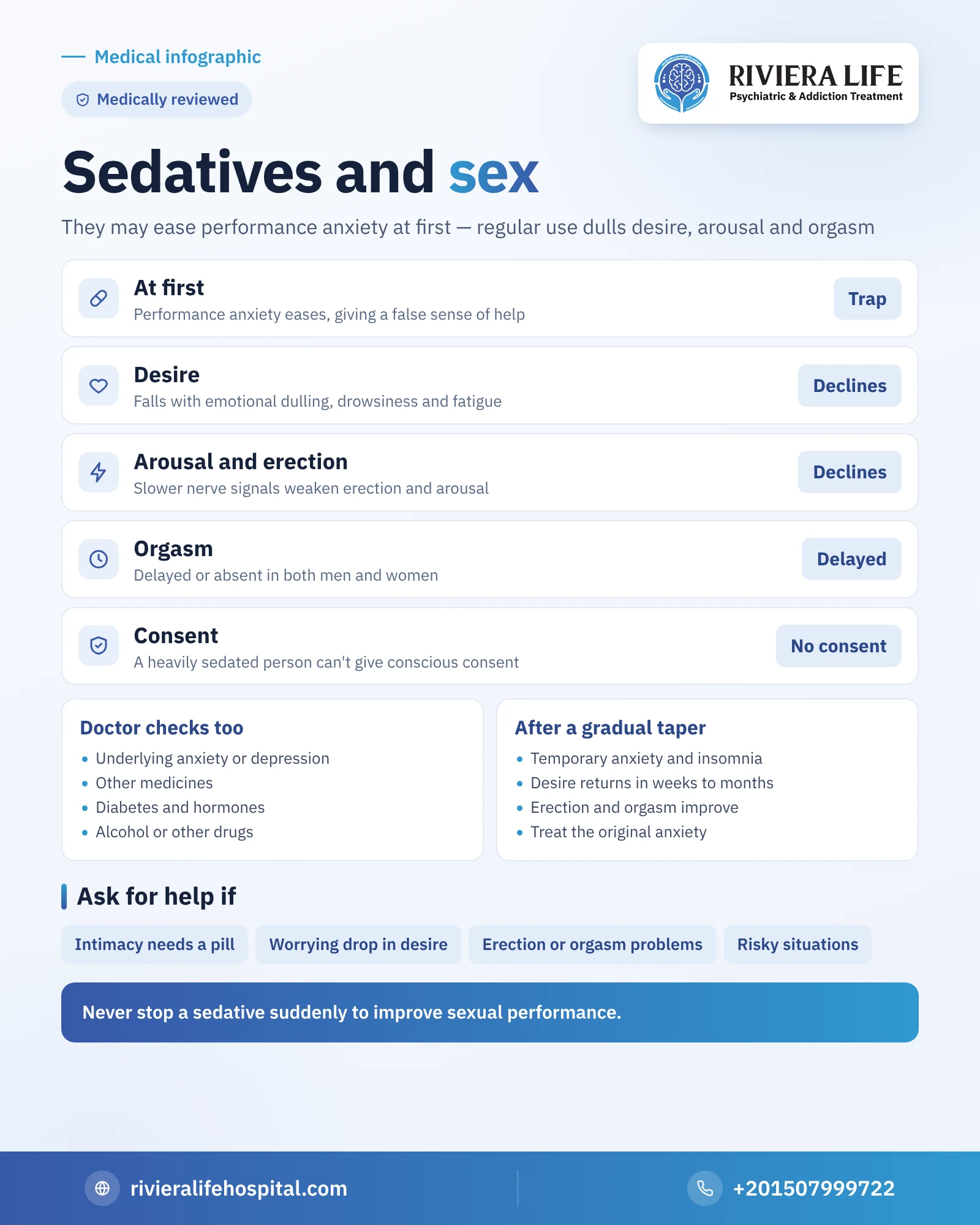
Many problems in intimacy are caused by anxiety: fear of failure, tension with the partner, or premature ejaculation linked to stress. When an anxious person takes a sedative tablet before sex, his tension calms so he feels a temporary improvement, and ejaculation may be delayed slightly. From here stories spread that “a sedative improves sex”.
But this improvement carries the problem within it. The person learns that sex only works with the tablet, then tolerance develops so he needs more, then the direct negative effects on desire and erection begin. What started as a solution for anxiety becomes a new cause of it.
The effect of sedatives on sexual desire
Low desire is one of the most common complaints of long-term sedative users, men and women. It happens because the medicine dampens emotional activity in general, so enthusiasm for everything falls, sex included. Added to this are constant drowsiness and fatigue, and the emotional flatness some describe as “I don’t feel anything”. And when untreated depression or anxiety lies behind the medicine use, the illness itself also lowers desire, and it is hard to distinguish between the effect of the medicine and the effect of the condition.
Arousal and erection
Sexual arousal needs an alert nervous system sending clear signals to the organs. Sedatives slow these signals, so erection weakens or is hard to maintain, and medical references list diazepam and other sedatives among the medicines that may cause erection problems. In women, arousal and natural lubrication may decrease, and reaching enjoyment becomes harder.
Things get worse when the sedative is combined with alcohol or opioids, substances that harm erection on their own. Those who want details about these two will find them explained in our articles on alcohol and sex and tramadol and sex.
Orgasm and ejaculation
Delayed orgasm or difficulty reaching it is common with regular benzodiazepine use, in both sexes. In men ejaculation may be bothersomely delayed, and in women orgasm may become weaker or rare. Some see delayed ejaculation at first as an advantage, but when it becomes excessive delay it spoils intimacy for both partners, and adds frustration that feeds anxiety again.
What about premature ejaculation?
Premature ejaculation has evidence-based medical treatments determined by an andrologist or psychiatrist, and using sedatives for this purpose isn’t advised, because their price is a dependence that may be harder than the original problem.
Sedatives and sexual risks
In large amounts or when mixed, sedatives reduce the ability to judge and weaken inhibitions, so the person does things he wouldn’t do when aware: sex without protection, with someone he doesn’t know, or in an unsafe place. Added to this is the problem of memory, as he may not remember later what happened or with whom. This raises the risk of sexually transmitted infections and unplanned pregnancy, and raises the risk of being exploited. Anyone who has been through such a situation is advised to have a medical check for sexually transmitted infections and follow-up with a doctor.
Consent under the influence of sedatives
Consent to sex must be free, conscious and ongoing. A person who is overcome by drowsiness, speaks heavily, can’t stand, has lost consciousness or won’t remember what happens doesn’t have the capacity to consent, even if they didn’t refuse in words. Any sexual act with a person in this state is assault, regardless of the relationship between the two.
For this same reason, some strong sedatives are used to spike drinks, and we have explained the signs of this and ways of protection in our article on Rohypnol pills. And if one or both partners are under a strong influence, the right decision is to stop and make sure of their safety.
The effect of sedatives on married life
Beyond physical function, dependence on sedatives changes the shape of married life as a whole. The wife or husband sees a partner who is drowsy all the time, says little, forgets agreements and withdraws from intimacy, and interprets this as coldness or personal rejection. Over time silence and accusations build up. Understanding that the medicine is part of the picture helps both partners deal with the problem as a medical condition, not a crisis of love. You will find advice on dealing with a partner who has an addiction in our article on how to deal with an addicted husband.
Is the medicine always the cause?
Not every sexual decline in someone taking sedatives is caused by the medicine. There are factors the doctor examines before judging:
- The anxiety or depression the sedative was prescribed for, both of which lower desire on their own.
- Other medicines the patient takes at the same time, such as some antidepressants and blood pressure medicines.
- Physical illnesses such as diabetes, hormone disorders and heart disease.
- Accompanying alcohol or drugs.
- Problems in the relationship itself, daily pressures and lack of sleep.
That is why it isn’t enough for the patient to decide alone that the sedative is the cause; an assessment is needed to draw the full picture before any adjustment.
Does sexual function return after a gradual taper?
In most cases yes, and this is one of the most reassuring things for patients. With gradual reduction under a doctor’s supervision, desire and arousal start to improve, but this happens in stages:
- During the taper: anxiety, insomnia and tension may appear, making intimacy temporarily difficult, and some men notice passing premature ejaculation as the nervous system’s sensitivity returns.
- After weeks to months: desire returns gradually, and erection and orgasm improve as sleep and mood improve.
- In the longer term: treating the original anxiety or depression with methods that don’t cause dependence makes the biggest difference.
A sedative must not be stopped suddenly to improve sexual performance, because sudden withdrawal may be dangerous. Any change in the medicine is made with the treating doctor alone, and the expected stages are explained in our article on benzodiazepine withdrawal symptoms.
When should you ask for help?
Ask for an assessment if intimacy has become tied to a tablet, desire has declined in a way that worries you or your partner, erection or orgasm problems have appeared since you started sedatives, or you have found yourself in risky sexual situations under their influence. The doctor may change the treatment plan or start a gradual taper with you, and refer you to psychological or sex therapy when needed.
At Riviera Life, consultants in psychiatry and addiction treatment discuss these problems in complete confidentiality and without judgment, within a plan that treats dependence and anxiety together. The first consultation is free on +201507999722.
More from our benzodiazepines guide
- Benzodiazepines: the complete guide
- Rohypnol pills (flunitrazepam)
- Drugs and sex
- The harms of benzodiazepines
- Night Calm and sex: insomnia, desire, sleep behaviors and consent
Questions many people ask
Using sedatives for this purpose isn't advised; premature ejaculation has evidence-based treatments determined by the doctor, and a sedative carries the risk of dependence and weaker desire later.
Yes, they may lower desire and arousal and make reaching orgasm harder in women as in men.
No, someone overcome by drowsiness, who has lost concentration or won't remember what happens, doesn't have the capacity for conscious consent.
It varies from person to person, and desire and arousal usually start to improve within weeks to months after the gradual taper is complete.
Don't stop it suddenly; discuss it with your doctor so they can adjust the plan or start a safe gradual taper.