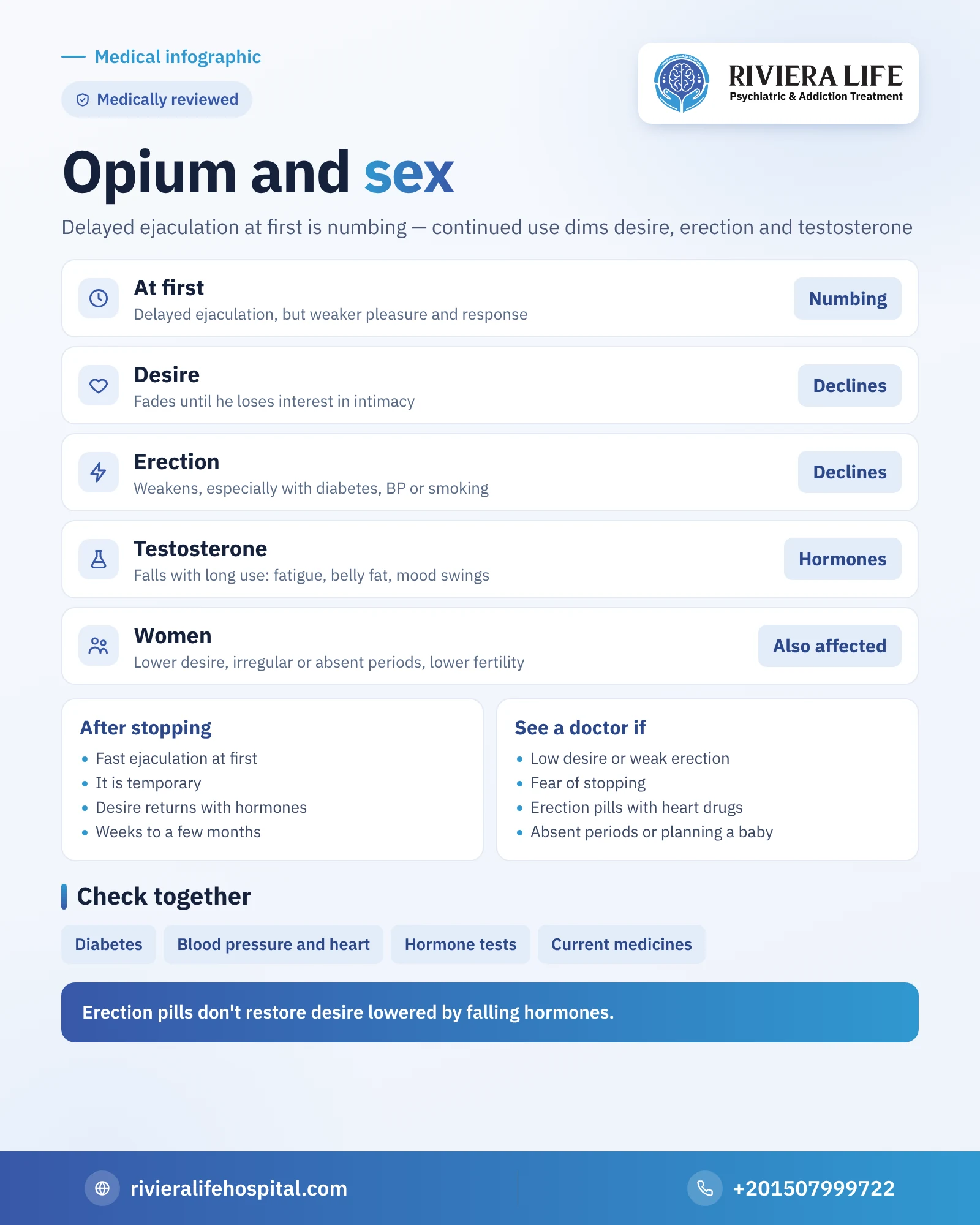
Opium and sex is a subject surrounded by old beliefs, the best known being that opium “makes it last longer” and delays ejaculation, and that it gives a man strength and staying power. The truth is that delayed ejaculation may indeed happen at first, but it comes as part of a general numbing of sensation and desire, and with continued use the man pays a higher price: sexual desire that fades, erectile weakness, and a gradual fall in testosterone. In women, periods become irregular and desire decreases. The good news is that most of these changes improve after stopping. This article explains the difference between what is said in gatherings and what happens in the body.
Opium and sex: where did the myth about married life come from?
In some villages of Upper Egypt and the Delta, opium became associated with manhood, late nights and celebrations, and generations passed on the idea that it helps the groom on the wedding night, or gives a married man the ability to prolong intercourse. Many who use it today started with exactly this idea, then continued for years on the pretext of “pleasure” or back pain. This picture differs from that of a young man using tramadol looking for a “lasting pill”, or a heroin addict injecting daily; the opium user is usually a married man in middle age or older, who has used a steady amount for a long time, and whose sexual problems appear slowly so he doesn’t link them to opium.
To understand the substance itself and its history in Egypt, see our article on opium.
Why does opium delay ejaculation at first?
Opium contains morphine and other opioid substances, which act on receptors in the brain and spinal cord involved in controlling sensation and the ejaculation reflex. They reduce nerve sensitivity and calm anxiety, so ejaculation is delayed in some men. But this effect isn’t an “improvement” in performance, but a kind of numbing: the feeling of pleasure itself weakens, the man becomes less responsive to his partner, and it may reach severe difficulty ejaculating or its absence.
What happens with continued use?
With regular use over months and years, the picture gradually changes:
- Sexual desire: decreases until the man isn’t interested in intimacy at all, and he may put it down to fatigue or age.
- Erection: weakens or becomes hard to maintain, especially with diabetes, high blood pressure or smoking.
- Ejaculation: is greatly delayed or absent, so intercourse becomes tiring rather than enjoyable.
- Psychological state: lethargy, mild depression and distance from his wife, things that increase emotional coldness.
Opium and testosterone
Opioids in general affect the hormone axis between the brain and the testes, reducing the brain’s signals that stimulate the testes to produce testosterone. With long-term use, this hormone falls in a large proportion of users, a condition known to endocrinologists. Its signs include low desire, constant fatigue, weak muscles, more belly fat, mood swings and, over time, weaker bone density.
In a man of fifty or sixty, all these symptoms may be attributed to “getting older”, while a large part of them is due to opium. That is why hormone testing is an important part of assessing a man who uses opium and complains of sexual weakness.
When opium comes together with the illnesses of age
Many opium users have diabetes, high blood pressure or heart disease, all of which weaken erection through their effect on blood vessels and nerves. On top of this, smoking opium or cigarettes harms the blood vessels. So the causes accumulate, and it is hard for the man to know which is responsible. Some blood pressure and depression medicines also affect sexual function. The right path here isn’t increasing the opium or adding a sexual stimulant from the pharmacy without consultation, but a comprehensive assessment of the heart, sugar, hormones and medicines.
Sexual stimulants with opium
Some men turn to erection pills to make up for weak performance, while continuing the opium. These pills may help erection, but they don’t restore the desire extinguished by low hormones, nor do they treat delayed ejaculation. More dangerously, using them without a doctor in a man with heart disease or taking certain heart medicines may be dangerous. That is why they should be prescribed by the doctor after knowing the full condition.
The effect of opium on women
Opium use by women is less common in Egypt, but it exists, and sometimes a woman starts with it to treat chronic pain or is exposed to it through her husband. With regular use, sexual desire may decrease, orgasm becomes difficult, and periods become irregular or stop because of the effect of opioids on ovarian hormones, and fertility may decrease. It is important for a woman to know that absent periods here don’t mean pregnancy is impossible, and that opium during pregnancy needs careful medical follow-up because it may affect the fetus, and mustn’t be stopped suddenly without a doctor.
Does opium affect fertility?
In men, low testosterone may lead to reduced sperm production and quality, so conception is sometimes delayed. In women, ovulation is disturbed along with the cycle. These changes usually improve after stopping, but anyone planning to have children benefits from a medical assessment of both partners. For other effects on the body, see our article on the harms of opioids.
What happens to intimacy after stopping opium?
Here is a surprise the couple should know about in advance. In the first weeks after stopping, nerve sensitivity returns quickly, ejaculation may become very fast, and spontaneous ejaculation may happen during withdrawal symptoms. Some men fear this and think “the opium was treating them”, so they go back to it. The truth is that this is a temporary part of resetting the nervous system, and it usually improves within weeks to months.
Desire and erection return gradually as hormones recover, which may take from several weeks to a few months depending on how long it was used, age and accompanying illnesses. And if the weakness persists after a sufficient period, an endocrinologist or andrologist can assess and treat it. During treatment itself, some medicines used to treat dependence may affect sexual function, something discussed with the doctor and not treated by stopping the medicine yourself. For the full treatment steps, see opium addiction treatment.
How does opium differ from heroin and tramadol in this respect?
The hormonal basis is the same in all opioids, but the practical picture differs. Heroin adds the risks of injecting, infection and chaotic daily life, as we explained in our article on heroin and sex. Tramadol is linked to the “lasting longer” myth among young men and adds the risk of seizures; its details are in our article on tramadol and sex. What distinguishes opium is that it is long, quiet use by an older man, in which the illnesses of age and tradition intertwine with the effect of the drug.
How can a wife talk about the problem?
Many wives notice the coldness and distance before the husband admits any problem. The best start is from health, not accusation: fatigue, poor sleep, and the need for sugar and hormone tests. The doctor may be best placed to link the weakness to opium in a way the husband accepts. And the wife can ask for a consultation for herself first to learn how to start the conversation.
When should you see a doctor?
- If your desire has decreased or your erection has weakened while you use opium regularly, even if the amount is “small”.
- If you are thinking of stopping and fear what will happen to intimacy afterward.
- If you are taking erection pills with heart or blood pressure medicines.
- If periods have stopped in a woman who uses opium, or if the couple are planning to have children.
How can Riviera Life help you?
If opium has taken more from your married life than it gave, recovery is possible with a plan that respects your age and privacy. Riviera Life’s consultants assess the whole condition, physical, psychological and hormonal, and set a plan for safe gradual withdrawal in complete confidentiality, and the first consultation is free on +201507999722.
More from our opioids guide
- Opioids: the complete guide
- Opium: what it is and its risks
- Opium addiction treatment
- Heroin and sex
- Morphine and sex: hormones, pain and illness, and what the patient and companion can do
Questions many people ask
It may delay ejaculation at first because it numbs sensation, but this comes with weaker pleasure and desire. With continued use it causes erectile weakness and a drop in testosterone.
In most cases no; desire and erection improve gradually after stopping as hormones recover. Someone with diabetes or heart disease may need additional treatment.
Because nerve sensitivity returns once the numbing wears off, so temporary premature ejaculation happens in the first weeks. This is part of recovery and usually improves with time.
It may cause irregular or absent periods through its effect on ovarian hormones, but that doesn't mean pregnancy is impossible. It needs medical follow-up.
It isn't advisable without a doctor, especially in heart patients or those taking certain heart medicines. And they don't treat the weak desire caused by low hormones.