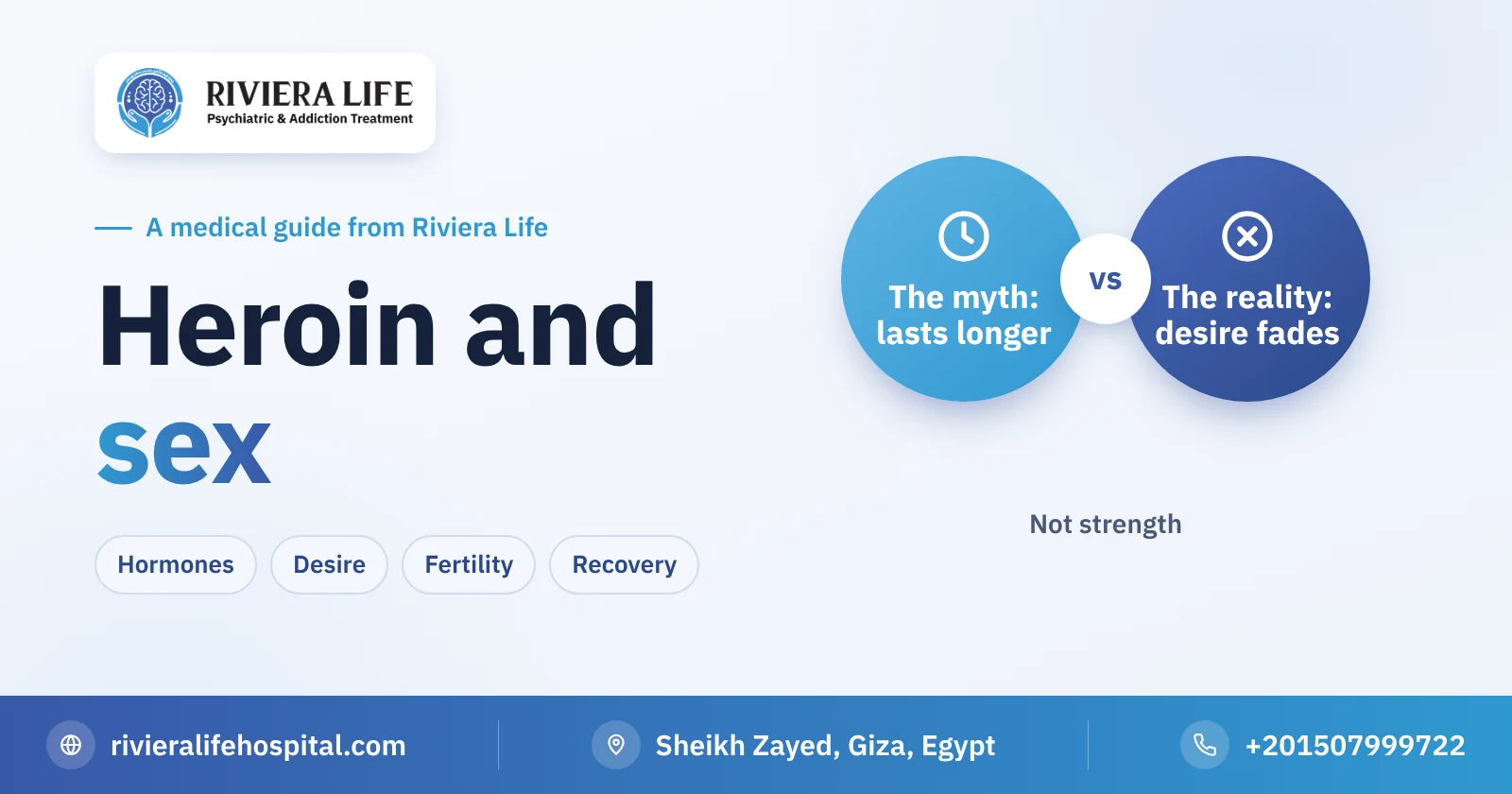
The subject of heroin and sex preoccupies many men, but they don’t raise it out loud. Some have heard that heroin “makes sex last longer”, and some are living the exact opposite: absent desire, weak erection and a wife who feels distant. The truth is that heroin affects sexual life from more than one side: hormones, desire, performance, fertility and the marriage itself. This article explains exactly what happens in men and women, what changes during withdrawal, what can return after stopping, and when you need a doctor.
Does heroin improve sex?
The common impression is that heroin delays ejaculation and so prolongs sex, which is part of the truth but misleading. The delayed ejaculation here isn’t better control, but the result of depressing the nervous system, and it usually comes with weak desire and difficulty reaching orgasm, or its complete absence. With continued use, interest in sex as a whole declines, because heroin itself becomes the brain’s main source of reward, so natural pleasures, including sex, gradually lose their appeal.
How does heroin affect hormones?
Opioids, including heroin, suppress the signals the brain sends to the testes and ovaries through the pituitary gland. The result is lower testosterone in men, and disturbance of the hormones that regulate ovulation and the cycle in women. The hormone prolactin may also rise, weakening sexual desire in both sexes. This condition is medically known as opioid-induced androgen deficiency, and it appears in a large proportion of long-term users, which is why hormone testing is an important part of the assessment.
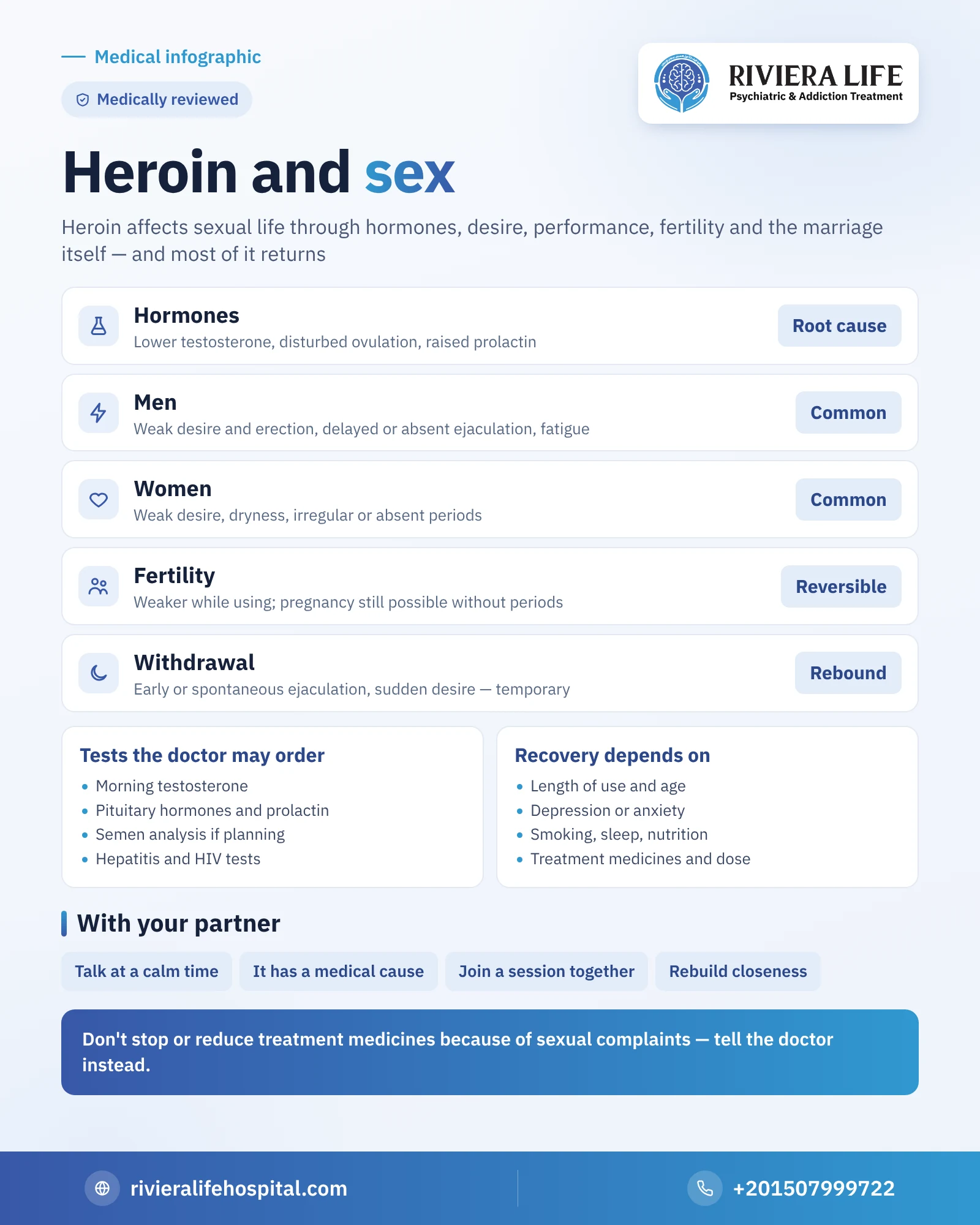
Heroin and sex in men
- Weak desire: one of the most common complaints, linked to low testosterone and changes in the brain’s reward system.
- Erectile weakness: may happen even when desire is present, because of hormones and the substance’s effect on nerves and blood vessels, and increases with smoking, hepatitis and vessel problems from injecting.
- Delayed or absent ejaculation: and difficulty reaching orgasm, which is wrongly interpreted as “strength”.
- Symptoms of hormone deficiency: constant fatigue, loss of muscle mass and low mood, and bone density may be affected in the long term.
Heroin and sex in women
In women, desire may weaken, lubrication may decrease and orgasm may become harder, and the menstrual cycle may become irregular or stop for months. But here there is a common mistake worth warning about: an absent or irregular cycle doesn’t mean pregnancy is impossible. Ovulation may return at any time, especially when reducing the amount or starting treatment, and an unplanned pregnancy happens. That is why a woman who uses or has started treatment needs advice on suitable contraception if she isn’t planning to have children.
Does heroin cause infertility?
Heroin doesn’t cause permanent infertility in most cases, but it weakens fertility as long as use continues. In men, sperm count and motility may fall because of low hormones, and in women ovulation is disturbed. These indicators usually improve after stopping and hormones returning to normal. If a pregnancy is being planned, it is better done after treatment has stabilized and under medical supervision, because using heroin during pregnancy directly harms the fetus, as our article on the harms of heroin explains.
What happens to sexual life during withdrawal?
On stopping, something like a rebound happens. Some men may suffer premature ejaculation or spontaneous ejaculation unrelated to sex during the first days, and desire may return suddenly and confusingly. These changes are usually temporary and calm down as the body stabilizes, and don’t mean there is a permanent problem. Many find great relief in knowing this in advance, as it reduces anxiety in an already difficult period. The details of the other symptoms of this stage are in our article on heroin withdrawal symptoms.
Health risks linked to sex
Heroin use, especially by injection, is linked to a higher risk of bloodborne infections such as hepatitis B and C and HIV, some of which also pass to the partner through sex. Use also weakens the ability to make safe decisions. That is why testing for these infections is advised as part of the treatment assessment, to protect the patient and their partner together.
Do sex enhancers solve the problem?
Some men turn to sex enhancers without consultation; they may improve erection temporarily but don’t treat the cause, whether hormone deficiency or weak desire. Taking them with other substances or with undiagnosed heart disease may also be dangerous. The right path is a medical assessment that identifies the cause, then treatment directed at it. To compare the effect of different substances on desire and performance, see the effect of drugs on sex and fertility.
Do addiction treatment medicines affect sexual function?
The medicines used in treating heroin addiction aim to save the patient from withdrawal and relapse, and their benefit is much greater than their side effects. But some belong to the same opioid family, so some degree of low desire or delayed ejaculation may continue with them. Studies suggest this effect varies from one medicine and dose to another, which is why the medicine should never be stopped or reduced without consultation because of this complaint. It is better to mention it frankly to the doctor, who can adjust the dose, change the medicine, or treat a hormone deficiency if one is found.
What tests might the doctor order?
The assessment starts with a calm conversation about the nature and duration of the complaint and the medicines and substances used, then the doctor may order some tests, including:
- Testosterone, preferably measured in the morning.
- The hormones that regulate the reproductive glands, and prolactin.
- Semen analysis if a pregnancy is being planned.
- Tests for viral hepatitis and HIV.
- An assessment of mood, as depression is an independent cause of weak desire.
These tests determine whether the problem is hormonal, psychological or linked to blood vessels, so treatment is directed at the real cause instead of trial and error.
Does sexual ability return after stopping?
In most cases yes, and this is one of the most reassuring messages for patients. Hormones begin to recover within weeks to months after stopping, desire and erection return gradually, and fertility improves. But the improvement isn’t immediate, and may be affected by several things:
- The length of use, age and general health.
- Depression or anxiety, as both weaken desire independently of heroin.
- Smoking, lack of sleep and poor nutrition.
If the problem persists after several months of stability, hormone testing and treating any deficiency usually give good results.
How do you talk with your partner?
Silence turns the problem into a misunderstanding: the wife may interpret weak desire as rejection of her, and the husband may avoid intimacy out of fear of embarrassment. A frank conversation at a calm time, and reassurance that what is happening has a medical cause and can improve, ease the pressure on both sides. It helps for the partner to take part in a session with the treatment team, because rebuilding closeness and trust is part of recovery itself, not a side detail. And if the partner is the one looking for a way to deal with the situation, our article on how to deal with a heroin addict offers practical steps.
When do you need a doctor?
Talk to a doctor if weak desire or erection persists months after stopping, if periods have stopped for a long time, if you are planning a pregnancy, or if symptoms of hormone deficiency appear, such as constant fatigue and muscle weakness. Don’t hesitate to mention this complaint to the addiction treatment team; it is a normal part of the assessment, and doctors deal with it confidentially and respectfully. You will find the full treatment plan in our article on heroin addiction treatment.
More from our heroin guide
- Heroin: the complete guide
- Heroin addiction symptoms
- The causes of heroin addiction
- The difference between cocaine and heroin
- Opium and sex: the truth about delayed ejaculation and its effect on desire and erection
- Morphine and sex: hormones, pain, illness, and what the patient and partner can do
- Heroin vs opium: from the poppy to the powder and the ladder of strength
- Krokodil: the truth behind the terrifying pictures, its harms and treatment
Questions many people ask
It may delay ejaculation, but that comes from depressing the nervous system, and is usually accompanied by weak desire and difficulty reaching orgasm, then loss of interest in sex altogether with continued use.
Yes. It may cause erectile weakness through low testosterone and its effect on nerves and blood vessels, and this usually improves after stopping and treatment.
Yes. An irregular or absent cycle doesn't prevent ovulation returning at any time, so she needs advice on suitable contraception.
Usually not, but it weakens fertility in men and women as long as use continues, and the indicators usually improve after stopping and hormones returning to normal.
Hormones begin to recover within weeks to months, and desire and erection return gradually. If the problem persists after several months, a hormone test determines whether there is a deficiency that needs treatment.