
Treating addiction without admission is possible for some patients, and dangerous for others. The deciding factor isn’t the wish of the patient or the family, but a medical assessment that answers specific questions: what is the substance and what is the severity of dependence on it? Could withdrawal be dangerous? Is there an accompanying psychological problem? Is the home safe and supportive? This article compares outpatient treatment in the clinic, half residency, and full residence in hospital. It explains the signs that make the doctor choose one of them, and how one can move between them according to the progress of the case.
What is the difference between outpatient treatment and hospital residence?
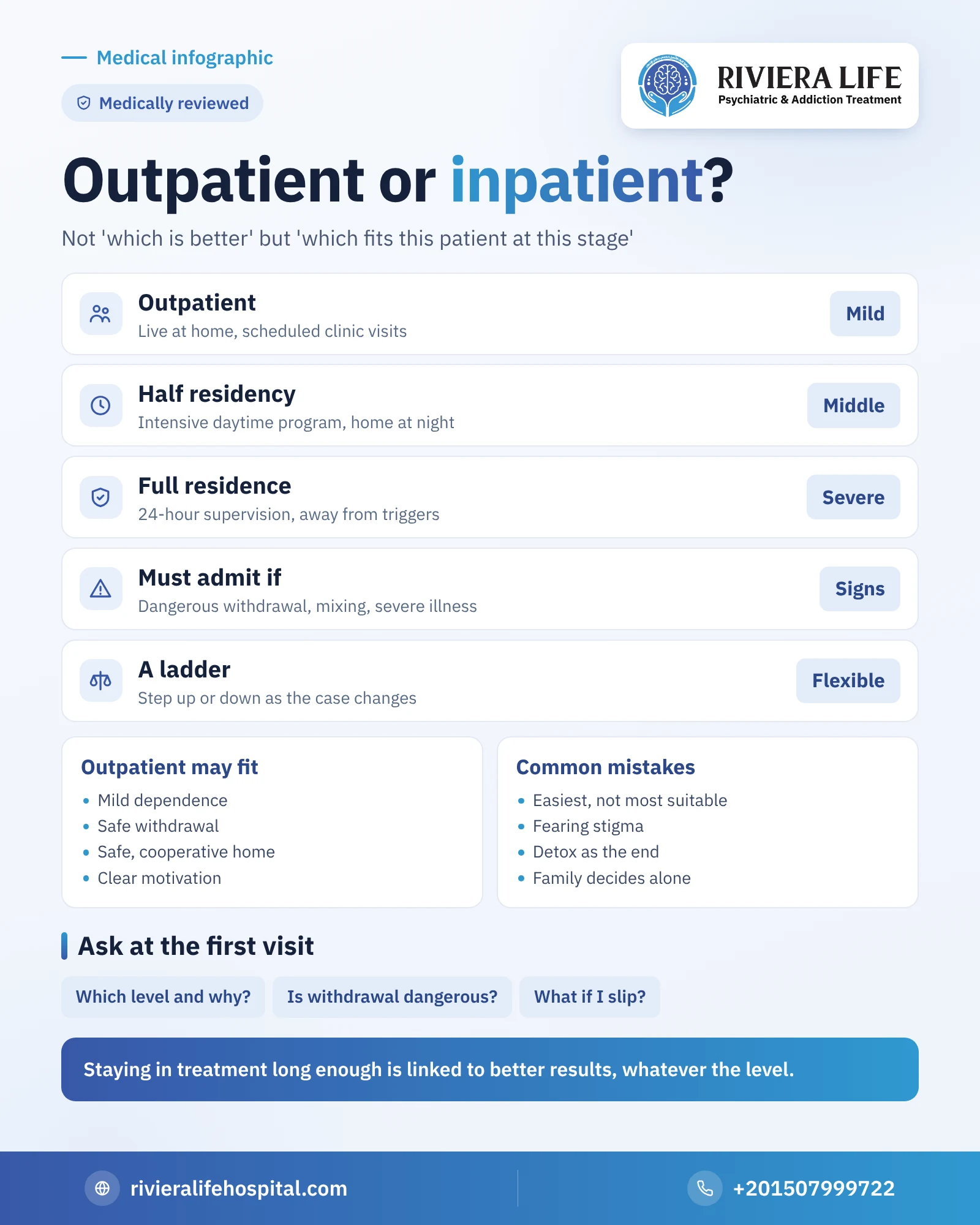
In outpatient treatment the patient lives at home and continues their work or study, and attends the clinic at set appointments for check-ups, psychological sessions and tests. In full residence, however, they stay in the hospital night and day for a period, under continuous medical supervision and in an environment away from the substance and its triggers. Between the two comes half residency: the patient spends the daytime hours in an intensive treatment program, then returns home in the evening.
International guidelines for addiction treatment stress that there is no single level that suits everyone. The right question isn’t “which is better?”, but “which is more suitable for this patient at this stage?”.
A quick comparison between levels of treatment
| Comparison | Outpatient treatment | Half residency | Full residence |
|---|---|---|---|
| Sleeping | At home | At home | In hospital |
| Program intensity | Spaced sessions | An intensive daily program | Round-the-clock follow-up |
| Supervision of withdrawal | For mild cases only | Limited | Complete, with immediate intervention |
| Distance from triggers | Weak | Partial | Complete during residence |
| Work and study | Usually continue | Usually pause temporarily | Pause temporarily |
| Suits | Mild dependence and a safe environment | Someone stabilized after detox or a moderate case | Severe dependence, dangerous withdrawal and complex cases |
When is addiction treatment without admission suitable?
The doctor may suggest outpatient treatment when most of these conditions come together:
- Mild or moderate dependence, or use that hasn’t yet reached severe physical dependence.
- A substance whose withdrawal is usually not medically dangerous, without mixing it with other substances.
- No severe mental disorder or thoughts of self-harm.
- A home free of the substance, a cooperative family, and not mixing with using friends daily.
- Clear motivation in the patient and commitment to appointments and tests.
- No many previous attempts that ended in quick relapse.
Outpatient treatment may also begin after a short residence for detox, as a follow-up stage.
What really happens in outpatient treatment?
Outpatient treatment isn’t a single visit to a doctor who writes a prescription and then it’s over. It is a plan with clear components, which the doctor determines according to the case:
- A comprehensive initial assessment: the history of use, all the substances, the psychological and physical state, and basic tests.
- Regular medical follow-up: to control symptoms and sleep and any medicine the doctor decides on, such as a medicine that reduces craving in some cases.
- Individual psychological sessions: usually with cognitive behavioral therapy, to deal with the triggers and thoughts that lead to use.
- Group sessions: with other people in recovery, to exchange experience and break isolation.
- Periodic tests: not an accusation, but part of building trust and knowing whether the plan is working.
- Family sessions: to learn how to support without suffocating supervision.
The success of this level depends on commitment. The patient returns every day to their usual environment, and the triggers around them haven’t changed, so regularity in appointments and tests is what makes up for the absence of continuous supervision. And if appointments start being delayed or cancelled, this is a signal the patient should discuss with their team early, not after the relapse happens.
When is hospital residence necessary?
- Withdrawal that may be dangerous: such as stopping alcohol or sedatives like Rivotril and Xanax after long use, because of the possibility of seizures or delirium.
- Mixing more than one substance: such as tramadol with pregabalin, or opioids with sedatives.
- An accompanying mental disorder: such as severe depression, psychosis or suicidal thoughts, needing a program that treats both together as in the dual diagnosis program.
- Repeated failed attempts: when the patient stops at home then returns within days time after time.
- An unsafe environment: the substance is available at home or in the neighborhood, or there are sharp family disputes.
- Physical complications: such as heart or liver disease, severe malnutrition or pregnancy.
The details of what happens inside the program day by day are in the residential addiction treatment program.
Half residency: the middle solution
Half residency suits someone who needs intensive daily treatment but doesn’t need night supervision. An example is a patient who has finished detox and stabilized, and has a safe home, but is still at the start of recovery and needs daily sessions and activities. They learn skills by day, then try them in their real life in the evening, and return the next day to discuss what they faced. A full explanation is in the half residency program.
Is home treatment the same as outpatient treatment?
Not exactly. Outpatient treatment means the patient goes to the clinic. The home treatment program, however, means the medical team follows them in their home according to a specific plan and conditions, and it doesn’t suit every case. And an individual attempt without any medical supervision is a completely different third thing, and may be dangerous. For a detailed comparison see the home addiction treatment program.
Common mistakes when choosing
- Choosing the easiest, not the most suitable: outpatient treatment seems less costly and less embarrassing, but if it doesn’t suit the case it may end in a relapse that costs more.
- Fearing residence as a stigma: residence is a temporary period of treatment in which confidentiality is kept, and isn’t a verdict on the patient.
- Considering detox the end of treatment: leaving after a week without outpatient follow-up is among the most common reasons for returning.
- The family’s decision alone: the family’s opinion matters, but choosing the level must come after a medical assessment.
Treatment is a ladder you go up and down
The level of treatment isn’t a final decision. Many patients start with residence for detox and stabilization, then move to half residency, then to outpatient follow-up and aftercare. The opposite also happens: a patient who started as an outpatient then had repeated slips, so they step up to a higher level for a period. What matters is that the doctor reassesses the case regularly, and that follow-up continues long enough, as international guidelines link staying in treatment long enough with better results.
Questions to ask at the first consultation
- Which level do you recommend for my case, and why?
- Could withdrawal from the substance I use be dangerous?
- Does my case need an additional psychiatric assessment?
- How often do I come to the clinic, and are there periodic tests?
- What happens if I stumble during outpatient treatment?
- What is my family’s role, and how is my confidentiality kept?
At Riviera Life hospital for addiction treatment and psychiatry all three levels are available: outpatient treatment, half residency and full residence, and the first assessment determines which suits the case.
How does Riviera Life help you?
Riviera Life provides all levels of treatment under the supervision of one team: the outpatient clinic, half residency, and full residence with round-the-clock medical supervision. Every treatment begins with an assessment carried out by consultants in psychiatry and addiction treatment to determine the suitable level, then the assessment is repeated as the case progresses. There is a program for the family and aftercare, with complete confidentiality. The hospital is licensed by the Ministry of Health and has fourteen years of experience. The first consultation is free on +201507999722 at any time, and the hospital is in Sheikh Zayed, Giza.
More from the treatment programs guide
- The residential addiction treatment program
- The half residency addiction treatment program
- The home addiction treatment program
- The duration of addiction treatment