
The home addiction treatment program at Riviera Life is an outpatient treatment plan run by a specialist medical team, in which the patient lives at home while the team handles assessment, prescribing medicines, psychological sessions, regular follow-up and tests. It isn’t “stopping in your room” or a prescription handed out once, but a program with admission criteria, steps, and a clear stopping point after which treatment moves to hospital if needed. This page explains how the program works in practice, who it accepts, and what is required of the family day by day.
What is the home addiction treatment program?
It is a level of structured outpatient care: the patient is at home, and the doctor and therapist are with them through clinic visits and phone or video follow-up at set times, with a family trained for a specific role. If you haven’t yet settled the question “is home treatment safe for our case at all?”, start with the article addiction treatment at home: the medical truth and the safe limits, which explains when home is suitable and when it becomes dangerous. This page starts from the next point: the doctor has decided that home is suitable, so how does the program proceed? The home program is no substitute for understanding the full picture of the course of drug addiction treatment, and when admission is needed instead of it.
Structured home treatment compared with a solo attempt
| Item | A medically supervised home program | A solo attempt at home |
|---|---|---|
| Assessment | Medical, psychological and tests before starting | Usually none |
| Medicines | Prescribed by a doctor and adjusted according to the response | Medicines from the pharmacy or from others’ experiences |
| Follow-up | Fixed appointments and contact in emergencies | No follow-up |
| Psychotherapy | Regular individual and family sessions | Usually none |
| In danger | Quick transfer to hospital | Confusion and delay |
Who does the program accept?
The decision is individual after assessment, but the suitable candidate usually:
- Is physically stable, and isn’t expected to go through dangerous withdrawal.
- Isn’t in an acute psychological crisis and has no thoughts of harming themselves.
- Lives with a responsible adult who can stay close in the first days.
- Has a home free of substances, with no one in it using.
- Accepts follow-up and tests themselves, not under threat alone.
- Can reach the hospital quickly if their condition changes.
Cases in which the team declines treatment at home
The team suggests another path if dependence on alcohol or sedatives is severe, if the patient mixes several substances, or has a history of seizures, pregnancy, an unstable physical illness, psychotic symptoms, or failed previous attempts at home. The alternative then is the detox program in hospital, after which part of the treatment can return home later.
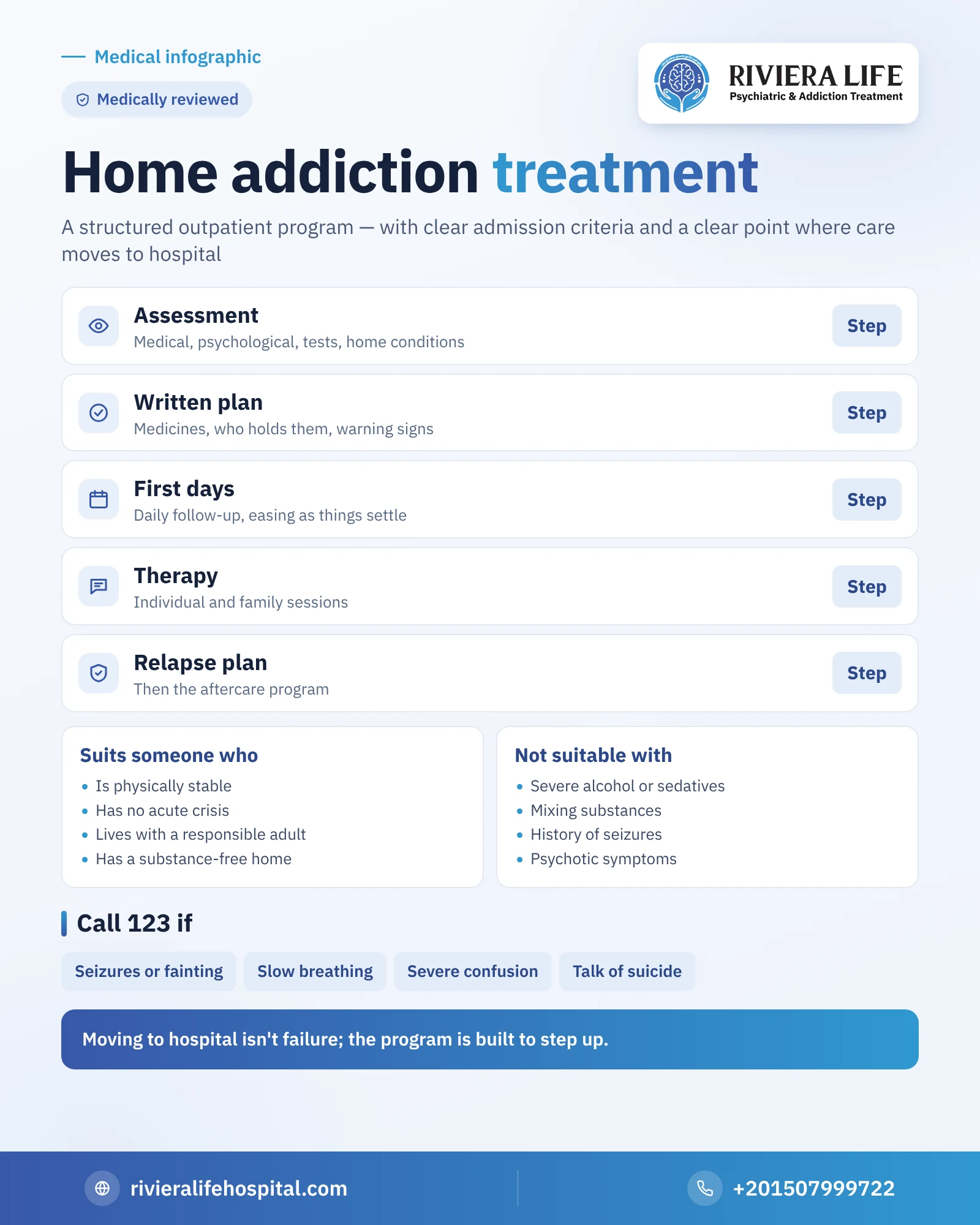
The program’s steps
1. First contact
A confidential call that gathers basic information and sets an assessment appointment, and alerts the family to what to do and what to avoid until then.
2. Medical and psychological assessment
An interview, examination, tests, an estimate of withdrawal risk, and a visit or detailed description of home conditions. Its result is either acceptance into the home program or a recommendation for a higher level of care.
3. A written plan
It sets out the medicines and their times, who keeps and gives them, follow-up appointments, the signs that require a call, and when treatment moves to hospital.
4. Managing the first days
Daily or almost daily follow-up at first, reducing gradually with stability. The team asks about sleep, eating, symptoms and mood, and adjusts medicines according to the answers.
5. Psychotherapy
Individual sessions in the clinic or remotely, working on the triggers and thoughts that lead to use. Online addiction treatment can be used for those who find it hard to attend.
6. Involving the family
Sessions that train the family in their role, and deal with the disputes that usually build up around addiction.
7. Relapse prevention and transition
A written plan for triggers and emergencies, then a move to the aftercare program.
Medicines in the home program
The doctor prescribes what the patient needs to ease symptoms, improve sleep and treat accompanying anxiety or depression, and may in selected cases use medicines that reduce craving or protect against relapse. The fixed rule: the patient doesn’t keep their own medicines at first, no medicines are added from outside the plan, and a “prescription” that worked for someone else isn’t borrowed. For someone who has recovered from opioids or alcohol, the naltrexone program may be part of the protection after assessment.
The family’s role step by step
- Get rid of all substances and unprescribed medicines in the house before the first day.
- Choose one person responsible for the medicines and for contact with the team.
- Keep short daily notes: sleep, eating, mood and any new symptom.
- Reduce visits and pressures in the first week.
- Set clear limits on money and going out, and agree them with the patient.
- Keep the team’s number and the ambulance number somewhere visible.
- Don’t hide any use or worrying symptom from the doctor for fear of “spoiling” the plan.
When does treatment move to hospital immediately?
The turning point is agreed in advance: repeated use despite the plan, withdrawal symptoms more severe than expected, psychological deterioration, or refusal of medicines and follow-up. Then the patient moves to full residential care without this meaning failure; the program was designed from the start to step up when the condition changes.
Call an ambulance on 123 immediately if you see
During treatment at home, don't wait for the follow-up appointment if you notice:
- Seizures or loss of consciousness
- Slow breathing or great difficulty waking the patient
- Severe confusion or hallucinations
- Chest pain or a very high temperature
- Serious talk of suicide or an attempt at self-harm
The program’s duration, advantages and limits
There is no uniform duration; the team decides when follow-up reduces according to the response. The program’s advantages include privacy, keeping work and study, and the family’s participation from day one. Its limits are that triggers remain close, medical oversight is less than in hospital, and there is more pressure on the family. That is why it shouldn’t be chosen just because it seems cheaper; the criterion is the safety of the case.
If you are comparing treatment at home, the outpatient clinic, half residency and full residency, the full comparison is in addiction treatment without admission or with residency?
Preparing the home before the program starts
The success of addiction treatment at home depends on the home itself as much as on the medical plan. That is why the team asks the family to take specific practical steps before the first day:
- Getting rid of any substances or unprescribed medicines in the house, and keeping prescribed medicines in a locked place managed by one family member.
- Choosing a companion who is available in the first days, and knows how to contact the medical team at any time.
- Reducing visits and pressures in the first week, and postponing heated discussions about the past.
- Agreeing on what happens if danger signs appear or a slip occurs, so the decision isn’t taken under pressure.
- Keeping to the times of medical visits, tests and sessions, as they make up for the absence of continuous supervision.
If the family can’t provide these conditions, or the case doesn’t allow them, it is more correct for treatment to start in hospital and then move home later. The medical limits of home treatment, and when it is dangerous, are explained in the article addiction treatment at home: the medical truth and the safe limits.
The right hospital for a home addiction treatment program: how to choose
The right hospital for home treatment is the one that has what the home doesn’t: a doctor who assesses and follows up, and a place ready to receive the patient immediately if the condition worsens. Ask:
- Is home treatment explicitly declined in unsuitable cases?
- Is the family given a written plan with the medicines and danger signs?
- Is follow-up regular with set appointments, or “call if you need us”?
- Is there a number that answers around the clock?
- Can the patient be moved to admission in the same hospital without waiting?
- Does the plan include psychotherapy and family sessions, not just medicines?
And beware of anyone selling “final home treatment in a week” or sending medicines without assessment.
How Riviera Life meets these standards
Riviera Life applies these criteria as follows:
- Official license: a hospital licensed by the Ministry of Health.
- Specialist assessment: consultants in psychiatry and addiction treatment decide whether home suits each case.
- Constant contact: a team available to the family around the clock.
- A ready alternative: admission to hospital with continuous medical supervision if the condition changes.
- Extended experience: fourteen years and thousands of recovered cases.
- A family program: practical training in their role at home.
- Complete confidentiality: treatment without anyone outside the family knowing.
Does home treatment suit you? Your first consultation is free, and the line +201507999722 is open day and night. The hospital is in Sheikh Zayed, Giza.
Read also
- Addiction treatment at home: when is it safe?
- The half residency addiction treatment program
- Can someone addicted to drugs quit alone?
- The 7-day detox program