
The family rehabilitation program in addiction treatment is a therapeutic track directed at the patient’s family itself, not at the patient alone. It starts from a fact known to everyone who has lived with an addicted person: addiction changes the whole home, from the way of talking to the distribution of money to the mother’s sleep at night. The program aims for the family to understand the nature of the illness, get out of cycles of conflict, and learn skills that support recovery and protect its members from exhaustion. On this page: the program’s approach, its seven stages, the steps of practical application, who takes part in it, and how Riviera Life hospital provides it.
What is the family rehabilitation program?
It is a set of structured sessions led by specialized therapists, attended by the family sometimes with the patient and sometimes without them. It doesn’t aim to put anyone on trial or to look for who “spoiled” the son, but to change what is happening now inside the home, because this is what the patient will return to after leaving.
The program suits families whose son still refuses treatment, families whose patient is currently receiving treatment, and families preparing to receive them after discharge. And the family is a partner in every stage of drug addiction treatment, not only in family rehabilitation sessions.
What therapeutic approach is the program based on?
The environment shapes behavior
A patient who recovers inside the hospital then returns to a home full of shouting and accusations faces pressure that may push them back. Changing the environment isn’t a luxury but part of treatment.
The family can be protection or danger
Some family patterns protect against relapse, such as clear limits and calm communication, and some feed use unintentionally, such as repeatedly paying the patient’s debts or covering for them.
Family support is part of recovery
The principles of effective treatment indicate that involving the family improves the chances of staying in treatment and continuing in recovery.
Family dysfunction is a symptom, not an accusation
The mother who searches the room every night, and the father who has withdrawn into silence, are both acting out of fear. The program deals with this as the result of long pressure, not as a mistake that deserves blame.
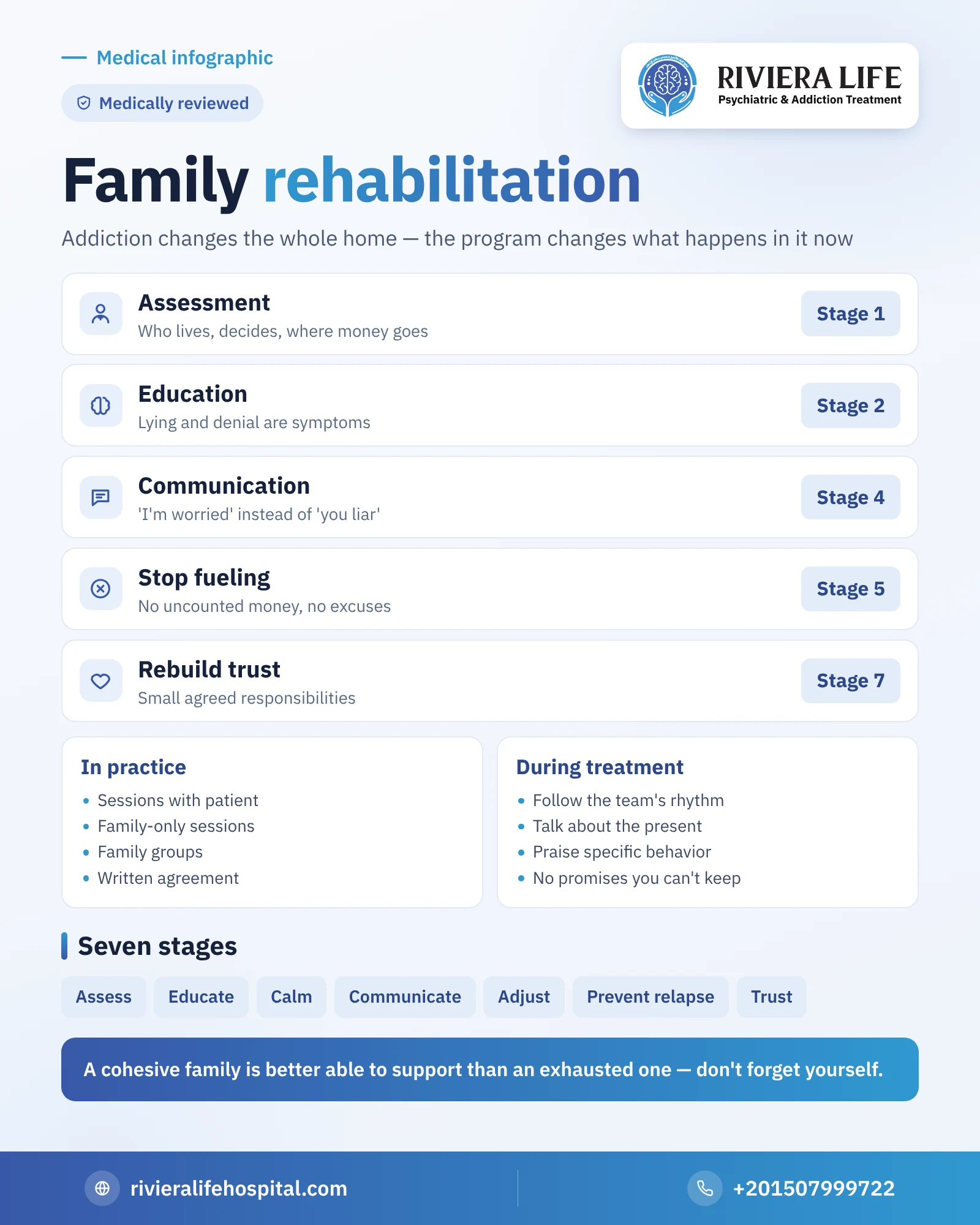
What are the stages of the family rehabilitation program?
Stage one: family assessment
Who lives in the home? Who makes the decision? How are disagreements managed? And where does the money go? Drawing this map reveals the strengths to build on, and the weaknesses that need work.
Stage two: education about addiction
Understanding that addiction is an illness that changes the brain, and that lying and denial are among its symptoms, greatly eases personal anger. The article how does a drug addict think? helps in understanding this angle.
Stage three: calming tension and breaking cycles of conflict
The family recognizes the recurring cycle: discovery, then shouting, then promises, then temporary calm, then a new discovery. And it learns how to get out of it.
Stage four: new communication skills
Using phrases that start with “I’m worried” instead of “you’re a liar”, choosing the time to talk when the patient isn’t using, and listening without interrupting. This stage benefits from well-known methods for training families to encourage their son towards treatment instead of sharp confrontation.
Stage five: adjusting the behaviors that feed addiction
Stopping giving money without accounting, making excuses to work or university, and rescuing the patient from every consequence of their actions. This isn’t cruelty, but withdrawing the fuel with which use continues.
Stage six: preventing relapse from within the family
Knowing the early warning signs, agreeing on a clear plan for what happens when there is suspicion, and keeping medicines at home safely. And for those whose patient has actually returned to use, the relapse treatment program provides the appropriate track.
Stage seven: rebuilding trust
Trust doesn’t return by decision, but through small agreed steps: a simple responsibility the patient commits to, then a bigger responsibility. And the family learns to notice progress and not bring up the past in every disagreement.
How is the program applied in practice?
- Family sessions with the patient: to discuss rules and expectations in the presence of a therapist who ensures the dialogue stays calm.
- Sessions for the family alone: allowing parents to express their anger and fears freely.
- Family groups: in which parents meet other families going through the same experience, and discover that they aren’t alone.
- A written agreement: setting the rules after discharge, such as return times, tests, pocket money, and what happens when they are broken.
- Follow-up after discharge: within the aftercare program.
Who takes part in the program?
Usually the parents and the husband or wife, and older siblings or anyone who lives with the patient and affects their day may take part. As for young children, what suits their ages is taken into account, so they aren’t burdened with details they don’t need. And in the case of a teenage patient, the parents’ participation is an essential part of the students and adolescents program.
What if the patient refuses treatment?
The family can start the program alone. Changing the way the parents deal with the patient, and stopping the patterns that protect use, often makes the patient more ready to accept help. For practical steps in persuasion, read how to help an addict and persuade them to get treatment.
How does the family deal with the addict during treatment?
Some families think their role stops until the patient leaves the hospital, but in reality the weeks of treatment are the best time to change the way of dealing. The patient is away from the substance, and the parents can sort out their feelings without a daily crisis consuming them.
- Stick to the team’s rhythm: visiting times and calls are set by the therapists according to the patient’s condition, so there’s no need for surprise visits or special requests.
- Talk about the present: the plan and what they achieved today are more useful than opening files from the past, as long reproach dampens their enthusiasm.
- Praise specific behavior: a phrase like “I noticed you attended all the sessions” has a truer effect than general praise.
- Hold back heavy news: debts and major family disputes; the therapist decides when and how they are told.
- Don’t make promises you can’t guarantee: such as returning to the job or paying off what they owe after discharge.
The patient may go through a day in which they ask to leave early, or call their family angrily and accuse them of locking them up. Don’t make a decision under this pressure, and inform the treatment team first; this wave is well known in the experience and often eases after days. And don’t bring them money or items that aren’t allowed during the visit.
And as the discharge date approaches, reading the guide to dealing with a recovering addict at home helps you prepare for what comes after the stay.
What can the family expect from the program?
No program has a magic wand, and no one can guarantee that the patient won’t relapse. But families that complete the program usually notice tangible changes: less intense disputes, decisions the parents agree on instead of contradicting each other in front of their son, and the ability to notice danger signs early instead of discovering them too late.
Research indicates that family participation in treatment is linked to better adherence to the plan and longer continuation in it. Most importantly, the family itself recovers: it returns to sleep, to its work, and to some of its life that stopped when the addiction began.
Don’t forget yourself
Many parents reach the program exhausted: insomnia, constant anxiety, and disagreements between the spouses about how to deal with it. Part of the program is dedicated to them: regaining some normal life, and seeking personal support when needed. A cohesive family is better able to support than a collapsing one.
The right hospital for a family rehabilitation program: how to choose
The right hospital for a family rehabilitation program is one that treats the family as a party in treatment with its own needs, not as a visitor receiving a report on their son’s condition. Ask:
- Are there regular sessions for the family, or just visits and calls?
- Are the sessions led by therapists specialized in family therapy for addiction?
- Can the family start the program even if the patient refuses treatment?
- Does the plan include a clear agreement for after discharge?
- Does the family learn the signs of relapse and the emergency plan?
- Does family support continue during aftercare?
And beware of any place that promises the family a guaranteed recovery rate or repairing relationships in days.
How Riviera Life meets these standards in its family program
This is what the patient and their family find at Riviera Life in practice:
- Official license: a hospital licensed by the Ministry of Health.
- A stand-alone family program: a fixed part of the treatment plan, not a side addition.
- Specialized consultants: in psychiatry and addiction treatment who explain the nature of the case to the family.
- Extended experience: fourteen years and thousands of recovered cases and their families.
- Round-the-clock supervision: reassures the family during the patient’s stay.
- Aftercare: accompanies the family after the patient returns home.
- Complete confidentiality: for what is said in sessions and for all the family’s data.
Any member of the family can book the free first consultation or call us night and day on +201507999722. We welcome you in Sheikh Zayed, Giza.
Read also
- How to help an addict and persuade my son to get treatment
- The addiction treatment program for students and adolescents
- The relapse treatment program
- The Matrix program for addiction treatment