
The half residency addiction treatment program is intensive day treatment: the patient spends long hours of their day inside the hospital in medical, psychological and rehabilitation sessions, then returns to sleep at home. It sits between full residence and outpatient follow-up, and suits someone whose medical condition has stabilized and who has a safe home and a supportive family. Its great advantage is that the patient applies what they learn in the morning in their real life in the evening, then returns the next day to discuss what happened. Here we explain how the program works, who it suits and who it doesn’t, its challenges, and the family’s role in the evening hours.
How does the half residency program work?
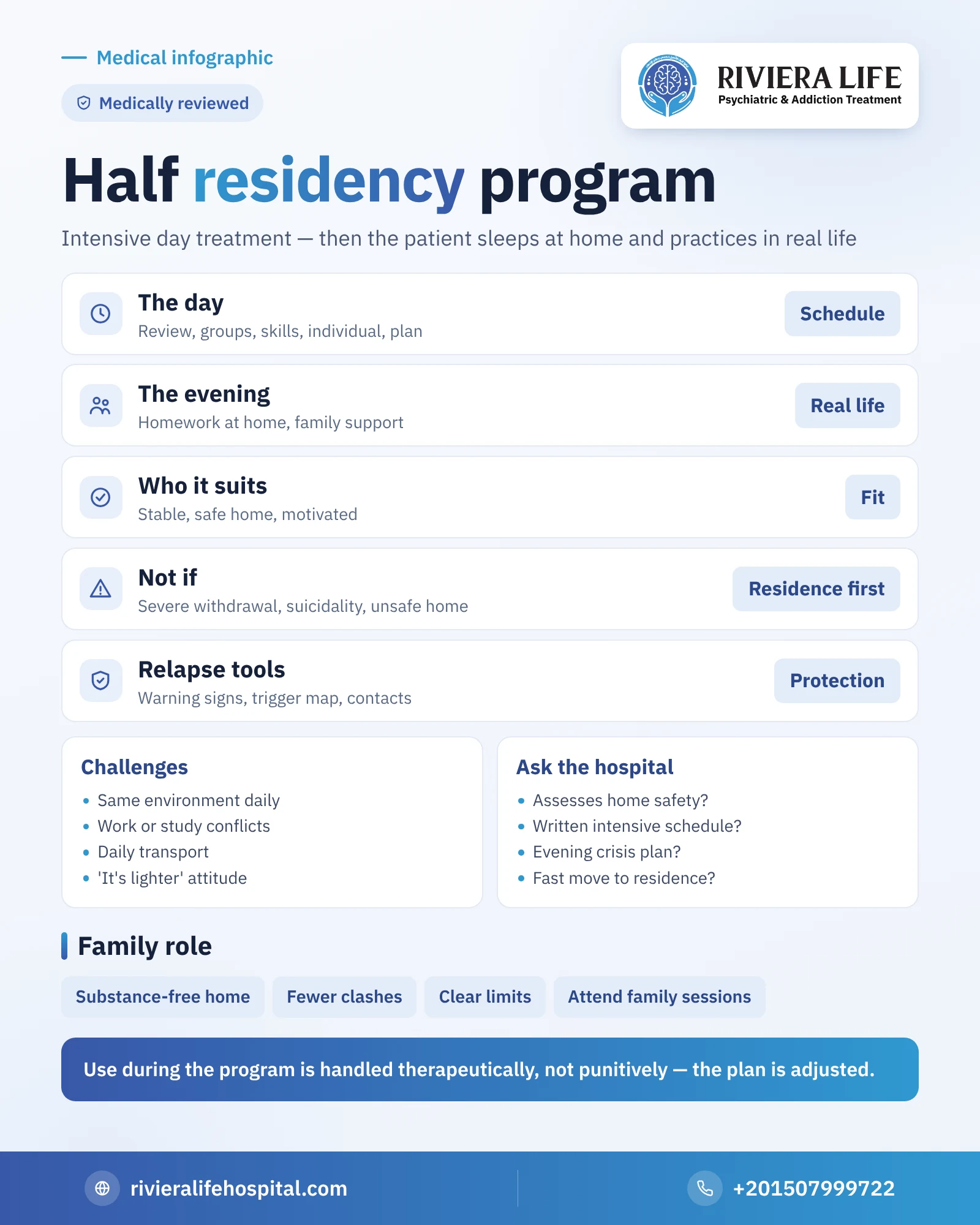
The patient attends at fixed times throughout the week, and their day goes through an organized schedule: a medical review, group and individual sessions, skills training, and follow-up of medicines if prescribed. Then they leave with a specific “homework” for the evening hours: a situation to try, a trigger to monitor, or a difficult conversation with a family member. The next day the discussion starts from what actually happened, not from what is supposed to happen.
This is what distinguishes it from the full residence program, where the patient lives in a completely protected environment, and from outpatient follow-up, which is limited to a few sessions a week. It helps before choosing half residency to know how drug addiction treatment generally goes and where this stage falls within it.
What are the program’s goals?
- Maintaining stability after detox or after full residence.
- Reducing craving for use and learning to deal with it the moment it appears.
- Turning theoretical skills into daily habits within the real environment.
- Regular follow-up of the psychological state and medicines.
- Repairing communication within the family and reducing conflict.
- Building a written relapse prevention plan before moving to lighter follow-up.
Who does the half residency program suit?
- Someone who has finished detox or full residence and needs a gradual transition, not a sudden jump.
- Someone whose medical condition is stable and who isn’t expected to go through dangerous withdrawal.
- Someone who lives in a home free of substances with a family ready to cooperate.
- Someone motivated for treatment who commits to attending on time.
- Someone who needs more intensive treatment than weekly sessions without moving away from home.
When isn’t half residency the right choice?
The program doesn’t suit cases in which the evening at home is a real danger: withdrawal expected to be severe as with alcohol or sedatives, an acute psychological crisis, suicidal thoughts, untreated psychotic symptoms, rapid repeated relapses, or a home where a substance is available or someone uses. In these cases full residence comes first, then half residency becomes a later step.
The assessment before joining
The patient goes through a medical assessment that reviews the substances and expected withdrawal, a psychological assessment that detects accompanying disorders, and a family and social assessment that answers a decisive question: is the home safe in the evening? Then an estimate of the level of motivation and the risk of relapse. If the assessment indicates that the patient needs a higher level of care, they are told so frankly.
A day in the half residency program
| Time | What happens |
|---|---|
| Start | A quick review of the previous night: sleep, craving, and any difficult situation. |
| Morning | An educational session then group therapy. |
| Midday | Training in skills such as refusing offers and managing anger, and a meal. |
| Afternoon | An individual or family session, and follow-up of medicines. |
| Close | The evening plan: what they will do, and whom to call if they feel at risk. |
The therapeutic methods used
The program relies on evidence-supported methods, most prominently cognitive behavioral therapy to understand the relationship between thoughts, situations and use, motivational interviewing to strengthen internal motivation, incentive systems that reward commitment, medication treatment when needed, and introduction to support groups such as the twelve-step program.
How long does the program last?
There is no single duration. Some plans start with several weeks and may extend longer, and actual progress determines when the number of attendance days decreases gradually. The indicators the team looks at: regular attendance, declining craving, improved sleep and mood, and the ability to solve problems without a substance.
As for the cost, it is usually lower than full residence because there is no overnight stay, but it changes according to the number of attendance days, the duration, medicines and family sessions, and its figure isn’t known until after the assessment. The cost factors are explained in the article on the cost of addiction treatment in Egypt.
Challenges the patient may face
- Returning daily to the same environment with its triggers and people.
- Difficulty reconciling attendance with work or study.
- The hardship of daily transport, a common reason for absence.
- A family that watches with excessive anxiety and so increases tension instead of easing it.
- Thinking the program is “lighter” so it doesn’t need full commitment.
These challenges aren’t fatal flaws, but material to work on in the sessions themselves.
The family’s role in the evening hours
In half residency the family becomes a daily partner. It is asked to keep the home free of substances, reduce clashes, encourage attendance without threats, set clear limits on money and going out, and attend its sessions in the family rehabilitation program. That doesn’t mean turning into police; suffocating supervision pushes toward lying, not recovery.
How does the program protect the patient from relapse?
Because the patient spends their nights outside the hospital, relapse prevention is built on practical tools they carry with them: a list of the warning signs they know about themselves, a map of their triggers in the neighborhood, work and phone, two or three numbers to call when craving comes, and a safe place to go if tension intensifies at home. In the sessions they train on real scenarios: an old friend calling, a salary arriving, or an argument with the family. Every situation that passes safely becomes evidence they learn from, and every difficult situation becomes the subject of tomorrow’s session.
What if the patient uses during the program?
This sometimes happens, and dealing with it is therapeutic, not punitive. The situation is assessed medically to make sure of safety, then what preceded it is examined, and the plan is adjusted: increasing attendance days, adding a medicine, or moving temporarily to full residence if it repeats. And if use is part of a pattern of repeated relapses, the relapse treatment program helps.
The right hospital for a half residency addiction program: how to choose
The right hospital for half residency is one that makes the day real treatment and prepares the patient for a safe evening. Ask:
- Is the safety of the home assessed before accepting the patient?
- Is the daily schedule written and intensive, or just one session?
- Is there a clear plan if strong craving or use appears in the evening?
- Can one move quickly to full residence when needed?
- Are medicines and the psychological state followed regularly?
- Does the family have regular sessions?
And beware of any program that promises a guaranteed result or a fixed short duration for everyone.
How Riviera Life meets these standards in the half residency program
All the previous criteria come together at Riviera Life, and these are their details in the half residency program:
- Official license: a hospital licensed by the Ministry of Health.
- Daily consultant follow-up: consultants in psychiatry and addiction treatment see the patient every day.
- Immediate escalation: full residence under round-the-clock supervision inside the same hospital when needed.
- Extended experience: fourteen years and thousands of recovered cases.
- The family as a partner: a family program that supports the evening hours.
- Continuity: an organized transition to aftercare.
- Complete confidentiality: for the patient’s attendance and data.
Learn about the half residency program in a free first consultation, or call us at any time on +201507999722. We receive you in Sheikh Zayed, Giza.
And one can move between half residency and full residence within one addiction treatment hospital according to how the case develops, without starting again with another team.
Read also
- The residential addiction treatment program
- The home addiction treatment program
- The aftercare program
- The addiction treatment program for students and teenagers