Pathological jealousy is jealousy that goes beyond a passing feeling of fear for a partner, turning into a persistent suspicion of their infidelity that takes over thinking and leads to checking, interrogation and control, despite the absence of convincing evidence. It may be part of anxiety or obsession that the person knows is exaggerated, and it may reach a firm delusion that no argument shakes, which doctors call “Othello syndrome”. In this article we explain the difference between normal, obsessional and delusional jealousy, the link between jealousy and alcohol and stimulants, the signs that deserve attention, when it becomes a safety risk, and how it is treated.
Normal jealousy: when is it part of love?
Most people feel a pang of jealousy if they see their partner laughing at length with someone else, or if they feel their attention has suddenly dropped. This feeling is understandable, is usually tied to a specific situation, and settles after a frank conversation or reasonable reassurance.
Healthy jealousy has three features: it is proportionate to the situation, it doesn’t last long, and it doesn’t turn into surveillance. A husband says, for example: “It bothered me that you didn’t answer the phone for two hours”, then hears the explanation and is satisfied. But when he hears the same explanation and becomes more suspicious, and starts looking for “the truth” in everything, the matter has left the circle of love for another one.
Three degrees of pathological jealousy
Psychiatrists distinguish between different forms of excessive jealousy, and the difference between them isn’t in the intensity of the pain but in the nature of the idea and how convinced the person is of it:
| Type | Nature of the idea | The person’s position on it |
|---|---|---|
| Normal jealousy | Tied to a clear situation | Settles with reassurance and conversation |
| Obsessional jealousy | Repeated intrusive thoughts about infidelity | Usually knows they are exaggerated and suffers from them, and seeks to make sure again and again |
| Delusional jealousy (Othello syndrome) | A fixed certainty of infidelity without evidence | Completely convinced, interprets anything as proof, and accepts no other explanation |
Obsessional jealousy
This is close to the spectrum of OCD and doubt: the thought “maybe she has cheated on me” intrudes into the mind many times, so he feels intense anxiety that only settles by checking the phone or asking the same question for the twentieth time. Reassurance relieves him for minutes, then the thought returns stronger. The painful side is that he knows inside that his suspicion is illogical, and is sometimes ashamed of it.
Delusional jealousy or Othello syndrome
It is named after the hero of Shakespeare’s play who killed his wife after slanderers convinced him of her infidelity. Here the person doesn’t suspect; he “knows”: a stain on clothes, a five-minute delay, or the way a door is closed are all conclusive evidence in his eyes. Delusional jealousy is considered one of the patterns of paranoia and delusional disorder, and it may also appear with schizophrenia, with diseases affecting the brain in older people, or with substance use.
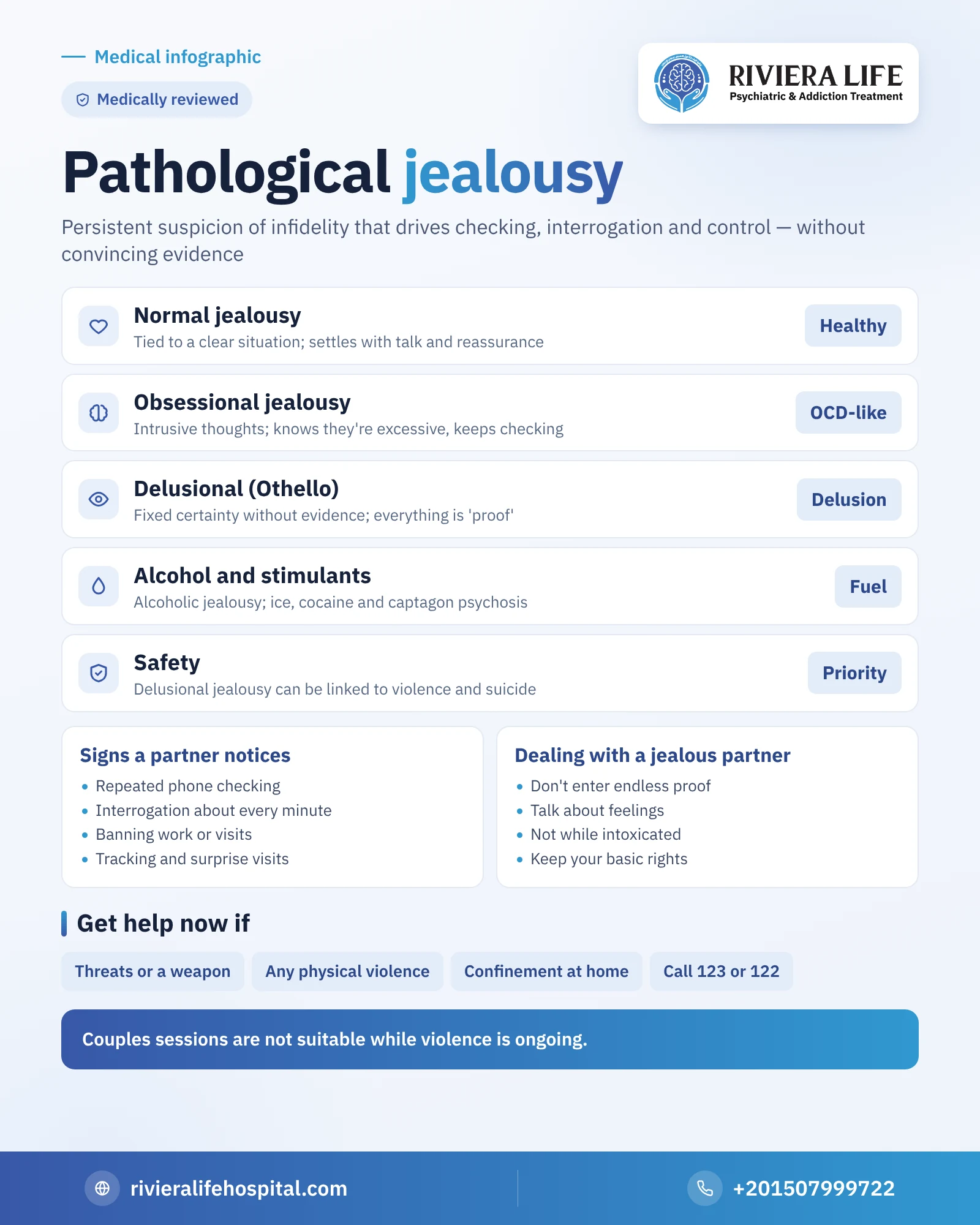
Signs of pathological jealousy that a partner notices
Pathological jealousy doesn’t appear in words alone, but in daily behavior that exhausts the other person. Among the things husbands and wives most often describe:
- Repeatedly checking the phone, messages, call log and social media accounts.
- Long interrogation about every minute outside the home, and demanding photos or video calls to prove the location.
- Interpreting innocent actions as signals: the color of clothes, a smile at a neighbor, or a changed password.
- Preventing the partner from working, visiting, or going out with their friends.
- Tracking their location, turning up suddenly at their workplace, or secretly asking others about them.
- Accusations of infidelity with relatives, neighbors or even people the partner doesn’t know at all.
- Turning every small disagreement into talk of infidelity, with fits of anger, crying or threats.
It is important to know that pathological jealousy affects both men and women, although the severe delusional form is observed more in men.
Alcohol, stimulants and hashish: fuel for suspicion
The link between pathological jealousy and substance use is old and well known in psychiatry. Chronic alcohol use is linked to what is known as alcoholic jealousy, in which the drinker accuses their partner of infidelity, and this increases with the sexual weakness the addiction itself may cause, which the person interprets as there being “someone else”. You will find details on this substance in our guide to alcohol.
Stimulants such as ice (shabu), cocaine and captagon may cause an acute psychosis full of suspicion, in which thoughts of infidelity are among the most common forms. And in Egypt we often hear about the hashish user who starts to suspect his wife; this particular picture is explained in detail in our article on the hashish addict and suspicion. The important rule: if acute jealousy appears or increases with drug use, treating the addiction is an inseparable part of treating the jealousy.
Why do some people develop pathological jealousy?
There is no single cause, but factors that come together:
- Old experiences: a real previous infidelity, or growing up in a home full of suspicion and infidelity.
- A fragile self-image: a deep feeling of unworthiness and fear of abandonment, as in some personality disorders.
- Psychiatric disorders: OCD, depression, delusional disorder and schizophrenia.
- Substance use: alcohol, stimulants and hashish as above.
- Organic causes: some brain diseases, especially when jealousy appears for the first time at an older age, which calls for a neurological examination.
When does jealousy become a safety risk?
This is the most important section of the article. Delusional jealousy in particular is sometimes linked to violence against the partner, and to suicidal thoughts in the person themselves. Psychiatric references indicate that Othello syndrome may be associated with thoughts of harming others or oneself, so it shouldn’t be treated as an “ordinary marital disagreement”. If you live with a partner whose jealousy is growing more intense, your safety comes first:
Seek urgent help immediately if you see
Call an ambulance on 123 or the emergency police on 122, and move to a safe place before any discussion.
- Threats to kill or harm, or carrying a weapon or sharp tool during the accusation
- Physical violence, even if it happened once or was apologized for afterward
- Locking the partner in the home or taking their phone or papers by force
- The jealous person talking about suicide or saying they don’t deserve to live
- Acute jealousy with alcohol or stimulant use and staying awake for days
- Thoughts of revenge directed at someone they believe is a third party
Prepare a safety plan: keep a charged phone and the numbers of people you trust within reach, and keep a copy of important papers outside the home. You can contact the complaints office of the National Council for Women on 15115, or the hotline of the General Secretariat of Mental Health and Addiction Treatment on 16328.
How do you deal with a jealous partner without confirming their suspicions?
- Don’t enter the endless cycle of proof; providing evidence time after time doesn’t end the suspicion, it feeds it.
- Talk about their feelings, not the details of the accusation: “I can see you’re suffering, and I want us to find help for this”.
- Choose a calm time, and don’t discuss it while they are under the influence of alcohol or any substance.
- Don’t give up your basic rights, such as working or seeing your family, just to calm them down.
- Suggest a specialist consultation as a step for the good of the relationship, not as an accusation that they are mad.
How is pathological jealousy treated?
Treatment begins with an assessment by a psychiatrist who determines the type of jealousy and what lies behind it: is it obsession? A delusion? The effect of an addiction? A sign of a physical illness? Then treatment is built on that:
- Cognitive behavioral therapy: effective especially in obsessional jealousy, as the person learns to deal with the intrusive thought without checking or interrogating. You can learn more about cognitive behavioral therapy.
- Medicines: the doctor may prescribe antidepressants from the serotonin reuptake inhibitor class in the obsessional form, or antipsychotics in the delusional form, according to their own assessment alone.
- Addiction treatment: when alcohol or drugs are involved, detox and rehabilitation are an essential part.
- Couples sessions: useful in less severe jealousy, and not suitable if there is ongoing violence before safety is ensured.
- Hospital stay: may be needed temporarily when there is a danger to the partner or the patient themselves.
A person with delusional jealousy rarely seeks treatment themselves, because they see a problem only in the other person. That is why the step toward treatment often starts with the family.
Can pathological jealousy be cured?
Obsessional jealousy responds well to treatment in most cases, and many gradually regain their ability to trust. Delusional jealousy needs longer follow-up, and improves more when its cause is treated, such as stopping alcohol or stimulants. Patience is necessary here, but it shouldn’t come at the expense of safety.
How can Riviera Life help you?
At Riviera Life, consultants in psychiatry and addiction assess the type of jealousy and its causes, and set a plan that includes psychotherapy, medication and treatment of drug use if present, with round-the-clock medical supervision when needed and complete confidentiality. The partner or family can start with the free first consultation to arrange the next step safely.
Read also
- The hashish addict and suspicion
- Paranoia: from passing suspicion to persecutory delusion
- OCD and doubt
- Psychosis: symptoms, causes and treatment
Questions many people ask
A passing check after a worrying situation doesn't mean illness. But repeated checking despite no evidence, together with interrogation, prohibition and control, is a pattern that deserves assessment.
It is delusional jealousy, a fixed certainty that the partner is unfaithful without evidence, which no argument changes. It is considered a form of delusional disorder, and may be linked to alcohol, stimulants or brain disease.
Mild obsessional jealousy may improve with cognitive behavioral therapy alone. The delusional form usually needs medicines decided by the doctor, alongside psychotherapy.
It improves a lot in many people after stopping, especially if it appeared with drug use. But some cases persist and need psychiatric treatment and follow-up.
You can start yourself with a specialist consultation to get a plan for coping and persuasion. And if threats or violence appear, the priority is your safety and seeking help immediately.