The short answer
The symptoms of mental illness are changes in mood, thinking, perception, behavior or the body that last for weeks and are stronger than usual, disrupting sleep, work or relationships. Being sad for two days after a family disagreement is normal, but losing interest in everything for two weeks in a row, with insomnia and withdrawal from people, deserves an assessment. A single symptom doesn't make a diagnosis; the doctor looks at the symptoms together and their duration, and rules out physical causes and the effect of substances before naming the disorder.
- The pattern is what countsSymptoms that cluster, repeat and last, not a single sign
- The body takes partPalpitations, insomnia and pain with no physical cause may be a psychological picture
- Emergencies don't waitTalk of death or losing touch with reality calls for 123
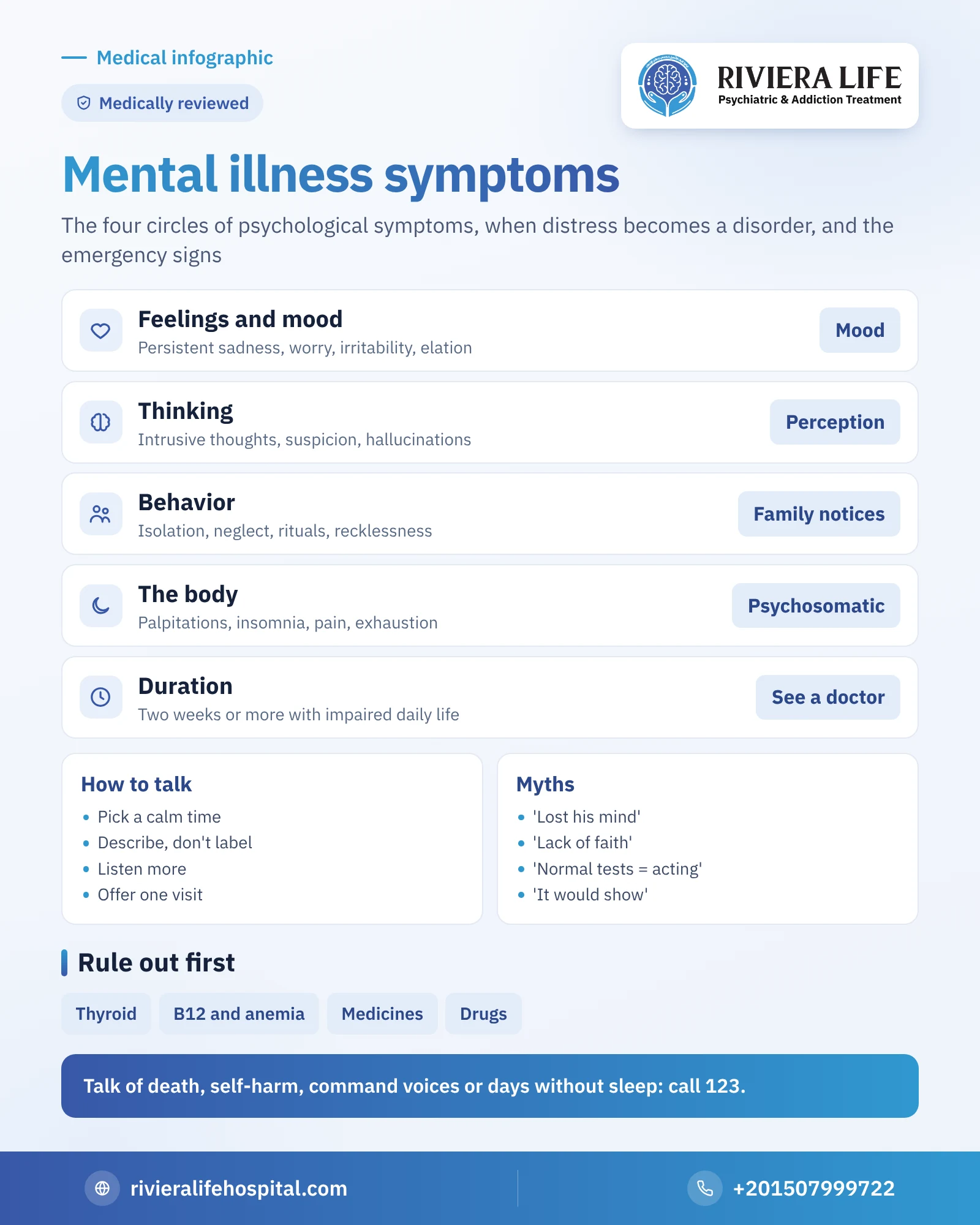
The symptoms of mental illness usually start with small changes that those close to the person notice before they do: a son who used to sit with his family at dinner now takes his plate to his room, a mother who stopped her evening calls with her sisters, or a hard-working employee who starts arriving late and missing work without explanation. Here we explain how symptoms appear in feelings, thinking, behavior and the body, when distress becomes a disorder, when the cause is physical or a drug, and when it is an emergency, then we guide you to our most important articles.
Mental illness symptoms: when does a normal feeling become a sign of illness?
Everyone worries before final secondary-school exams and grieves the loss of a loved one, then calms down. We speak of the symptoms of mental illness when the feeling becomes detached from the situation or exceeds it in size and duration, and in the clinic we ask three questions:
- How long does it last? The DSM-5 diagnostic manual requires, for a depressive episode, near-daily symptoms for at least two weeks, and for generalized anxiety disorder, six months.
- How severe is it? Does the person calm down if kept busy, or does the feeling dominate their day?
- What is its effect? Has their performance at school or work declined, have they withdrawn from people, or neglected their food and hygiene?
Sadness after a loss that eases graduallyA normal response
Two weeks of insomnia and distress with a decline at workWorth a consultation
Cutting off from work, food and peopleAssessment soon
Talk of death or voices giving ordersEmergency now
The World Health Organization estimates that nearly one in every seven people in the world, about 1.2 billion people, were living with a mental disorder in 2023, so there is no shame in the symptoms of mental illness, nor are they rare. You can find the definition of each disorder separately in the section Mental illnesses and their types.
Mental illness symptoms in feelings and mood
Mood is the backdrop of the whole day, and when it is disturbed the details take on its color. The clearest emotional signs:
- Sadness or inner emptiness that good news doesn't dispel, and loss of pleasure in what used to delight the person, such as a match he was looking forward to or Friday outings with his friends.
- Continuous anxiety and constantly expecting the worst, or sudden attacks of fear.
- Irritability and quick temper, which in men and teenagers is often the visible face of depression.
- Excessive elation, exaggerated confidence and little need for sleep for days in a row; this is the picture of a manic episode.
These signs direct the question rather than settle it: are we dealing with depression, an anxiety disorder, or the swings of bipolar disorder?
Thinking and perception: when the way of seeing reality changes
The symptoms of mental illness in thinking are harder on the family because they can't be seen, but they appear in speech and decisions:
- Disturbing intrusive thoughts that return despite attempts to push them away, which the person knows are exaggerated and is ashamed of; this is a known pattern in OCD.
- Fixed suspicion of neighbors, the spouse or colleagues, or certainty that someone is watching or plotting against them, which doesn't budge in the face of evidence.
- Hearing voices or seeing things that others don't perceive; these are hallucinations.
- Disorganized speech that jumps between ideas, or distraction and forgetfulness not explained by tiredness.
The important difference here is "insight": a person with an obsession knows their thought is illogical, while in psychosis the person usually loses the ability to see that what they are experiencing isn't real, which is why they don't seek help themselves.
Behavior and daily life: what the family notices first
Many families tell us: "He didn't complain about anything, but he isn't himself anymore." Behavior is the clearest mirror of the symptoms of mental illness, and among its changes when they last:
- Disturbed sleep: staying up until dawn and sleeping in the day, or waking very early and being unable to get back to sleep.
- A clear change in appetite and weight.
- Isolation and keeping the bedroom door closed, and neglecting bathing, study and work.
- Repeated rituals that consume time, such as washing hands until they crack, or checking the door and gas many times.
- Sudden recklessness in spending or driving.
- Turning to sedatives, hash or alcohol to bear feelings.
And if you suspect a drug, see the page The signs of drug use the family notices.
Mental illness symptoms in the body
Many people visit cardiologists and gastroenterologists for months before the psychiatrist, because their symptoms of mental illness began as physical: chronic anxiety raises stress hormones, so the heart speeds up, the muscles tense and digestion is upset.
What the body complains of
- Palpitations, shortness of breath and sudden dizziness
- Pressing headache and tension in the neck and shoulders
- Bloating, cramps and changed bowel movements
- Constant exhaustion despite enough hours of sleep
- Numbness, weakness or loss of voice with no neurological cause
What may lie behind it psychologically
- A panic attack or an anxiety disorder
- Chronic tension and accumulated pressures
- Anxiety that stirs up irritable bowel
- Depression or a sleep disorder
- Conversion disorder after severe stress
A physical symptom is not attributed to the mind before the physical cause is ruled out, and new chest pain is examined in the emergency department first. The article Psychosomatic disorders explains how the organs speak the language of stress.
Passing distress or a mental disorder? A practical comparison
A table to help you organize what you see; it doesn't replace an assessment of the symptoms of mental illness by a doctor:
| Item | Normal distress | A disorder that needs assessment |
|---|---|---|
| The cause | A clear situation such as a loss or a disagreement | There may be no cause, or the reaction is much bigger than the event |
| Duration | Days, easing gradually | Weeks or months, or it returns in episodes |
| Daily functioning | Slightly affected and continues | A clear decline at work, school or home |
| Sleep and eating | A temporary disturbance | A persistent change in sleep, appetite and weight |
| Response to support | Improves with talking and rest | Doesn't change despite support and time off |
| Safety | No thoughts of self-harm | Thoughts of death or losing touch with reality may appear |
If what you are going through is closer to the first column, the topics of mental health and daily balance, such as dealing with stress and burnout, may help you.
Symptoms shared between different disorders
Some people read a list online, pick up a symptom and diagnose themselves, even though most symptoms of mental illness appear in more than one disorder:
- Insomnia accompanies depression, anxiety, mania and withdrawal from alcohol and sedatives.
- Poor concentration appears in depression, ADHD, anxiety and lack of sleep.
- Irritability may be depression, anxiety, mania or an effect of stimulants.
- Suspicion of others may be a personality trait, psychosis, or a direct effect of ice and captagon.
That is why anxiety and depression often occur together in the same person, and the article The difference between depression and anxiety explains how the doctor separates them. A diagnosis is built on how symptoms cluster, their sequence, and family history.
Psychological symptoms caused by a physical illness, a medicine or a drug
Some symptoms of mental illness have a physical cause, so the doctor first asks: is there another explanation?
- An overactive thyroid resembles anxiety, and an underactive one resembles depression.
- Vitamin B12 deficiency, anemia and low blood sugar may cause tiredness and mood swings.
- In older people, a urinary infection or dehydration may appear as sudden delirium.
- Medicines such as cortisone may cause insomnia and mood swings.
Substances have a clearer effect: stimulants such as ice and captagon may cause suspicion and hallucinations, hash may uncover a predisposition to psychosis in those at risk, and withdrawal from alcohol and sedatives may cause delirium. The details are in the article Drug-induced psychosis and in the section The effect of drugs during use. When a disorder and an addiction come together, it is a "dual diagnosis" treated as a whole, as the article Depression and addiction explains.
Do the symptoms of mental illness differ by age?
Yes. The World Health Organization states that half of all cases of mental disorders begin before the age of fourteen, so watching for the symptoms of mental illness early starts at home and at school.
- 1ChildhoodBehavior speaks instead of words
Frequent tantrums, silence outside the home, or stomach aches before school. Telling naughtiness apart from ADHD needs a specialist.
- 2AdolescenceBetween normal rebellion and alarm
Mood swings are expected, but a sudden drop in grades, long isolation and harming the body are signs not to be ignored.
- 3AdulthoodSymptoms hiding behind responsibilities
Many hide their suffering, so depression appears as exhaustion, irritability and overworking.
- 4Old ageForgetfulness or depression?
Depression in older people may resemble the beginning of dementia, so a careful assessment is needed.
For details by stage, read The signs of mental disorder in children and Psychological changes in older people.
Symptoms of mental illness in women, men and teenagers
A disorder is the same in its medical definition, but the way it appears is affected by age, sex and social expectations, and this is what makes some cases discovered late.
In women
Anxiety and depression are diagnosed more in women, and some are linked to hormonal stages such as the premenstrual period, after childbirth and menopause. Symptoms sometimes appear as constant exhaustion, headaches, shifting pains and easy crying, so they are treated physically for months before anyone asks about the psychological state. Wider details are in Excessive irritability in women.
In men
Many men don't say "I'm sad". In them, depression appears as irritability and quick anger, immersion in work, staying up, smoking and drug use, or silent withdrawal from home. That is why they are at higher risk of depression going undiagnosed and becoming mixed up with addiction.
In teenagers
Swings are part of adolescence, but the difference lies in intensity, persistence and effect: a sudden academic drop, isolation lasting weeks, a major disturbance in sleep and eating, harming the body, and talk of pointlessness. Telling the normal from the worrying is explained in the article Psychological changes in adolescence and the guide Teen depression.
In children
A child expresses themselves more through behavior and the body than through words: stomach aches before school, tantrums, bedwetting after it had stopped, and intense clinging to the mother. The broader reference is in Mental illness in children.
Misconceptions that delay seeking help
Inherited ideas delay dealing with the symptoms of mental illness:
What is said at home
- Whoever visits a psychiatrist has lost their mind
- Depression is a lack of patience or distance from God
- As long as the tests are normal, the pain is just acting
- If he were ill, it would show on his face
What medicine says
- Most patients suffer from anxiety or depression and live their lives
- Depression is a medical condition that affects the religious and others, and responds to treatment
- Psychosomatic pain is real and the person truly feels it
- Many smile at work and suffer alone at night
When should you see a psychiatrist, and what happens in the assessment?
If the symptoms of mental illness last more than two weeks and affect your day, a visit is justified without waiting for a "breakdown". The article When do you need a psychiatrist? details the signs. The usual steps of assessment:
1
Record what you notice
Write down when the symptoms began, what makes them worse, and how sleep, eating and work have changed.
2
The first interview
The doctor asks about the symptoms and their history, the family, medicines and substances, frankly and confidentially.
3
Ruling out a physical cause
They may order tests such as thyroid and a blood count, and sometimes a drug test or a scan.
4
Diagnosis and explanation
They connect the symptoms and explain to you and your family what is happening in clear language.
5
The treatment plan
Psychotherapy, medication or both, under a doctor's supervision, with a set follow-up appointment.
Learn about the types of psychotherapy and sessions, and about psychiatric medicines and their families, and don't start or stop a medicine except under a doctor's supervision.
Psychiatric emergency signs: don't wait for an appointment
Some symptoms of mental illness can't wait until morning or until the patient is convinced.
Call the ambulance on 123 immediately if you see any of these signs
Stay with the person, remove sharp tools and medicines from them, and don't leave them alone until help arrives.
- Talk of death or the wish to end life, especially with a plan, goodbyes or giving away their belongings
- Harming the body with cuts or burns, or taking a large amount of medicines
- Voices ordering them to harm themselves or others, or an explicit threat of violence
- Refusing food and drink, or rigidity and complete silence
- Sudden confusion with fever and muscle rigidity after starting a psychiatric medicine
- Days without sleep with severe impulsivity and recklessness
- For psychological support: the hotline of the General Secretariat of Mental Health and Addiction Treatment, 16328
If you yourself are having thoughts of harming yourself, help is available now, and these thoughts ease with treatment. Read What to do when you have suicidal thoughts, and if someone you love is harming their body, the article How to help someone who harms themselves guides you without blame.
How do you talk to someone showing psychological symptoms?
The way you talk to someone showing the symptoms of mental illness may open the door to treatment or close it for years. What usually works:
- Choose a calm time, away from a moment of disagreement.
- Describe what you saw, not what you think: "I've noticed you haven't left your room for a week" instead of "You're depressed".
- Listen more than you talk, and don't interrupt with advice.
- Ask directly about thoughts of death if you feel worried; a calm question doesn't plant the idea, it opens the door to safety.
- Suggest one assessment visit, and offer to go with them, instead of talking about long treatment.
And avoid the phrase "Others have bigger problems"; it pushes them into silence.
The mental illness symptoms and causes article guide: from the sign to understanding
We have chosen the most important articles, arranged by type of symptom, so start with the section closest to what you notice.
Introduction: reading symptoms and when to worry
8 articlesWhere to start if you notice a change and don't know its name
- Signs that it's time for a psychiatrist: and preparing for the appointment.
- Why mental disorders appear in the first place: genes, stress and substances.
- Does mental illness pass to children?: the limits of heredity's role.
- Signs of concern about a child's mental health: by each age stage.
- Mental disorders after sixty: and telling them apart from dementia.
- What people call a nervous breakdown: its medical meaning.
- Mood swings between temperament and illness: where the dividing line is.
- Poor concentration and a scattered mind: its psychological and physical causes.
Anxiety, fear and phobia
6 articlesWhen fear becomes bigger than the situation
- The signs of anxiety in the mind and body: and when it needs treatment.
- The differences between the main anxiety disorders: what each type looks like.
- A panic attack or a heart attack?: and what to do during an attack.
- The signs of fear of facing people: psychological and physical.
- Fear of crowds and open spaces: and why the world closes in on the sufferer.
- Overthinking and rumination: and practical techniques to stop it.
Depression and sharp mood swings
8 articlesFrom persistent sadness to manic episodes
- What depression actually looks like: its psychological, physical and behavioral signs.
- When does sadness turn into illness?: duration and effect.
- Loss of passion and pleasure: its link to dopamine and depression.
- Masked depression in men: anger, overwork and substances.
- The forms of depression in women: and hormonal stages.
- Depression in adolescence: and the parents' role.
- After childbirth: passing blues or depression?: and safe treatment.
- The signs of manic and depressive episodes: in bipolar disorder.
OCD and repetitive behaviors
6 articlesThoughts that intrude and acts that don't stop
- The signs of OCD in thought and behavior: and its effect on the body.
- The best-known themes of OCD: what each type looks like.
- Obsessions about purity and worship: when carefulness becomes torment.
- Washing and sterilizing obsession: and the family's role.
- Compulsive hair pulling: and why the hand doesn't stop.
- Pathological preoccupation with a flaw in appearance: body dysmorphic disorder.
Psychosis, hallucinations and disturbed perception
7 articlesWhen reality mixes with what isn't there
- What the family notices when there are hallucinations: and when to seek an assessment.
- Auditory, visual and other hallucinations: the differences between them.
- The early and psychotic signs of schizophrenia: before the first episode.
- Pathological suspicion and persecution: from passing doubt to delusion.
- Fixed false beliefs: the types of delusions.
- Acute delirium versus psychosis: why the distinction matters.
- Psychosis made by drugs: the substances, the duration and treatment.
Trauma, dissociation and personality
6 articlesThe effect of difficult events and patterns of relating to others
- After trauma: intrusive memories and avoidance: and its signs.
- Reactions after a traumatic event: and when you need treatment.
- The feeling that the self or the world isn't real: depersonalization.
- Paralysis or seizures with no neurological cause: conversion disorder.
- When being affected by a crisis lasts too long: adjustment disorder.
- Unstable relationships and fear of abandonment: the signs of borderline personality.
The body, sleep and emergencies
10 articlesPhysical complaints and situations that can't be postponed
- When the body expresses stress: psychosomatic disorders.
- Breathlessness linked to anxiety: and telling it apart from the physical kind.
- Sleep problems and their types: and when to see a doctor.
- Refusing food and the obsession with thinness: anorexia nervosa.
- What is attributed to serotonin deficiency: psychological and physical signs.
- If you have thoughts of ending your life: help is available now.
- Wounding the body to vent pain: how to support without blame.
- Medicine-induced serotonin toxicity: and when to call the ambulance.
- Fever and rigidity after antipsychotics: a rare and dangerous emergency.
- When depression and drug use come together: simultaneous treatment.
When should you seek help?
Seek help if the symptoms of mental illness last more than two weeks, disrupt your work, study or relationships, the family notices a clear change it doesn't understand, or a mental disorder comes together with substance use. In dangerous situations, call the ambulance on 123 or the hotline on 16328 without delay. At Riviera Life, licensed by the Egyptian Ministry of Health, consultant psychiatrists and addiction specialists have worked for fourteen years, with round-the-clock medical and nursing supervision for inpatients, complete confidentiality and a family program. The first consultation is free and confidential; call us on +201507999722.
Medical sources and referencesThe information in this article is based on reliable scientific sources