
Transporting an addiction patient to hospital is a sensitive moment that often determines how the whole treatment journey will begin. Safe transport doesn’t start with a car in front of the house, but with a calm call to the hospital, an initial assessment of the case, and a plan in which the family knows what to prepare, what to say, and when the matter is an emergency. This article is a practical guide for the family: from the first call to the moment of arrival, including what concerns psychiatric patients too, and what to avoid to protect the patient’s dignity and safety.
Why does the family need a transport plan?
Many families wait a long time for the patient to agree, then agreement comes suddenly late at night or after a crisis. If there is no plan, the chance is lost: the patient backs down, or the trip turns into a fight on the way. The opposite is also true; when the family knows in advance whom to call, which papers are needed, and what will happen on arrival, the transport becomes a short step, not a battle.
This guide differs from the question of persuading the patient to get treatment in the first place, explained in how to help someone addicted to drugs. Here we assume the decision to treat has been made, and the question now is: how do we get there safely?
Step one: call the hospital before making any move
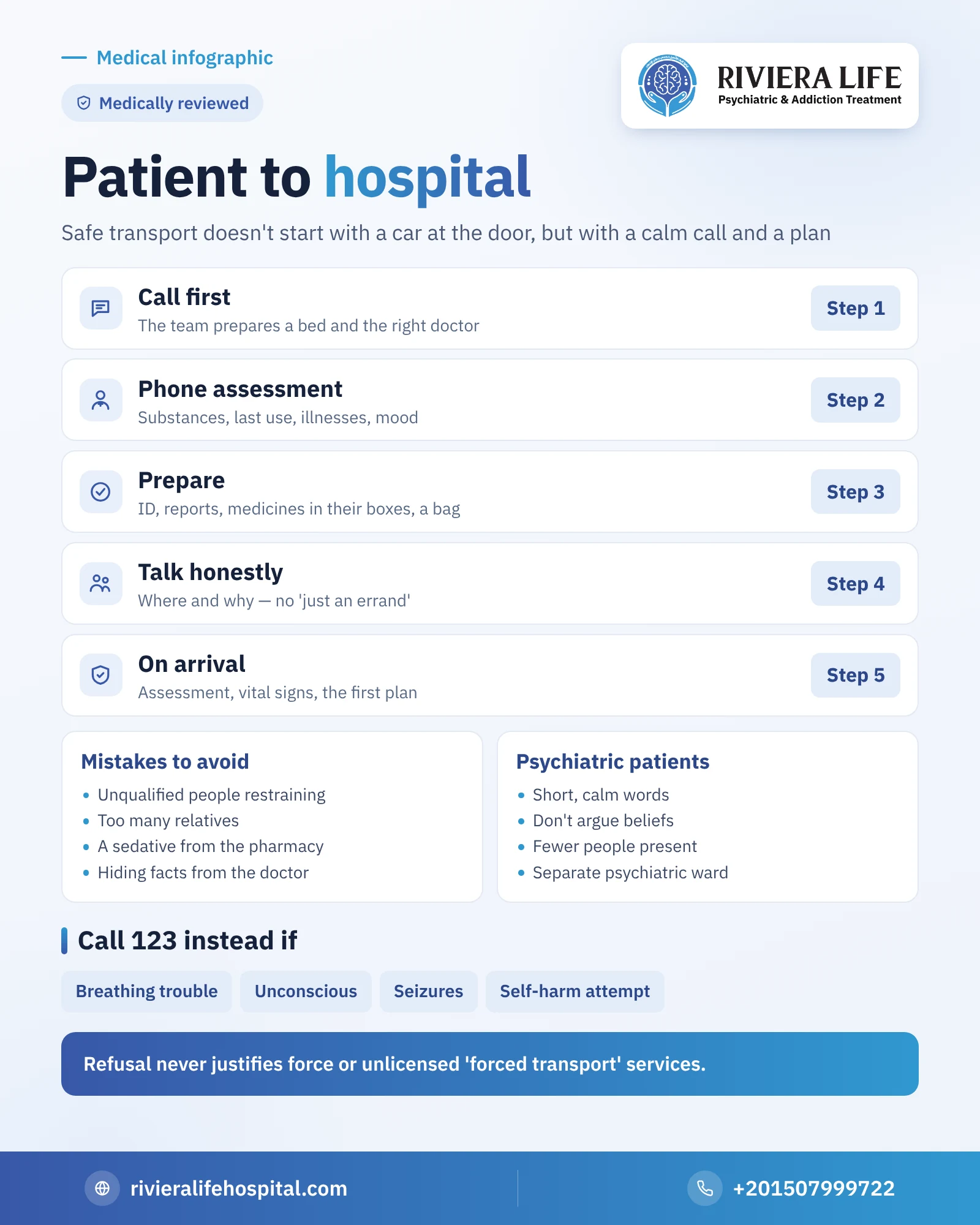
Don’t put the patient in a car and head to the hospital without calling first. The first call lets the team know the case, prepare the bed and the right doctor, and alert you if there are signs that call for an ambulance instead of ordinary transport. Riviera Life provides a service to transport the patient to the hospital, and its details, such as the means of transport, who accompanies the patient and the timing, are explained by the team when you get in touch, according to the case.
The phone assessment: what will you be asked?
- What substances does the patient use, for how long, and do they mix more than one substance?
- When did they last use?
- Do they have a chronic illness such as diabetes, heart disease or epilepsy?
- Have acute psychiatric symptoms appeared, such as hallucinations, intense suspicion or talk of harming themselves?
- Do they agree to treatment, or are they hesitant, or refusing?
- Have they been treated before, or had complications when stopping?
Honest answers here aren’t formalities; they are what lets the doctor decide whether ordinary transport is safe, or whether the case needs urgent intervention.
What do you prepare before transport day?
- Papers: the ID card, and any previous medical reports or tests.
- Medicines: all the medicines they take in their original boxes, so the doctor knows their names.
- A simple bag: comfortable clothes for a few days and personal items; the team will tell you what is allowed.
- A calm companion: one or two people the patient trusts, not the whole family.
- Suitable timing: coordinated with the hospital, at a time when the patient is closer to calm.
How do you talk to the patient about going?
Lying to the patient that they are going on a “visit” or “an errand” destroys trust from day one, and may make them reject the whole treatment team. It is better to tell them clearly and calmly where they are going and why. Talk about what matters to them: their health, their children, their work, the sleep they have lost. Acknowledge their fear instead of ignoring it: “I know you’re worried about withdrawal, and the doctors there will follow you day and night”. And on transport day don’t open past accounts and blame; this isn’t the time.
If the patient refuses: the general legal framework
Refusal doesn’t mean the family turns to force or to unlicensed parties offering “forced transport”. The Egyptian law on the care of psychiatric patients allows admission without consent only in specific cases, such as danger to oneself or others or severe deterioration, and after a psychiatric medical assessment inside a licensed facility, with clear rights for the patient to object and appeal. No one can decide this outside this framework. The legal details are explained in involuntary psychiatric admission in Egypt, and the options for dealing with an addict who refuses are in treating an addict against their will.
Transporting a psychiatric patient: greater sensitivity
The service isn’t only for addiction patients. A patient with severe depression, mania in bipolar disorder, or psychosis may also need hospital admission. A patient with psychosis in particular may see the attempt to transport them as a real threat because of the ideas they are living with, so they need short, calm words, no arguing about their beliefs, and fewer people present. Ways of talking to them are detailed in how to deal with a psychosis patient. The hospital receives these cases in a psychiatric ward separate from the addiction department.
When don’t you wait for transport and call an ambulance?
Some situations can’t wait for an appointment to be arranged, and the right place for them is the nearest emergency department via the ambulance.
Call an ambulance on 123 immediately if you see
These are medical emergency signs that come before any arrangement to transport to a treatment hospital:
- Difficulty breathing or very slow breathing
- Loss of consciousness or difficulty waking them
- Seizures
- Severe chest pain
- An attempt at self-harm or a serious threat of it
- Violence that puts the patient or those around them in immediate danger
In psychiatric crises you can also call the mental health hotline 08008880700.
Mistakes families make on transport day
- Bringing in unqualified people to restrain or lead the patient away.
- A large number of relatives being present, so the patient feels surrounded.
- Giving them a sleeping pill or sedative from the pharmacy to calm them on the way, which may be dangerous with the drugs in their body.
- Postponing the appointment every time the patient shows slight hesitation.
- Hiding information from the doctor for fear the case will be refused.
What happens on arrival?
It starts with a medical and psychological assessment, a check of vital signs, and tests as needed. Then the team explains to the patient and family the initial plan, the expected length of stay and how to stay in touch. The patient keeps their right to be treated with respect and to have their privacy protected from the first moment.
After the patient settles, the family’s role comes: don’t call every hour to ask when they will come out, and don’t promise them early discharge if they agree to be admitted. Agree with the team on a fixed time for updates, and start attending family sessions yourself, as what you learn there is what the patient will need when they come home.
Arrange the transport in one step
If your family is thinking of transporting an addiction or psychiatric patient to hospital, start with a call. Riviera Life’s consultants in psychiatry and addiction treatment carry out an initial assessment and decide with you the suitable and safe way, and the first consultation is free and completely confidential. The hospital is licensed by the Ministry of Health, has round-the-clock medical supervision, and is located in Sheikh Zayed, Giza. Get in touch at any time on +201507999722.
More from the treatment programs guide
- Treating an addict against their will
- Involuntary psychiatric admission in Egypt
- The full residential addiction treatment program
- VIP addiction rehab: private accommodation