
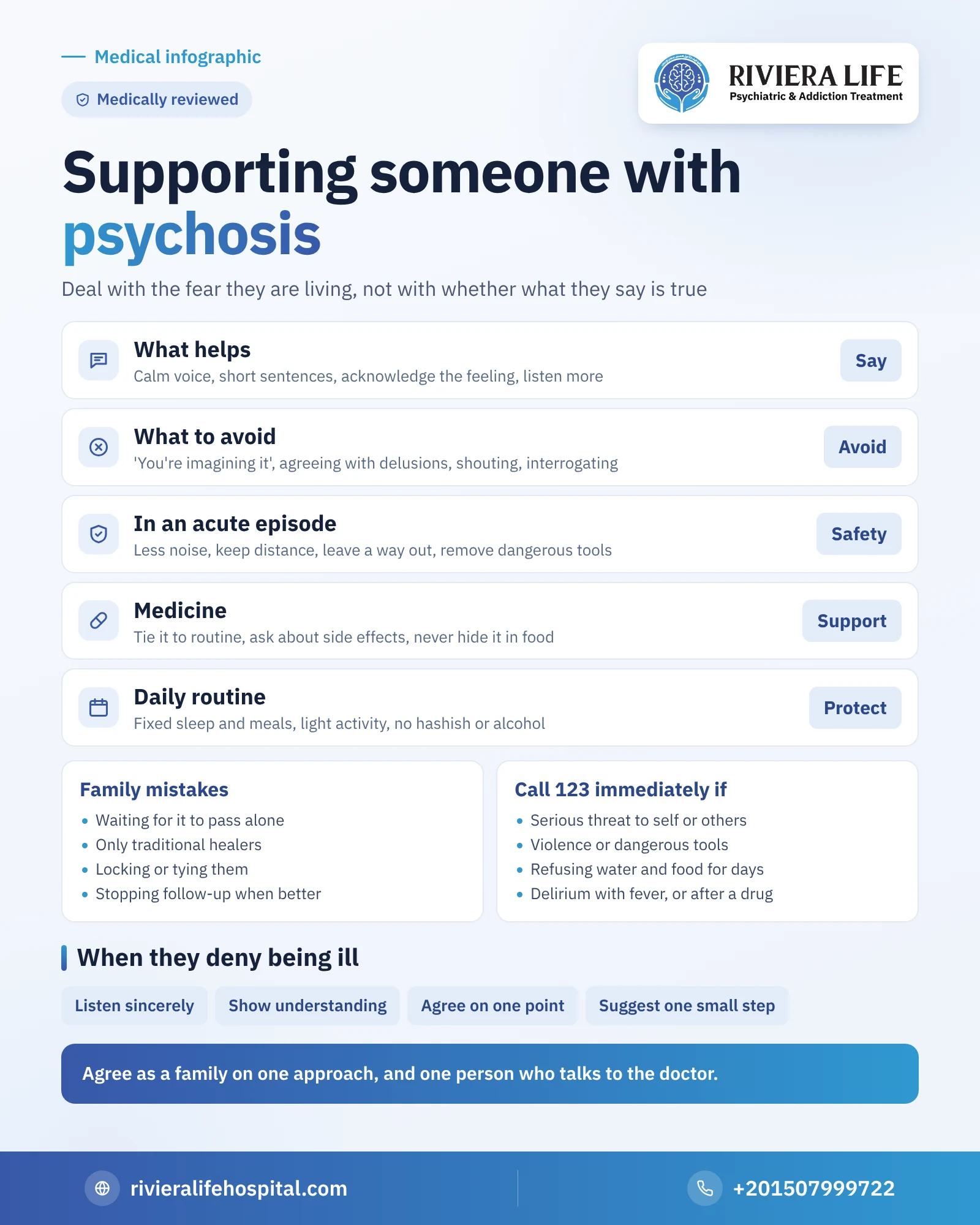
How to deal with someone with psychosis rests on a single rule from which the rest of the advice branches: deal with the fear they are living, not with whether what they say is true. A patient who hears voices or believes someone is plotting against them is living an experience that is real to them, and trying to prove them wrong makes them cling to it more and pushes them away from you. This article gives practical steps for the family: how to talk with them during an episode, what to say and what to avoid, how to help them with medicine, how to keep the home safe, when to call an ambulance, and how to protect yourself from burnout. This guidance is general; the doctor sets the plan for each case.
Start with understanding: what is the patient living?
In a psychotic episode, reality mixes with what the brain produces: voices no one else hears, suspicious thoughts that seem completely logical to them, scattered thinking and intense fear. Most patients don’t realize they are ill at that moment; this isn’t stubbornness but part of the illness, called lack of insight. If you understand this, your anger at them decreases and your capacity for patience grows. To learn the signs in more detail, you can read our complete guide to psychosis and the symptoms of hallucinations.
Words that help
- A calm voice and short sentences: one idea in each sentence, in a low, slow tone.
- Acknowledging the feeling without endorsing the idea: “I can see you’re afraid, and that’s a hard feeling”, instead of “no one is following you”.
- Honesty without argument: “I don’t hear what you hear, but I believe you hear it and that it frightens you.”
- Simple questions about needs: “What could make you feel more comfortable right now?”
- Listening more than talking: the patient calms down when they feel someone is listening.
Words to avoid
- “You’re imagining it” or “this is crazy”: it makes them feel insulted and breaks trust.
- Agreeing with the delusion so they “feel better”, which reinforces it and confuses them more when they discover the truth.
- Shouting, threats or mockery.
- Many questions in a row, or interrogation.
- Talking about them in their presence as if they weren’t there.
- Threatening hospital as a punishment, so the doctor becomes an enemy in their mind.
How do you act during an acute episode?
When the patient is frightened or agitated, the family’s priority is calm and safety:
- Lower the noise, the lighting and the crowd, and move children and visitors away.
- Keep a comfortable distance and don’t corner them or hold them except when absolutely necessary.
- Leave them a way out of the room, as someone cornered turns to attack.
- Remove tools that could hurt, and lock doors leading to dangerous places.
- Talk calmly and don’t argue among family members in front of them.
- Call the doctor or the hospital, and in danger call an ambulance.
Call an ambulance on 123 immediately if you see
Everyone's safety comes first, and don't try to deal with danger alone.
- A serious threat to harm themselves or others, or voices ordering them to
- Violence, breaking things, or holding dangerous tools
- Trying to go out into the street or to a dangerous place
- Refusing water and food for days
- Delirium with fever, or confusion after a drug
You can also ask for guidance from the hotline of the General Secretariat of Mental Health on 16328.
Medicine: how do you help without chasing?
Stopping medicine is one of the best-known causes of episodes returning, the subject of our article on psychosis relapse. The family’s role here is supportive, not policing:
- Tie the medicine to a fixed routine such as breakfast, and a weekly pill organizer that is easy to check.
- Ask kindly about side effects and tell the doctor about them, as silent stopping is usually caused by a troublesome effect that can be treated.
- Don’t hide the medicine in food, as this destroys trust if discovered; if the problem is strong refusal, ask the doctor about alternatives such as long-acting medicines.
- Don’t change, stop or add to the medicine yourselves; the decision is the doctor’s.
You can read more about these medicines in antipsychotics.
Daily life at home: a protective routine
Stability in the details of the day reduces tension and protects against episodes:
- Fixed times for sleep, meals and waking.
- Light activity such as walking, housework, prayer and hobbies, without pressure on performance.
- Staying completely away from hashish, alcohol and stimulants; for details see drug-induced psychosis.
- Less coffee, stimulating drinks and late nights.
- Small, clear tasks instead of big demands, with praise for every step.
The whole family needs a shared rule
The worst that can happen is for one family member to speak firmly, another with mockery, and a third agreeing with the patient’s delusions. Agree on one approach, and choose one person to communicate with the doctor. If the family criticizes the patient a lot and raises its voice, this environment itself may trigger relapse, and a therapist can train the family in calmer approaches. If the patient has young children, explain to them simply that their father or mother is ill and needs treatment, and that what they say isn’t because of them.
What about hospital admission if they refuse?
Some patients refuse treatment because they don’t see themselves as ill. Egypt’s mental health law regulates admission routes, including admission without the patient’s consent when there is danger to themselves or others, done inside a licensed hospital and according to set controls. Don’t try deceit or tricks to admit them, as honesty preserves their trust for after the acute stage. Ask the doctor or hospital for guidance on the correct steps, and try calmer solutions before that.
How do you protect yourself from burnout?
Accompanying someone with psychosis drains the nerves. Share caring among more than one person, take breaks, talk to people you trust, and ask about a family program, as family intervention is one of the approaches that has shown an effect in reducing relapses. If you feel severe anxiety, insomnia or persistent sadness, seek help for yourselves too; caring for the carer is part of caring for the patient.
When the patient denies being ill
The hardest thing families face is the sentence: “I’m not ill — you’re the ill ones.” Arguing here closes the door. Instead, try a four-step approach used by many therapists: listen sincerely to what they say, express your understanding of their feelings, agree with them on at least one point, such as sleep having got worse or anxiety having increased, then suggest a small step together, such as seeing the doctor to treat the insomnia.
A patient who sees that the family is on their side, not against them, is more able to accept help. It may take several attempts over days or weeks, so don’t give up at the first refusal.
Common mistakes families make with good intentions
- Waiting for them to “get better on their own” despite weeks passing since the change.
- Turning only to sheikhs or charlatans and delaying the doctor for months, which may cost the patient the chance of early recovery.
- Locking the patient in a room or tying them up, which increases fear and violence.
- Overprotecting and doing everything for them, so they lose their self-confidence.
- Talking about their illness in front of neighbors and relatives without need.
- Stopping follow-up when they improve.
What happens once they calm down?
After the episode passes, the patient may feel ashamed or afraid of what they said or did. Don’t remind them of what happened with blame; talk about the future: what helped them, what bothered them, and what they want people to do if the signs return. This calm conversation can become a written plan with the doctor. For families thinking about life decisions such as marriage there is our article on psychosis and marriage, and for the full treatment, psychosis treatment.
How can Riviera Life help you?
At Riviera Life, consultants in psychiatry and addiction guide the family from the first call to the safest way of dealing with the situation, and provide round-the-clock medical supervision when a stay is needed, a family program, aftercare and complete confidentiality. The first consultation is free, and you can contact us on +201507999722.
More from our psychosis guide
- Psychosis: the complete guide
- Psychosis relapse
- The behavior of a person with mental illness
- Psychosis treatment
Questions many people ask
No, agreeing reinforces the delusion. Acknowledge their fear and say you don't see it as they do, but you believe it frightens them.
Ask about the reason, as it may be a side effect, tell the doctor, and ask about alternatives such as long-acting medicines; don't adjust the medicine yourself.
When the patient threatens themselves or others, is violent, refuses food and water for days, or is severely confused with fever or after a drug.
Egypt's mental health law regulates this when there is danger, and it is done inside a licensed hospital; ask the doctor about the correct procedure instead of deceiving them.
Share caring among family members, take breaks, ask about a family program, and seek help for yourself if persistent anxiety or insomnia appears.