The short answer
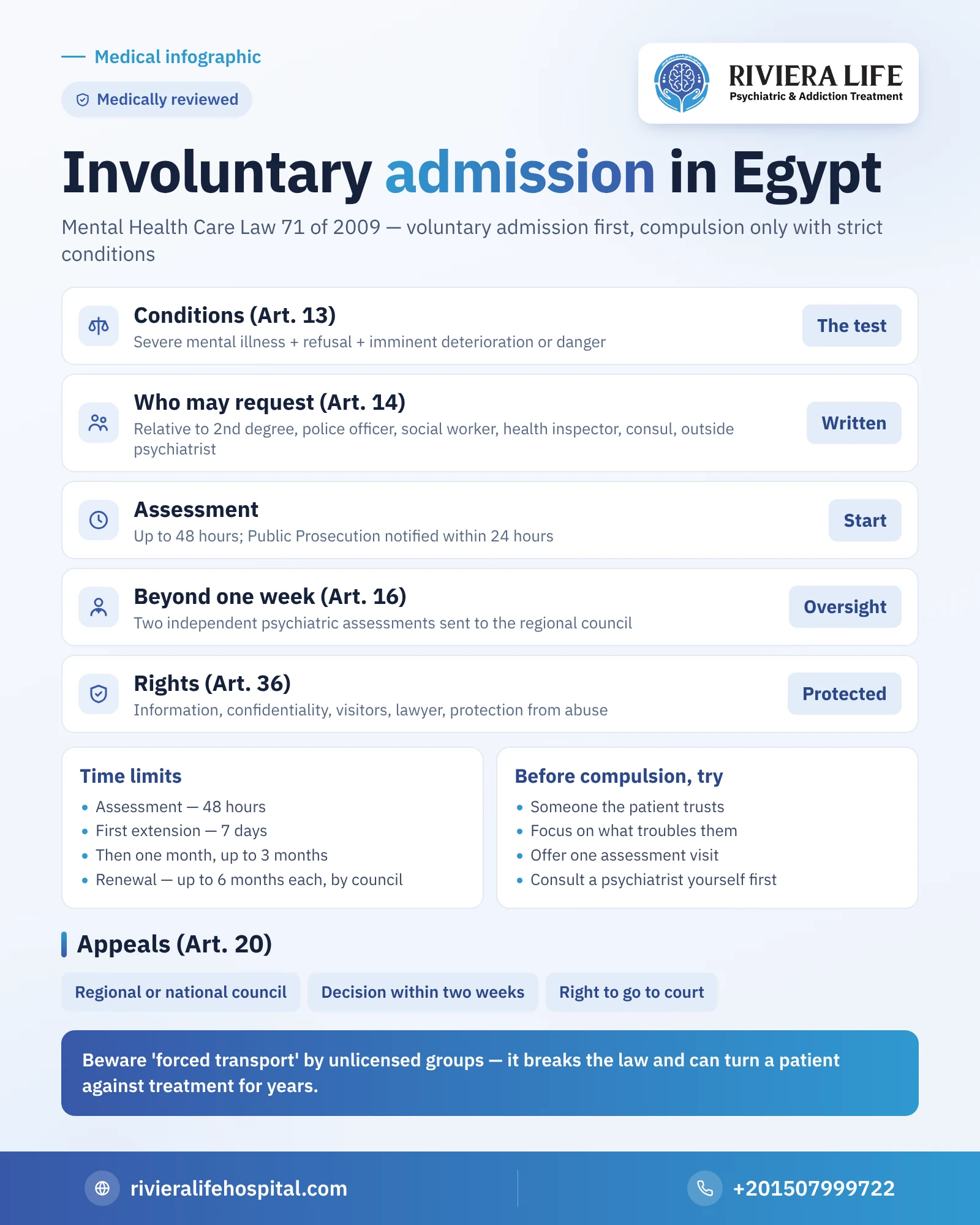
Egypt’s Mental Health Care Law No. 71 of 2009 allows a patient to be admitted to hospital without their consent in only two situations: having a severe mental illness with a likely severe and imminent deterioration, or having symptoms that pose a serious, imminent threat to their own safety or the safety of others, while refusing admission. It begins with an assessment of up to 48 hours at the written request of a relative up to the second degree or others specified by the law, the Public Prosecution is notified within 24 hours, and any continuation beyond a week needs two independent assessments sent to the regional mental health council. The patient has protected rights, including appeal, confidentiality and contact with their lawyer.
- The lawMental Health Care Law 71 of 2009
- The startAssessment of up to 48 hours on a written request
- OversightThe Public Prosecution and the regional mental health council
One of the hardest moments for any family is seeing their son or husband hearing voices no one else hears, stopping eating and sleeping, or threatening to harm himself, and then refusing with all his strength to see a doctor. This is when the search begins for “admitting a psychiatric patient” and “the conditions for entering a psychiatric clinic”, and conflicting advice multiplies, some of it dangerous. This article explains what Egyptian law actually says, how the procedures run step by step, what the patient’s rights are, and what the family should try before turning to compulsion.
Note: this is a simplified explanation of the law’s provisions for awareness purposes, not legal advice. Some articles may have amendments or details in the executive regulations, so ask a lawyer or the licensed facility about your case.
Voluntary admission first: always the better path
The law makes voluntary admission the norm. Article 10 gives every psychiatric patient aged eighteen or over the right to request admission without anyone’s consent, and the right to request discharge at any time, unless the conditions for involuntary admission apply. Their family is informed of their admission if they agree. Even with voluntary admission, Article 11 allows the responsible psychiatrist to keep the patient for up to 72 hours if they request discharge and pose a serious, imminent danger to themselves or others, or are unable to care for themselves, and during this time no non-emergency treatment is given without their consent.
Why do we start with this? Because a patient who is admitted convinced, even partly, sticks to treatment after discharge far more than one admitted against their will. The effort the family puts into persuasion isn’t wasted time.
When does the law allow involuntary admission?
Article 13 requires, for a patient to be admitted against their will, clear signs of a severe mental illness that requires treatment in a facility, and that the patient refuses admission, together with one of two situations:
- The likelihood of a severe and imminent deterioration in their condition if not treated.
- Symptoms that pose a serious, imminent threat to their safety, health or life, or to the safety of others.
In practice this means that refusal alone isn’t enough, nor is a family dispute or annoying “strange” behavior. There must be a severe mental illness and imminent danger or deterioration, and a psychiatrist decides this. Common examples include acute psychosis with dangerous behavior, severe depression with suicidal thoughts and refusing food, or a manic episode in which the patient loses their money or puts themselves in danger. The details of these pictures are in the behavior of someone with a mental illness.
Who has the right to request admission for assessment?
Article 14 provides that the request is made in writing by one of the following:
- A relative of the patient up to the second degree.
- An officer of the police station.
- The competent social worker for the area.
- The competent health inspector.
- The consul of the patient’s country if they are a foreigner.
- A psychiatrist from outside the facility, with no kinship up to the second degree to the patient or the facility’s director.
Based on the request, a doctor in the facility, even if not a psychiatrist, may admit the patient for assessment for up to 48 hours.
The steps of involuntary admission from assessment to decision
1. Notifications within 24 hours
Article 13 requires notifying the family, the facility’s director, the social service office for the patient’s place of residence, and the national or regional mental health council within 24 hours, with a report on the patient’s condition. Article 14 requires notifying the Public Prosecution within 24 hours of admission for assessment.
2. Assessment of up to 48 hours
The responsible psychiatrist examines the patient. If the reasons for compulsion end before the period expires, they may cancel the involuntary admission, informing the patient, the family and the authorities concerned.
3. Keeping the patient for up to a week
Article 15 allows the responsible psychiatrist to extend the admission up to seven days if the reasons continue.
4. Beyond a week: two independent assessments
Article 16 requires, for continuation beyond a week, assessments by two psychiatrists registered with the regional council, one from outside the facility, not working for the same body, and the two reports are sent to the regional council within seven days. If these steps aren’t followed, the involuntary admission ends.
5. Longer periods
According to Article 19, the stay can be extended for a month to complete the assessment or begin treatment, then up to three months after notifying the regional council; after that, renewal only happens by decision of the council after reassessment, for periods of up to six months each time.
| Stage | Maximum period | Key condition |
|---|---|---|
| Admission for assessment | 48 hours | A written request from the specified parties, and notifying the Prosecution within 24 hours |
| First extension | 7 days | The reasons continue, by decision of the responsible psychiatrist |
| Beyond a week | One month, then up to 3 months | Two independent assessments and notifying the regional council |
| Renewal | Up to 6 months each time | A decision by the regional council after reassessment |
The patient’s rights inside the hospital
Involuntary admission doesn’t strip the patient of their rights. Article 36 sets out a number of them, most notably:
- Decent care in a safe, clean environment.
- Knowing the name and role of every member of the treatment team caring for them.
- Full information about their diagnosis, the proposed treatment and the expected course of their condition.
- Confidentiality of information about them and their medical file, except in exceptional cases set by the law.
- Protection of their privacy and personal belongings.
- Receiving or refusing visitors, unless this conflicts with the treatment plan.
- Meeting their lawyer.
- Protection from exploitation, physical and psychological abuse, and degrading treatment.
Article 37 requires the facility to give the patient a copy of their rights on admission and to post it in a visible place. Article 38 requires every facility to have a patients’ rights committee that receives complaints.
Is treatment given against the patient’s will?
In principle, the patient is informed of any treatment, its purpose, side effects and alternatives, under Article 28. The law allows an involuntarily admitted patient to be required to take treatment if they refuse it, after following specific procedures that are reviewed at least every four weeks, with an independent assessment if the compulsion exceeds three months. In a genuine emergency, treatment may be given without consent for up to 72 hours. As for sessions that regulate brain rhythm with electricity, Article 30 requires them to be done under general anesthesia with written consent, and they are only imposed on a refusing patient after an independent assessment. Their medical details are in electroconvulsive therapy.
How can the patient or family object?
Article 20 gives the patient, their lawyer or their family the right to appeal to the regional or national mental health council, which must decide on the complaint within two weeks, while the right to go to court remains. The courts also have jurisdiction over disputes about admission decisions, after taking the opinion of the regional council and the Prosecution. This means that both the family requesting admission and the patient objecting to it are protected by oversight outside the facility itself.
What about someone with addiction?
If the reason is addiction without a severe mental illness, it is handled differently, as explained in our article on treating an addict against their will. But if psychosis appears because of stimulants or hashish, or acute depression with suicidal thoughts during withdrawal, the conditions of this law may apply. In these cases the patient needs a facility that treats addiction and mental illness together; the details of substance-induced psychosis are in drug-induced psychosis.
Before compulsion: attempts worth trying
- Choose the person the patient trusts most to talk with them, away from arguing about “are you ill or not”.
- Focus on what bothers them: insomnia, fear or work problems, and suggest the doctor as a solution for them.
- Offer a single visit for assessment instead of talking about a hospital admission.
- Consult a psychiatrist on your own first; many doctors agree to meet the family and suggest an approach.
- If the patient was previously followed and stopped their medicine, contacting their former doctor is a quick, important step.
Broader details are in our guide on how the family can deal with a psychiatric patient, and in our guide to dealing with someone with psychosis if there are hallucinations or delusions.
What should you do at the moment of danger?
If the patient is trying to harm themselves or others now, don’t wait for the procedures. Call an ambulance on 123, move sharp tools and medicines out of reach, and don’t try to restrain them yourself or with the neighbors’ help, as this puts everyone at risk of injury. If it comes to violence, calling the police is legitimate, and the police station officer is among those entitled to request an assessment under the law.
Beware of “forced transport” by unlicensed groups
Adverts are widespread for centers offering to “transport the patient from home” with a team that restrains and takes them, without a psychiatrist, an assessment or notifying any authority. These practices break the law, and expose the patient to physical and psychological harm that may make them refuse treatment for years afterwards. A licensed facility follows the procedures we have explained, notifies the competent authorities, and gives the patient a copy of their rights. If none of this happens, ask why.
The practical side of getting the patient to hospital, and when the situation is an emergency that calls for an ambulance first, is in transporting the patient to hospital safely.
How can Riviera Life help you?
Riviera Life’s psychiatry team explains to the family the options available for their patient’s condition, from attempts at persuasion and assessment in the clinic to admission for treatment and the procedures the law requires, with a program that treats addiction and mental illness together when needed. The first consultation is free and confidential on +201507999722.
Read also
- Is a person with mental illness responsible for their actions?
- Psychiatric hospital prices in Egypt and how to choose
- Schizophrenia symptoms: early signs and when to seek help
- Mental health: the complete guide
Questions many people ask
In principle yes, but the psychiatrist may keep them for up to 72 hours if they pose a serious, imminent danger to themselves or others or are unable to care for themselves, and it may become an involuntary admission if its conditions are met.
Yes. If the reasons for the compulsion no longer apply, the responsible psychiatrist cancels it and informs the patient, the family and the authorities; the periods in the law are maximums, not mandatory durations.
Yes. The law requires the matter to be referred to the Public Prosecution within 24 hours of admission for assessment, alongside notifying the regional mental health council and the family.
Yes. Among the rights set out in Article 36 is meeting their lawyer, as well as receiving visitors unless this conflicts with the treatment plan, and appealing to the regional or national council.
No. The law requires a severe mental illness with imminent deterioration or a serious, imminent danger to the patient or others, decided by a psychiatrist; refusal alone or a family dispute isn't enough.