Stress urticaria is a raised, intensely itchy rash resembling insect bites that appears or worsens when a person goes through psychological pressure, anxiety or shock, then disappears within hours only to appear somewhere else. Stress in this case doesn’t usually create urticaria out of nothing, but it triggers it or prolongs it in many people. This article explains how that happens, how to tell transient from chronic urticaria, when a rash is an emergency that needs an ambulance, and how the dermatologist and psychiatrist work together to treat it.
What is urticaria, and why is it called “psychological”?
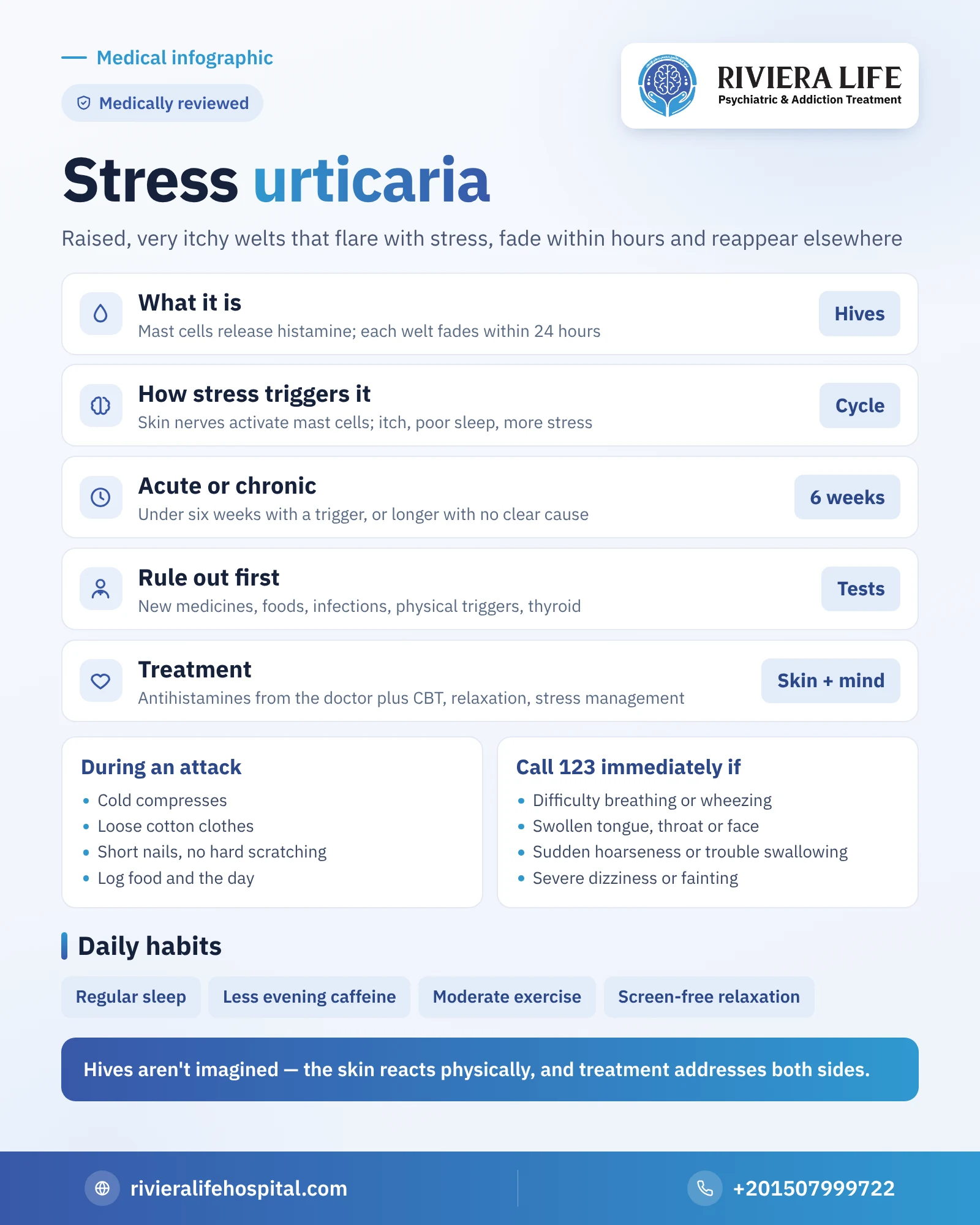
Urticaria, which people call hives or nettle rash, happens when cells in the skin called mast cells release histamine, so fluid leaks under the skin and swollen red or pale patches appear that itch intensely. Each patch usually lasts less than twenty-four hours and then fades without a mark, but the rash renews itself.
Urticaria is called “psychological” when stress is the clearest factor in its appearance. It is more accurate to say it is urticaria affected by the psychological state, as medical diagnosis doesn’t treat “psychogenic urticaria” as a disease in its own right, but the clinical reality is clear: many people notice the rash comes after the difficult weeks.
How does stress wake up the itch?
The skin and the nervous system develop from the same embryonic tissue, which is why the skin is quickly affected by what a person feels. Under stress, skin nerves release substances that activate mast cells, and stress hormones rise and change the immune response. The result is skin more ready to release histamine at the slightest stimulus. Then comes the familiar cycle: itching deprives you of sleep, lack of sleep raises tension, and tension increases the rash. We described the mechanism of stress and its effect on the body in our article on psychological stress.
What does the rash look like, and how does it differ from others?
| Feature | Urticaria | Similar conditions |
|---|---|---|
| Duration of a single patch | Fades within hours, usually before a full day | Eczema and contact allergy last for days and peel |
| Shape | Swollen red or pale patches with changing borders | Psoriasis has fixed silvery scales |
| Moving around | Appears and disappears in different places | Skin infections stay in one place |
| Mark after fading | Leaves no scar or discoloration | Vascular inflammation leaves bruises |
It may be accompanied by swelling of the lips, eyelids or hands called angioedema, which deserves attention, as we will see shortly.
Acute or chronic? The division that changes the story
Urticaria lasting less than six weeks is called acute, and its best-known causes are viral infections, foods, medicines and insect bites. Urticaria that keeps recurring for more than six weeks is called chronic, and in most cases no specific external cause is found. Here there is more talk of the role of autoimmunity and psychological stress. It varies from patient to patient, and some chronic cases settle gradually over months or years, which is reassuring but doesn’t mean waiting without treatment.
When is urticaria an emergency?
Call an ambulance on 123 immediately if the rash comes with
These may be signs of a severe allergic reaction (anaphylaxis) that needs immediate intervention.
- Difficulty breathing or wheezing in the chest
- Swelling of the tongue, throat or face
- Sudden hoarseness or difficulty swallowing
- Severe dizziness, fainting, or pallor and coldness
- Vomiting and severe abdominal pain appearing with the rash
Psychological stress alone doesn’t cause these symptoms, so never assume they are “from nerves”. Any rash accompanied by shortness of breath is an urgent medical condition until proven otherwise.
Tests that should come before explaining it as psychological
Before the rash is attributed to stress, the dermatologist or allergist reviews your history: new medicines including painkillers, foods, recent infections, and whether the rash appears with heat or cold, pressure on the skin, friction or sun. They may request blood tests including the thyroid, as thyroid disorders are sometimes linked to chronic urticaria. What matters is that physical causes are searched for seriously before talking about the mind, and then the psychological picture is looked at alongside them, not instead of them.
What should you do during an attack?
- Use cold compresses on the area, as coolness calms the itch for most people, unless the rash is caused by cold itself.
- Wear loose cotton clothing, and avoid extreme heat and hot showers.
- Keep your nails short and avoid hard scratching, because it irritates the skin and prolongs the cycle.
- Write down what you ate and what happened in your day, as a link may appear that helps the doctor.
- Don’t take antihistamines or cortisone repeatedly on your own; the doctor decides the type and duration.
Treatment: skin and mind in one plan
The foundation of medical treatment is antihistamine medicines set by the doctor, and in stubborn cases specialized treatments may be used, prescribed after assessment. That is the skin side. The psychological side includes:
- Assessing anxiety and depression: if they are clearly present, treating them eases the frequency of attacks in some patients.
- Cognitive behavioral therapy: teaches the patient how to break the cycle of tension and itching, and how to deal with the thoughts that accompany an attack.
- Relaxation and breathing training: lowers the body’s stress response and improves sleep.
- Stress management: rearranging the load at work and at home as far as possible, and setting aside time for rest.
If the urticaria coincides with health anxiety that drives repeated tests, read illness anxiety disorder. For the general picture of symptoms affected by the mind, see psychosomatic disorders.
Who is more likely to have skin affected by stress?
There is no single picture, but clinical observations recur in certain groups: women in young and middle adulthood, those with chronic anxiety or insomnia, those who have been through a recent loss or trauma, and people working under continuous pressure without breaks to rest. In some of them the rash appears during exam days, before travel or after a sharp argument, so they start to link the two moments. In children, urticaria may appear with infections more than with stress, but anxiety may prolong it, so attention to the child’s sleep and a calm home helps alongside the doctor’s treatment.
Daily habits that reduce the frequency of attacks
- Regular sleep at a fixed time, as sleep deprivation raises sensitivity to itching.
- Less caffeine and stimulants in the evening, as they raise tension and delay sleep.
- Moderate physical activity such as walking, because it lowers stress hormones.
- Watching for personal triggers: heat, friction from tight clothes, heavy sweating.
- A short daily space for relaxation without screens.
Is urticaria a mental illness? And what if no one believes me?
No, it isn’t a mental illness, and the effect of stress doesn’t mean the patient is imagining or inventing the itch. The skin reacts physically, and the rash can be seen. It is painful for a patient to hear “you’re just stressed”. The right approach is to treat both together: serious skin treatment, and psychological support that eases the triggers. If the itching has damaged your sleep, work and relationships, that is reason enough to seek psychological help without embarrassment; you may find details on when to seek a consultation in when to see a psychiatrist.
How can Riviera Life help you?
If your urticaria is linked to anxiety, depression or ongoing stress, Riviera Life’s consultant psychiatrists can assess the psychological side and build a treatment plan that works alongside the skin treatment from your doctor. The first consultation is free and confidential on +201507999722.
More from our psychosomatic disorders guide
- Psychosomatic disorders: when the body speaks
- Psychological stress and its effect on the body
- Illness anxiety disorder: when worry about health takes over
- Anxiety: the complete guide
Questions many people ask
Stress can trigger them or make them last longer in many people, but it isn't the only cause, which is why the doctor first looks for other causes such as infections, medicines and the thyroid.
Usually less than twenty-four hours, then it fades without a mark, but new patches may appear in other places.
When there is difficulty breathing, swelling of the tongue or throat, or severe dizziness: call an ambulance on 123 immediately.
Acute hives last less than six weeks and often have a clear trigger, while chronic hives go beyond that, and in most cases no specific cause is found.
It may ease attacks in people whose rash is linked to stress, because it treats the accompanying anxiety, sleep and thinking, but it is used alongside skin treatment, not instead of it.