Illness anxiety is a psychological disorder in which the person lives with a constant fear that they have or will get a serious illness, even though the tests are normal or the symptoms are minor. It isn’t about acting or “being spoiled” as some think; the suffering is real, and the person spends hours checking their body, searching for symptoms online and visiting doctors, then only calms down a little.
The good news is that cognitive behavioral therapy is very effective with this condition. In this article we explain how the cycle of health anxiety works, why a normal result isn’t enough, the difference between it and obsessive-compulsive disorder and panic attacks, and how the doctor and family deal with the person.
What is illness anxiety?
The old name was “hypochondria”, while the modern American classification of psychiatric disorders divided it into two conditions. The first is illness anxiety disorder: physical symptoms are few or absent, and the main problem is intense fear of having a serious illness and constant preoccupation with it for at least six months. The second is somatic symptom disorder: real, bothersome symptoms such as pain or fatigue, but the thinking about them, worry over them and time spent on them are much greater than their size justifies.
In both conditions the illness the person fears is usually specific: cancer, a clot, multiple sclerosis or a heart disease. And the fear may move from one illness to another after each normal test. Illness anxiety is considered close to the family of anxiety disorders in the way it works and is treated.
What does illness anxiety look like from inside?
Imagine a man in his forties who felt a twinge in his chest while climbing the stairs. He checked his pulse several times, then read about the symptoms of a heart attack until dawn, and went in the morning for an ECG that came back normal. He felt relieved for two days, then noticed his left arm was “a bit heavy”, so the fear came back again. Among the common signs:
- Interpreting ordinary body sensations, such as headache, heart palpitations or tingling in the limbs, as a sign of catastrophe.
- Checking the body repeatedly: feeling the lymph nodes, measuring blood pressure several times a day, or looking at the throat in the mirror.
- Repeatedly asking those close: “Does my color look pale? Do you think this is normal?”.
- Avoiding hospitals or news of illnesses in some, in contrast to excessive testing in others.
- Anxiety that sometimes extends to the health of the children or spouse.
The cycle of checking and seeking reassurance: why isn’t a normal result enough?
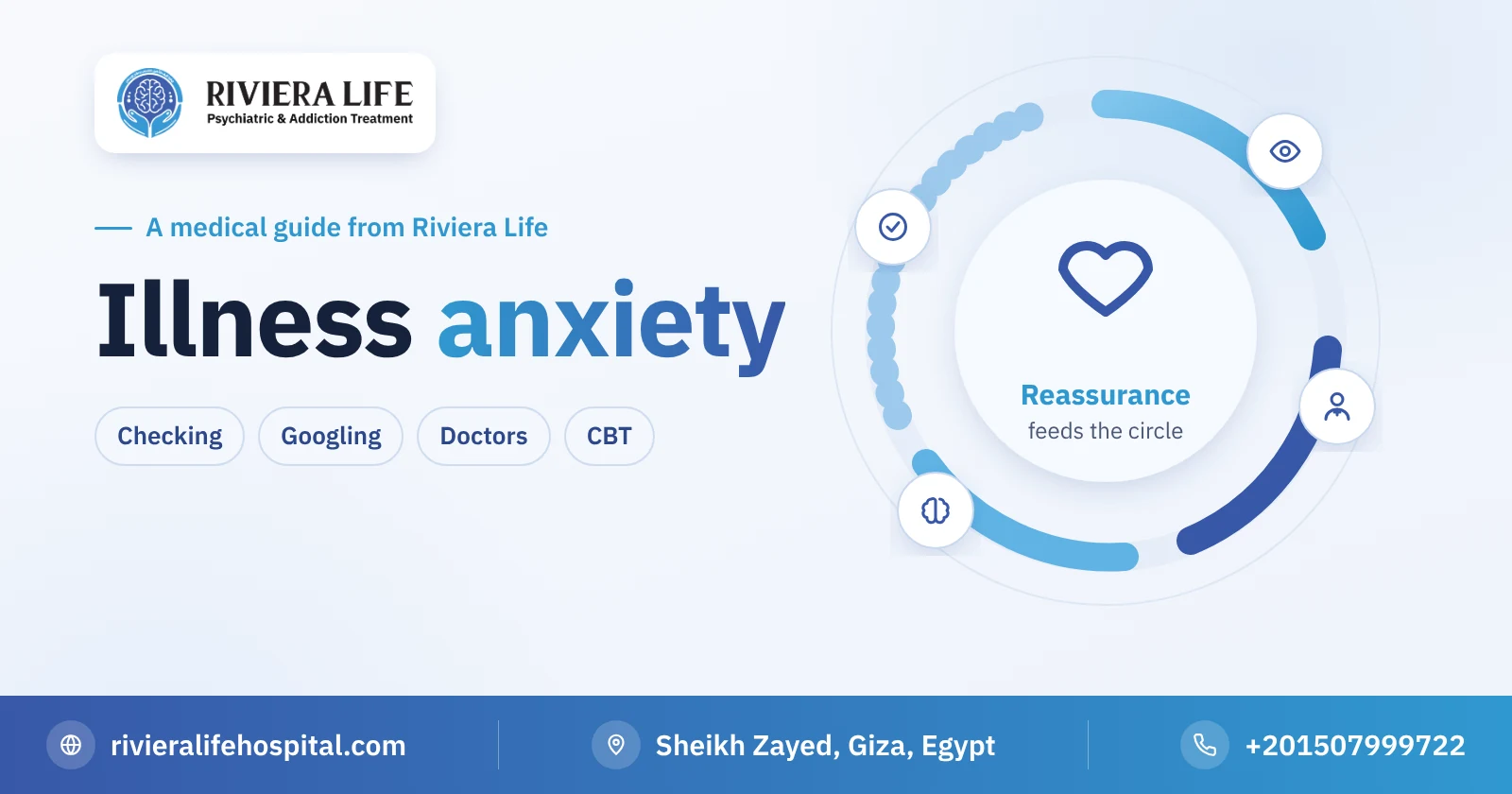
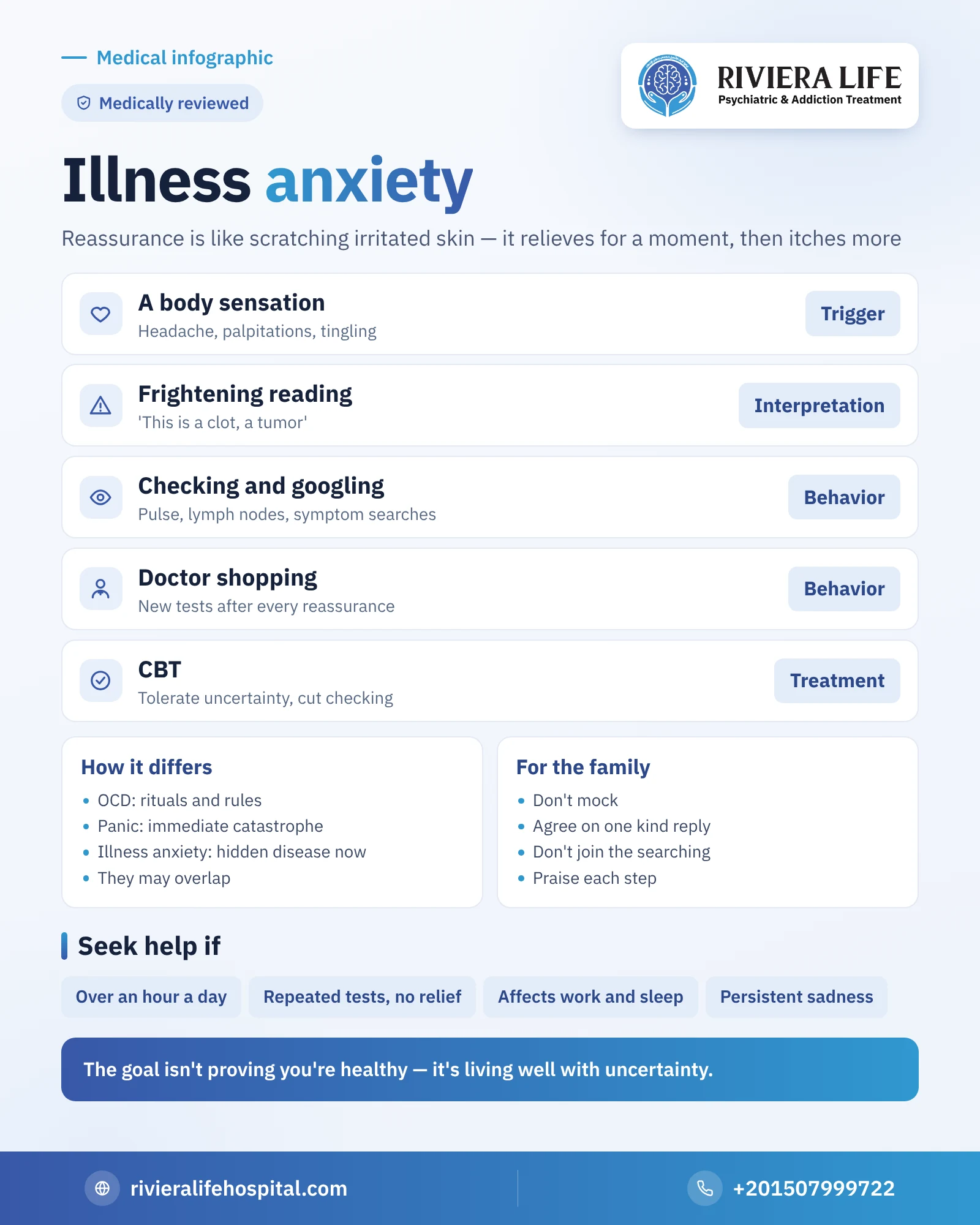
This is the heart of the problem. A body sensation happens, the mind interprets it in a frightening way, anxiety rises, so the person does something that reassures them: checking, searching, asking or visiting a doctor. The anxiety calms a little, and this calm teaches the brain that checking is the way to safety, so it goes back to it faster at the next sensation. Worse, anxiety itself creates physical symptoms, such as palpitations, muscle tension and stomach upset, so the cycle feeds from within.
A normal result is usually met with doubt: “maybe the lab made a mistake”, “maybe the illness is at a stage that doesn’t show in the test”. That is why therapists say that reassurance in illness anxiety is like scratching irritated skin; it relieves for a moment and increases the itch afterwards.
Searching for symptoms online
Search engines don’t know who you are or how old you are, and show rare possibilities side by side with common ones. Search for “headache behind the eye” and you will find fatigue and old glasses, but the eye of anxiety will stop at a brain tumor alone. And with each search the person learns names of new symptoms that they start to watch for. Some researchers call this phenomenon “cyberchondria”. Treatment here doesn’t mean banning the internet completely, but setting clear limits on it within a treatment plan, as we will see.
Moving between doctors and repeated tests
Some patients visit more than one doctor for the same complaint within weeks, and ask for new scans and tests after each reassurance. This pattern has a price: a large financial cost, repeated radiation exposure in some tests, and the discovery of incidental findings of no value that open a new door for anxiety and testing. On the other hand, some patients may avoid the doctor completely for fear of hearing bad news, so the detection of a real problem is delayed. The balance needed is regular medical follow-up with one doctor, not chasing reassurance.
Illness anxiety, obsessive-compulsive disorder and panic attacks: where is the difference?
| Condition | Focus of fear | What the person does |
|---|---|---|
| Illness anxiety | That they have a serious undiscovered illness now | Checking the body, searching and visiting doctors |
| Obsessive-compulsive disorder | Intrusive thoughts usually about infection, contamination or harm | Specific rituals such as washing and checking with strict rules |
| Panic attacks | An immediate catastrophe during the attack: death or losing control | Escape or calling an ambulance, then avoiding places of attacks |
The boundaries aren’t always sharp. Someone who fears catching an infection and washes their hands with strict rituals is closer to contamination OCD, and someone who reads their heart palpitations as an imminent heart attack may suffer from panic attacks. And both may come together with illness anxiety in the same person, and the doctor distinguishes them through assessment.
Why do some develop illness anxiety?
There is no single cause, but some factors recur: a serious illness in childhood or in a parent, the sudden death of a relative or friend, an upbringing that focuses heavily on health danger, or a general tendency to anxiety and difficulty tolerating uncertainty. The disorder often starts or intensifies after great pressure or after reading about an illness that affected a famous person. And it often overlaps with other causes of anxiety and depression.
Cognitive behavioral therapy for illness anxiety
It is the first treatment, and studies show clear improvement in a large proportion of those who complete it. The therapist doesn’t try to convince you that you are healthy, as that is another reassurance, but helps you change your relationship with the fear itself:
- Drawing your own cycle: which sensations set off the anxiety? And which actions keep it alive?
- Reducing checking and searching gradually: from measuring blood pressure ten times to once, then to the appointments agreed with the doctor.
- Behavioral experiments: such as focusing on a part of the body for two minutes to notice how attention alone creates new sensations.
- Exposure: reading the word “cancer” or visiting a hospital without checking or searching afterwards, until the brain learns that anxiety calms on its own.
- Tolerating uncertainty: no one has a complete guarantee of their health, and the goal is to live well with this possibility.
You will find details of this treatment method in the article on cognitive behavioral therapy.
Are medicines used?
In severe cases, or when illness anxiety is accompanied by depression or generalized anxiety, the doctor may prescribe an antidepressant from the selective serotonin reuptake inhibitor class, a class that doesn’t cause addiction and whose effect appears within weeks. The doctor decides the medicine and its duration, and it isn’t stopped except with them.
How does the doctor deal with an illness anxiety patient?
The most successful thing an internist or family doctor does is to be a fixed reference: regular appointments set in advance instead of emergency visits, a calm clinical examination, and avoiding ordering tests the examination doesn’t justify, with a clear explanation of what the symptoms mean. Most importantly, they shouldn’t tell the patient “there’s nothing wrong with you”, as this pushes them to another doctor; rather they acknowledge their suffering and refer them to the psychiatrist as a treatment step, not an accusation.
How does the family deal with someone with illness anxiety?
- Don’t mock them or say “it’s all in your head”; the psychological pain is real.
- Don’t answer the same repeated question dozens of times. Agree in advance on one friendly reply: “We agree this is a question for the anxiety, let’s do something else”.
- Don’t share searching online with them or accompany them on rounds of doctors outside the plan.
- Praise any step in which they bear the anxiety without checking.
- Encourage them gently towards treatment, and take part in a session with the therapist if possible.
When do you ask for help?
If worry about your health takes more than an hour a day, or you have started visiting doctors and doing tests repeatedly without being reassured, or the matter has started affecting your work, relationships and sleep, this is a suitable time for a psychiatric assessment. It becomes more urgent if continuing sadness or loss of hope appears. At Riviera Life the consultant psychiatrists assess the case and set a cognitive behavioral treatment plan that suits you, in complete confidentiality, and the first consultation is free via +201507999722.
More from the anxiety guide
- Anxiety: the complete guide
- Panic attacks: how to tell them from a heart attack
- Types of anxiety: the main disorders and the differences between them
- Overthinking: rumination, anxiety and techniques to stop it
- Factitious disorder: when illness is fabricated and why?
- Psychological IBS: how anxiety moves the bowel and what calms it?
Questions many people ask
No, they feel real and painful anxiety, and may feel actual physical symptoms created by the anxiety itself. The problem is in interpreting the symptoms and being preoccupied with them, not in inventing them.
Because reassurance eases anxiety temporarily then strengthens the need for it, so a new doubt or another symptom appears. Treatment teaches you to tolerate uncertainty instead of chasing reassurance.
Many improve clearly with cognitive behavioral therapy, and medicine may be added in some cases. Symptoms may return at times of pressure, but the skills gained help control them.
No, what is needed is regular follow-up with one doctor at agreed appointments, while avoiding repeated visits and tests that the examination doesn't justify.
In illness anxiety the symptoms are few or absent and fear of illness is the core. In somatic symptom disorder there are real, bothersome symptoms but preoccupation with them exceeds their size.