Mixing drugs, meaning using two or more substances at the same time or within a short period, is one of the most common causes of substance-related death. Substances don’t accumulate in the body like numbers being added, but interact: some multiply each other’s effect on breathing, and some hide the danger signs until it is too late. In Egypt, combinations such as tramadol with hashish, pregabalin with tramadol, and sedatives with alcohol are widespread, and many think they are “normal”. This article explains why combinations become deadly, the most dangerous of them, the emergency signs, and how addiction to more than one substance is treated.
What is meant by mixing drugs?
Doctors call this pattern “polysubstance use”. It takes several forms: someone who deliberately combines two substances to get a stronger effect, or takes a substance to ease the effects of another, like someone who takes a sleeping pill to come down from a stimulant. Mixing may also happen unintentionally, when a counterfeit pill contains a substance the user didn’t expect, or when someone drinks alcohol while taking a prescribed sedating medicine.
And mixing isn’t an exception among users, but almost the rule for many of them. That is why it isn’t enough to ask “what substance does he use?”, but “what are all the substances?”.
Why is mixing more dangerous than each substance alone?
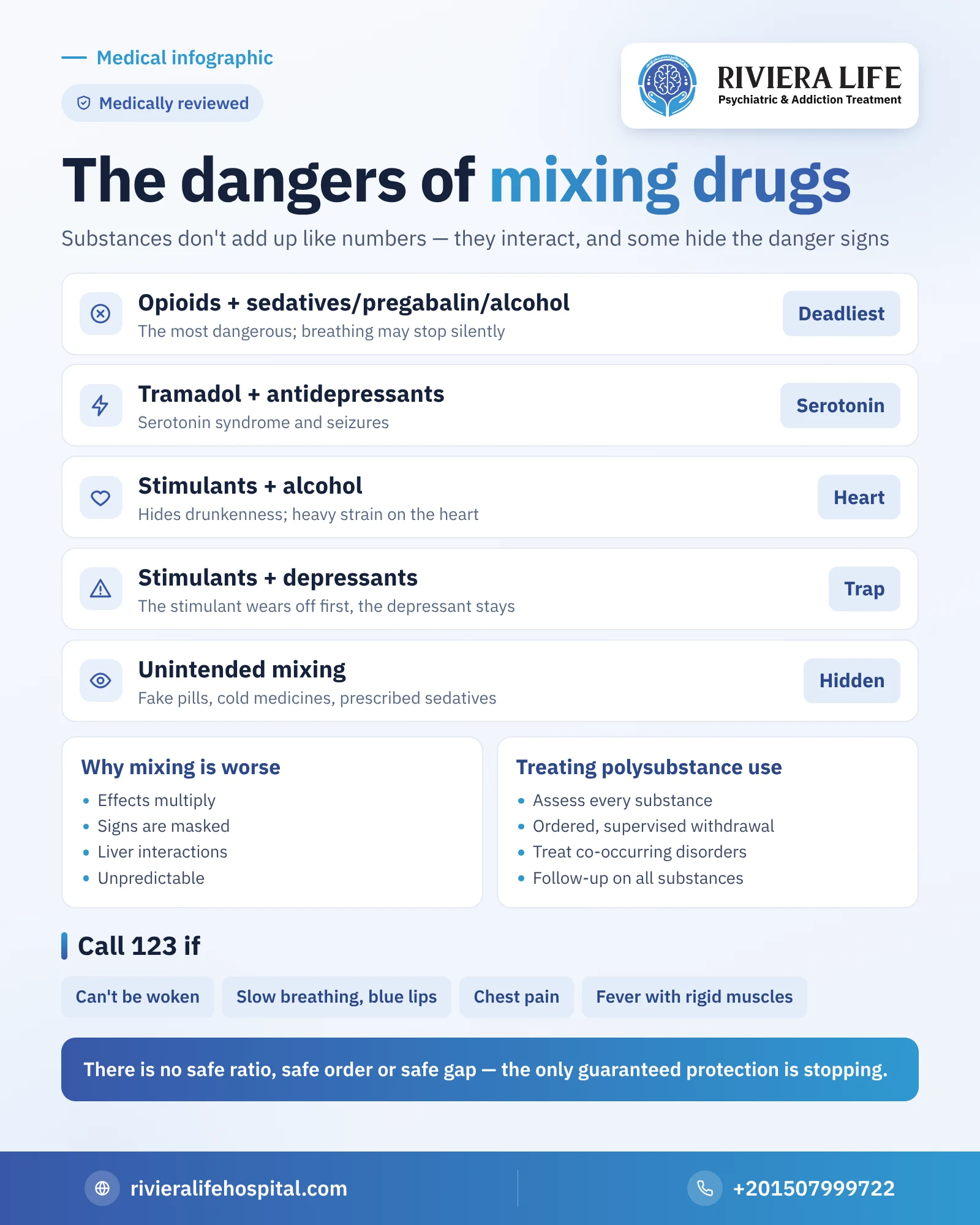
- Multiplied effect: two substances that slow breathing together may depress it much more than each does alone.
- Masking signs: the stimulant covers the drowsiness caused by the depressant, so the person feels “fine” and increases the amount, then the stimulant wears off first and the depressant remains alone in a large amount.
- Interaction in the liver: some substances slow the breakdown of others, so their blood concentration rises without the user taking anything more.
- Unpredictability: the response differs from person to person and from day to day, so there is no fixed formula.
Opioids with sedatives, pregabalin or alcohol
This is the most dangerous combination of all, and the best-known cause of stopped breathing. Opioids, including tramadol, heroin, codeine and nalbuphine, depress the breathing center in the brain. Sedatives such as Rivotril and Xanax, pregabalin and alcohol do the same thing by a different route. When they come together, the person may sleep deeply and then his breathing stops without any noise.
Major medicines agencies have warned against combining opioid painkillers and benzodiazepines because of the risk of death, and have also warned of a similar risk to breathing when combining pregabalin or gabapentin with opioids. For those who combine pregabalin with drinking specifically, our article on pregabalin and alcohol explains this relationship in detail, and you will find the harms of sedatives themselves in the harms of benzodiazepines.
Tramadol with antidepressants: serotonin and seizures
Tramadol isn’t an ordinary opioid; it also raises serotonin and lowers the seizure threshold. That is why combining it with some antidepressants or other medicines that raise serotonin may cause a condition called serotonin syndrome: tremor, muscle spasms, high temperature, sweating, agitation and diarrhea. Severe cases are a medical emergency, explained in our article on serotonin syndrome.
And if you take a prescribed antidepressant, don’t stop it suddenly out of fear of this interaction. Tell your doctor honestly about everything you use, and he decides what needs adjusting.
Stimulants with alcohol: a heart under double pressure
Many combine cocaine, Captagon or ice with alcohol “to last” longer. The stimulant hides the feeling of drunkenness, so drinking continues to a level that may cause alcohol poisoning. With cocaine specifically, a new compound forms in the liver from the two substances together, which stays longer in the body and is linked to a higher risk to the heart.
The possible result: palpitations, a sharp rise in blood pressure, heart rhythm disturbance, and more aggressive or impulsive behavior than with either substance alone.
Stimulants with depressants: a tug of war in two directions
Some users combine a stimulant and a depressant, or take a sleeping pill to come down from ice or Captagon. They think the two substances “cancel each other out”, but what actually happens is that the heart is exposed to the pressure of the stimulant, while breathing is exposed to the depressant’s suppression. And when the stimulant fades before the depressant, which happens often, the person is left with a large amount of depressant without any cover.
Hashish and bango in the mix
Hashish is seen as the “lightest” component in any mix, but it isn’t neutral. With alcohol it increases dizziness, vomiting and impaired judgment, and with stimulants it may increase palpitations and anxiety. Synthetic cannabinoids, such as strox and voodoo, are of unknown composition to begin with, and mixing them with any substance multiplies the unpredictability. You will find a comparison of tramadol and hashish and the risks of combining them in the difference between tramadol and hashish.
Unintended mixing
Not all mixing is a conscious decision. Pills circulating outside pharmacies may contain substances different from what is said, and some cold, cough and allergy medicines cause drowsiness that multiplies with sedatives or alcohol. And someone taking prescribed psychiatric medicines may not know that drinking or strong painkillers interact with them. That is why your doctor and pharmacist must know everything you take, even what you consider “simple”.
A recurring picture in the emergency department: a young man takes a sedative a doctor prescribed for his anxiety, then at a night out takes “a strip of tramadol” thinking it is just a painkiller, and adds some drinking. He didn’t intend to mix anything, but his body received three depressants in one night.
Emergency signs when mixing
The signs of poisoning by a mix may be a strange combination: severe drowsiness with palpitations, or agitation followed by unconsciousness. Don’t try to analyze what is happening; call an ambulance and tell the paramedics all the possible substances, because this changes how treatment is given. What you do in the first minutes is explained in our article on drug overdose.
Call an ambulance on 123 immediately if you see
With mixing, symptoms may change quickly from agitation to coma, so don't wait.
- Difficulty waking him or unconsciousness
- Slow breathing, strange snoring or blue lips
- Chest pain or severe irregular palpitations
- A high temperature with tremor and muscle spasms
- Seizures or confusion and delirium
- Repeated vomiting with severe drowsiness
Is there a safe way to mix?
No. There is no safe ratio, no safe order and no time gap that guarantees safety, because the interaction changes with the person’s weight, the state of his liver, his degree of tolerance and the purity of the substance that day. Tolerance to one substance doesn’t mean tolerance to another, so someone used to tramadol may stop breathing because of adding a sedative he isn’t used to. The only guaranteed protection is stopping, and asking for help if stopping is difficult.
Treating addiction to more than one substance
Treating polysubstance use is more complex than treating a single substance, but it is possible and routine in addiction hospitals. It starts with a careful assessment of each substance, its amounts and timing, because the order of withdrawal matters: withdrawal from alcohol and sedatives may cause seizures and needs medical supervision, and they shouldn’t be stopped suddenly at home.
Then comes a psychological plan that treats the reason the person looked for more than one substance, which is often an accompanying psychiatric disorder such as anxiety or depression, and here the dual diagnosis program helps. Relapse prevention needs special attention, because returning to any substance may drag the rest along.
During treatment the family learns that one substance disappearing doesn’t mean recovery, as some patients leave tramadol, for example, then increase pregabalin or hashish to compensate. That is why follow-up covers all substances, periodic tests when needed, and a clear plan for any relapse.
How can Riviera Life help you?
At Riviera Life, psychiatry and addiction treatment consultants deal with mixing substances as the usual condition, not the exception. We assess everything the patient uses in complete confidentiality, arrange safe withdrawal under round-the-clock medical supervision, treat the accompanying psychiatric disorder, and involve the family in the plan. The first consultation is free on +201507999722, and our premises are in Sheikh Zayed, Giza.
Read also
- Drug overdose: signs and first aid
- Pregabalin and alcohol: why is combining them dangerous?
- Serotonin syndrome: symptoms and causes
- The harms of tramadol and the risks of overdose
- Anabolic steroids: harms, dependence and treatment
Questions many people ask
Yes, as each affects consciousness and judgment, and combining them may increase dizziness, vomiting and impaired judgment. And tramadol itself carries the risk of seizures and depressed breathing.
Yes, as depressants multiply each other's effect, and an amount that seems small for each substance may be dangerous together. And the limit can't be known in advance.
Yes, alcohol doubles the effect of sedatives on breathing and consciousness. Talk frankly with your doctor, and don't stop the prescribed medicine suddenly on your own.
A person may start with one substance then add another to strengthen the effect, ease side effects, or when the first runs short. And often an untreated psychiatric disorder lies behind it.
He needs a more careful assessment and a planned order of withdrawal, especially with alcohol and sedatives. He also needs follow-up covering all substances so that one doesn't replace another.