Hash is extracted from the cannabis plant, and contains hundreds of compounds, the best known being THC, responsible for the psychological effect. Spice, on the other hand, has nothing to do with the plant except in appearance: it is worthless dry leaves sprayed with lab-made substances that stick to the same receptors THC targets, but more strongly and with a makeup that changes from bag to bag. This is the core of the difference between spice and hash, and it explains why spice users end up in the emergency department more. The article presents the comparison from a scientific angle: the source of the substance, how it works, how stable its makeup is, and dependence and withdrawal, not from the street’s angle.
Spice vs hash in brief
| Point of comparison | Spice | Hash |
|---|---|---|
| Source | Synthetic chemical compounds sprayed on dry herbs | Resin extracted from the cannabis plant |
| Active substance | Several compounds that constantly change and are unknown to the user | Mainly THC with CBD and other compounds |
| How it binds to receptors | Strong, full binding in many compounds | Weaker partial binding |
| Stability of makeup | Varies between bags and within the same bag | Varies, but limited by the plant’s limits |
| Presence of mitigating CBD | Absent | Present in varying proportions |
| Most dangerous thing seen in emergencies | Seizures, agitation, psychosis, kidney and heart injury | Anxiety, panic attacks and psychosis in those predisposed |
| Dependence and withdrawal | Usually fast, with harsher symptoms | Slower, with usually milder symptoms |
| Predicting the effect | Almost impossible | Relatively clearer |
A substance from the plant and a substance from the lab
Hash is prepared from the resin secreted by cannabis flowers, so its makeup is governed by what the plant produces. The article on hash vs marijuana compares its forms. Spice, on the other hand, starts from a chemical powder dissolved in a solvent and sprayed on ordinary plant leaves, so the mixture looks like a natural herb, while the whole source of the effect is the spray. Its main page is the spice guide.
And here is an essential difference: the plant can’t multiply its strength dozens of times, but the lab can. That is why doctors describe spice as “an unknown substance” every time.
What happens at the receptors?
In the brain there are receptors called cannabinoid receptors, which control mood, memory, pain and appetite. The THC in hash binds to them partially, meaning it stimulates them without taking them to the maximum however much the amount increases. Many spice compounds bind fully and more strongly, stimulating the receptors as far as they can go. One result of this is that spice’s effect doesn’t stop at an “upper limit” as usually happens with hash; every increase in concentration pushes the brain further.
The missing “brakes”: the role of CBD
Natural cannabis contains another compound, CBD, which doesn’t cause a high and is believed to ease some of THC’s anxiety-provoking effect. Spice doesn’t carry this balance; it is one or more strong compounds without anything to restrain their effect. This is one of the explanations proposed for the severity of the cases arriving from spice, with the note that science is still studying the details of this relationship.
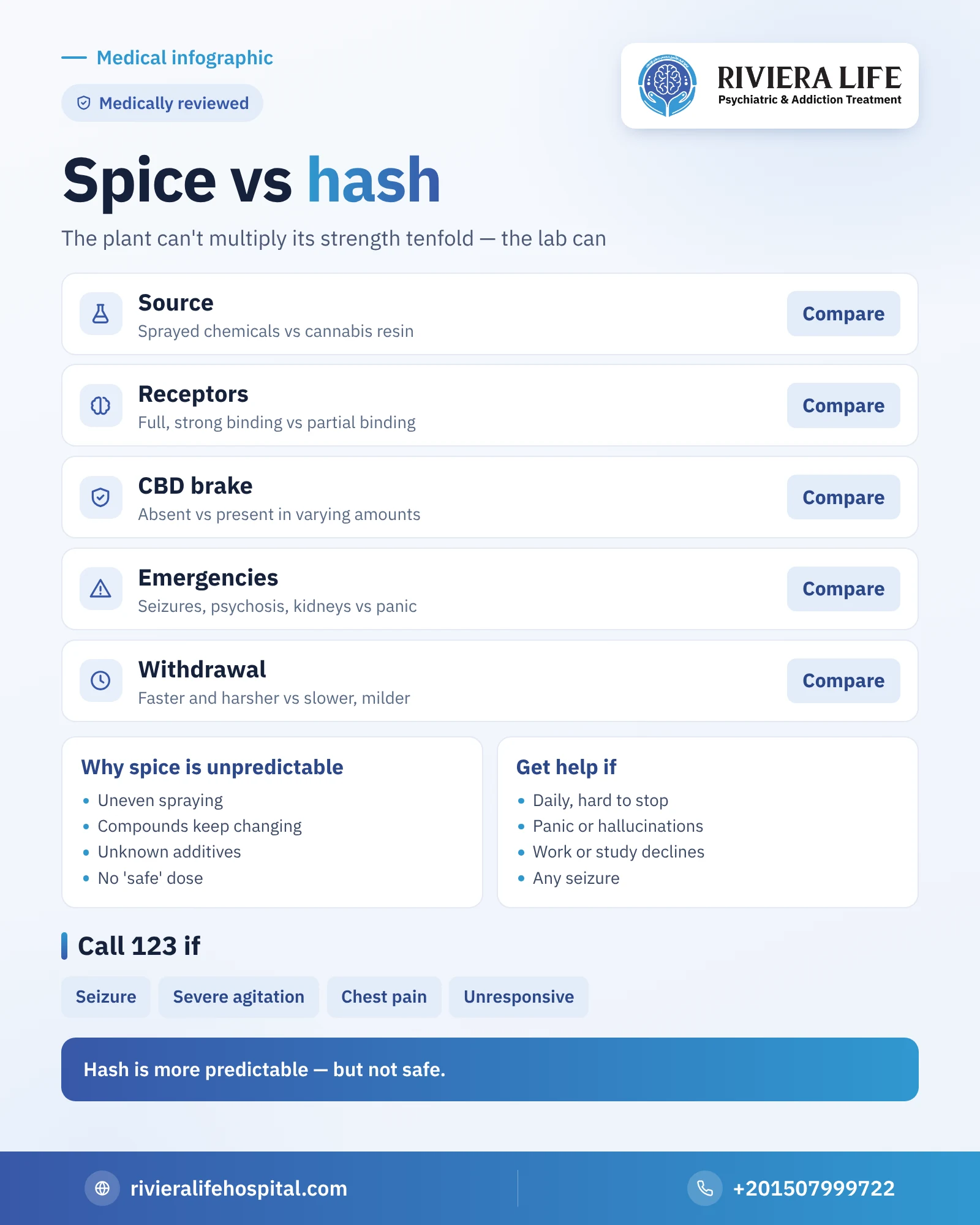
Why can’t spice’s effect be predicted?
Three reasons combine. The first is that the spraying is uneven, so part of the bag may carry a tiny concentration and another part several times that. The second is that manufacturers change the compound whenever a country bans it, so today’s bag is chemically different from last month’s. The third is that some bags are mixed with other substances no one knows. Hash also varies in concentration, but the regular user roughly knows what they will feel, and this knowledge is completely absent with spice. The articles on the harms of spice addiction and the harms of hash cover the details of each one’s harms.
Does either have a medical use?
Purified cannabis extracts, with specific formulations and under strict regulation, have entered some medicines approved in certain countries for conditions such as some types of childhood epilepsy. This doesn’t apply to street hash. Spice compounds were originally made for scientific research and didn’t become medicines, and everything sold in bags is outside any medical framework, with no “safe” dose.
Mind and mood
Hash may cause anxiety, panic attacks, slowed thinking and listless motivation, and may trigger psychosis in those with a genetic predisposition, especially with high concentration and early starting. Spice does this faster and more violently: suspicion, hallucinations, agitation and severe confusion, and the episode may reach an aggression that doesn’t resemble the person’s character. Some psychological symptoms remain after the effect wears off in some users.
The body: heart, kidneys and seizures
Hash’s direct physical effect is milder: a faster pulse, red eyes, dry mouth and increased appetite, then lung damage from smoking in the long term. Spice, on the other hand, has been linked in poison center reports to seizures, severe vomiting, high blood pressure, a racing heart and disturbed kidney function in some of those affected, and in rare cases deaths. This isn’t an inevitable result for every user, but these are results we don’t usually see with hash alone.
Call an ambulance on 123 immediately if you see
After spice, hash or any unknown mixture, and don't leave the person alone.
- A seizure or loss of consciousness
- Severe agitation, hallucinations or violent behavior
- Chest pain or a very fast pulse
- Continuous vomiting or difficulty breathing
- Inability to respond or be woken
Dependence and withdrawal
Hash causes dependence in a proportion of its users, with symptoms on stopping in the form of irritability, insomnia, loss of appetite and strong craving, usually easing within weeks. You will find the details in hash withdrawal symptoms. Spice tends towards faster dependence in many, and its withdrawal is harsher: anxiety, panic attacks, insomnia, nausea, sweating, palpitations and sharp mood swings, and some cases may require medical care. It is explained in spice withdrawal symptoms.
Is hash really “milder”?
Yes in terms of predictability and the severity of episodes, but this doesn’t make it safe. Hash causes real addiction and effects on study, work and mental health, and there is no “guaranteed safe” amount. The bigger problem is that some people move from hash to spice looking for something cheaper or because it is marketed as “natural” or “undetectable”, so they move from a known problem to an unknown substance. And what is said about it not showing in tests isn’t a valid criterion for choosing a substance; how long spice stays in the body explains frankly what is known scientifically.
Treatment: a difference in details
There is no approved medicine specifically for addiction to either substance. Treatment rests on psychological and physical assessment, following insomnia and anxiety, treating psychosis or depression if they appear, then cognitive behavioral therapy and relapse prevention. Someone who uses spice needs closer monitoring in the first days because of the possibility of seizures and agitation. The details of each path are in spice addiction treatment and hash addiction treatment.
The legal position in Egypt
Hash is a criminalized narcotic substance, and synthetic substances similar to cannabis are in turn included in the schedules, with the lists constantly expanding. Someone who seeks treatment in a licensed hospital is protected by confidentiality, and seeking treatment isn’t a door to accountability.
When should you seek help?
- If use has become daily or hard to stop despite attempts.
- If panic attacks, suspicion or hallucinations appear after use.
- If work, study or relationships have deteriorated.
- If a seizure or loss of consciousness has happened even once.
- If the person moves between hash, spice and others looking for “something stronger”.
The consultants in psychiatry and addiction treatment at Riviera Life follow cases under round-the-clock medical supervision and in complete confidentiality, and the first consultation is free on +201507999722.
More from the spice guide
- Spice: the complete guide
- Strox vs hash
- Spice addiction symptoms
- Spice and sex
- Khat vs hash: effect, risks, dependence and withdrawal
Questions many people ask
Not in the precise sense. It is synthetic compounds that stick to the same cannabinoid receptors, but they are chemically different and usually stronger, and are sprayed on herbs that have nothing to do with cannabis.
Because its makeup and concentration are unknown and change from bag to bag, and because many of its compounds bind to the receptors more strongly, which may cause seizures, agitation and psychosis.
It is more predictable, but not safe; it causes dependence, anxiety and effects on study and work, and may trigger psychosis in those predisposed to it.
Usually yes. Spice withdrawal tends towards anxiety, panic attacks, palpitations and severe insomnia, and may need medical care, while hash withdrawal is usually milder.
There is no approved medicine for either; treatment rests on medical assessment, treating symptoms, cognitive behavioral therapy and relapse prevention.