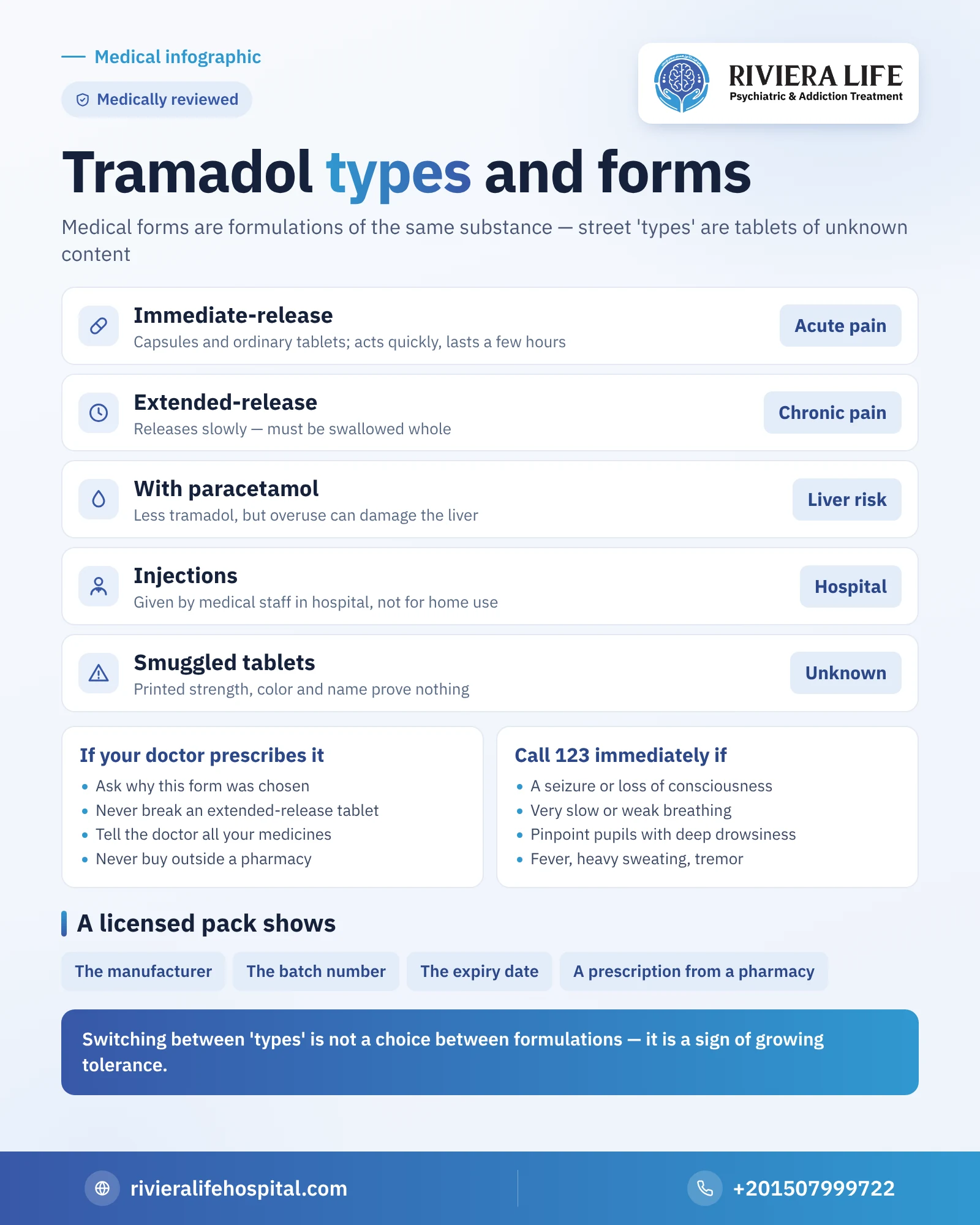
In medicine, the types of tramadol are not different kinds of substance but different formulations of the same substance: immediate-release tablets and capsules, extended-release tablets that release the medicine slowly, combinations of tramadol with paracetamol, and injections used in hospitals. On the Egyptian street, however, the word “types” means something else: smuggled tablets with different colors, names and numbers, whose contents no one knows precisely. This article explains the difference between licensed medical formulations and the tablets passed around outside pharmacies, and why no “type” changes the fact that tramadol is an opioid that causes dependence.
What do people mean by types of tramadol?
When a patient in a clinic asks about types of tramadol, they usually mean: is there a milder form, or one better suited to my pain? When a young man on the street asks the same question, he means: which tablets are stronger? The two questions are completely different. The answer to the first is a set of formulations the doctor chooses between; the answer to the second is that many of the tablets in circulation are of unknown origin, and the “strength” printed on them can’t be trusted.
It helps to remember a simple rule: the active substance is called tramadol, and everything else is a brand name, a formulation or a street name. If the name, color or shape changes, the substance stays the same — and so does its danger.
Immediate-release formulations
These are the most widespread, and they include capsules and ordinary tablets, and in some markets tablets that dissolve in water or oral drops. Their effect begins relatively soon after swallowing and lasts a few hours, which is why they are usually used for moderate to severe acute pain for limited periods, such as after certain operations or injuries.
The speed with which the effect begins is what makes this formulation more attractive to people who misuse it, because the feeling of euphoria or calm comes faster. That is why doctors take care to prescribe it for the shortest possible time and follow the patient up.
Extended-release formulations
These are tablets designed to release tramadol slowly over longer hours, and a doctor may prefer them in some cases of chronic pain that need steady relief instead of repeated rises and falls. They must be swallowed whole, because breaking or chewing them releases the dose all at once, which can cause poisoning. One of the best-known examples of this formulation on the Egyptian market is covered in our article on tramadol vs Tramundin, so we won’t repeat the details here.
Combinations with paracetamol
In some countries, tablets are available that combine a smaller dose of tramadol with paracetamol, on the idea that the two substances work through different mechanisms and so complement each other. A doctor may prescribe them for moderate, short-term pain.
But these combinations carry an extra danger when misused: someone who takes a large number of tablets in search of tramadol’s effect also swallows a large amount of paracetamol, which can damage the liver without clear symptoms at first. Taking them with cold remedies or other painkillers that contain paracetamol can also raise the total amount without the patient noticing.
Injections: a hospital formulation
There are injectable forms of tramadol used in emergency departments or after operations, given by medical staff under monitoring. This formulation is not for home use, and obtaining it outside hospital or injecting it oneself adds the risks of infection and poisoning to the risks of tramadol itself.
Brand names: many names, one substance
Different companies produce tramadol under many brand names, and the tablets may differ in shape, color and packaging. This does not mean any difference in the nature of the substance. So if a doctor prescribes a medicine whose name you don’t recognize, read the name of the active ingredient on the box and tell the doctor about any other medicine you take, so that you don’t end up taking tramadol twice under two different names.
Smuggled and counterfeit tablets in Egypt
This is where the biggest problem lies. On the Egyptian street, tablets said to be tramadol are passed around; some are known by their color, some by numbers printed on them suggesting a high strength, and some by street names. Many of these tablets come from outside the licensed pharmaceutical system, and reports of seizures and laboratory analyses in the region indicate that their contents may differ greatly from what is printed: they may contain more than expected, less, or completely different substances.
- The printed strength is no guarantee: the large numbers printed on a tablet may not match what is inside it.
- Color is no guide: our article on red vs white tramadol discusses this common idea in detail.
- Street names don’t mean a known formulation: including the one covered in our article on tramadol vs Tamol.
- Differences between tablets: two tablets from the same strip may differ, so the user can be caught out at any time.
What tramadol looks like: can you tell the genuine one from the strip or the number?
Many people ask what a genuine tramadol strip looks like, or about tablets printed with 225 or 250. The medical answer is clear: licensed tramadol is dispensed by a pharmacy on prescription, and its pack carries the name of the manufacturer, the batch number and the expiry date — and the well-known licensed strengths of tramadol do not include numbers such as 225 or 250. Tablets carrying these numbers or striking colors mostly come from outside pharmacies, and the number printed on them proves nothing about their content.
No one can judge a tablet from its appearance or from a photo online, since a counterfeit tablet can be printed so well that it looks like the original. So appearance is no way to feel reassured; the only safe route is a medicine dispensed by a pharmacy on a doctor’s prescription, with the doctor following its use and duration.
Why are unknown tablets more dangerous?
Tramadol can cause seizures, and the likelihood rises as the amount rises. Someone who takes a tablet of unknown strength doesn’t know how much they have really taken, so they may reach an amount that triggers a seizure or slows their breathing without expecting it. The risk of serotonin syndrome also rises if tramadol is combined with certain antidepressants or other medicines that raise serotonin — a condition explained in our article on serotonin syndrome. And the danger multiplies when it is mixed with pregabalin, sedatives or alcohol.
Call an ambulance immediately (123 in Egypt) if you see
After taking any tramadol tablet, especially if it is of unknown origin or mixed with other substances.
- A seizure or loss of consciousness
- Very slow or weak breathing, or difficulty waking the person
- Very small pupils with deep drowsiness
- A high temperature with heavy sweating and tremor or confusion
Does the risk of addiction differ by type?
Not in any essential way. The extended-release form may seem calmer because it doesn’t give a quick rise, and the combination with paracetamol may seem milder because the tramadol dose in it is lower, but regular use of any of them can lead to tolerance, physical dependence and withdrawal symptoms on stopping. The same rule applies to all opioid painkillers, as our article on types of opioid analgesics explains. In other words, the right question is not “which type is milder?” but “do I need tramadol at all, and for how long?”
Doctors notice a recurring pattern in people whose use has developed into addiction: a person starts with a tablet prescribed after an injury or an operation, then moves on to a “stronger” tablet from a friend when the effect fades, then to smuggled tablets when a prescription becomes hard to get. Moving between types here is not a choice between formulations but a sign of growing tolerance, and every step brings seizures and overdose closer. This path and the factors behind it are set out in our article on the causes of tramadol addiction.
Do the types differ in drug tests?
The substance is the same, so the test looks for tramadol and its breakdown products whatever the formulation or brand name. The extended-release form or repeated use may affect how long it stays in the body to a limited degree, but there is no “type that doesn’t show up”. The details of detection times are in our article on how long tramadol stays in your system.
If your doctor prescribes tramadol
- Ask which formulation has been prescribed and why the doctor chose it for your case.
- Don’t break or chew an extended-release tablet.
- Tell the doctor about all your medications, especially antidepressants, epilepsy medicines and sedatives.
- Don’t buy tramadol outside a pharmacy or without a prescription.
- If you feel you need it after the pain has gone, discuss this with your doctor early.
When should you ask for help?
If looking for a “stronger type” has become part of your day, or you move between tablets depending on what is available, that is a sign of dependence, not curiosity. The same applies if a family finds strips of different colors and names with one of its members. At Riviera Life, an addiction treatment consultant assesses the situation in complete confidence and sets a safe withdrawal plan that takes into account the possibility that the person has taken tablets of unknown strength. The stages of the program are in our article on tramadol addiction treatment, and the first consultation is free on +201507999722.
More from our tramadol guide
Questions many people ask
Immediate-release forms such as capsules and ordinary tablets, extended-release tablets, combinations with paracetamol in some countries, and injections used in hospitals.
It may seem calmer because it doesn't give a quick rise, but regular use still causes tolerance and dependence, and breaking or chewing it is an extra danger.
They can't be trusted. Smuggled tablets may contain a different amount from what is printed, or other substances, and one tablet may differ from another.
Someone who takes many of these tablets swallows a large amount of paracetamol, which can damage the liver without clear symptoms at first.
No. The active substance is the same in every formulation, and the dedicated test detects tramadol and its breakdown products whatever the brand name or form.