
Trypophobia is an intense aversion some people feel when seeing close clusters of small holes or repeated bumps, such as a honeycomb, a dried lotus seed head or the bubbles on the surface of some foods. Those who have it describe goosebumps, itching, nausea and an urge to look away immediately.
It isn’t an official diagnosis in the American diagnostic manual, and the dominant feeling in it is disgust more than fear, but it is completely real to those who live with it, and in a few it may reach a degree that disrupts life. In this article we explain what we know about it, the theories that try to explain it, and when it needs treatment. And you won’t find any pictures here; description in words is enough.
What is trypophobia?
The name combines a Greek word meaning hole with the word phobia, and it spread on internet forums before researchers paid attention to it. The trigger here isn’t a single hole, but a visual pattern: small, similar shapes, repeated and packed together, usually a dark color inside a light surface. The source may be natural, such as sea sponges, some seeds and some corals, or manufactured, such as the bubbles in aerated chocolate, or edited pictures deliberately spread on social media.
Sara, a university student, says she can’t eat a pastry topped with tightly packed seeds, and that she once turned off her phone on public transport because an advert passed in front of her and she felt her skin “crawling”. This description recurs a lot, and may be met with mockery from those around, so the person feels that what they are going through is strange or made up.
Is trypophobia an official diagnosis?
No. The fifth edition of the Diagnostic and Statistical Manual of Mental Disorders doesn’t mention trypophobia by name, nor does the International Classification of Diseases. But this doesn’t mean it is an illusion. If the response is severe and persistent, and pushes the person to clear avoidance that disrupts their day, the doctor may classify it under specific phobia in the “other types” category. The majority, though, live with passing discomfort when seeing the trigger, which doesn’t amount to a disorder and doesn’t need treatment.
How does the response appear?
The severity varies a lot from person to person, but the signs that recur in descriptions by those affected include:
- Goosebumps and a feeling that something is crawling on or under the skin.
- Sudden itching, sometimes with an urge to rub the skin.
- Nausea or an aversion resembling what happens on seeing spoiled food.
- Tension and tightness, and in a very few, palpitations and sweating resembling an anxiety attack.
- An urgent urge to look away or close the picture.
- Avoiding particular foods, places or materials, or refraining from browsing social media for fear of a surprise.
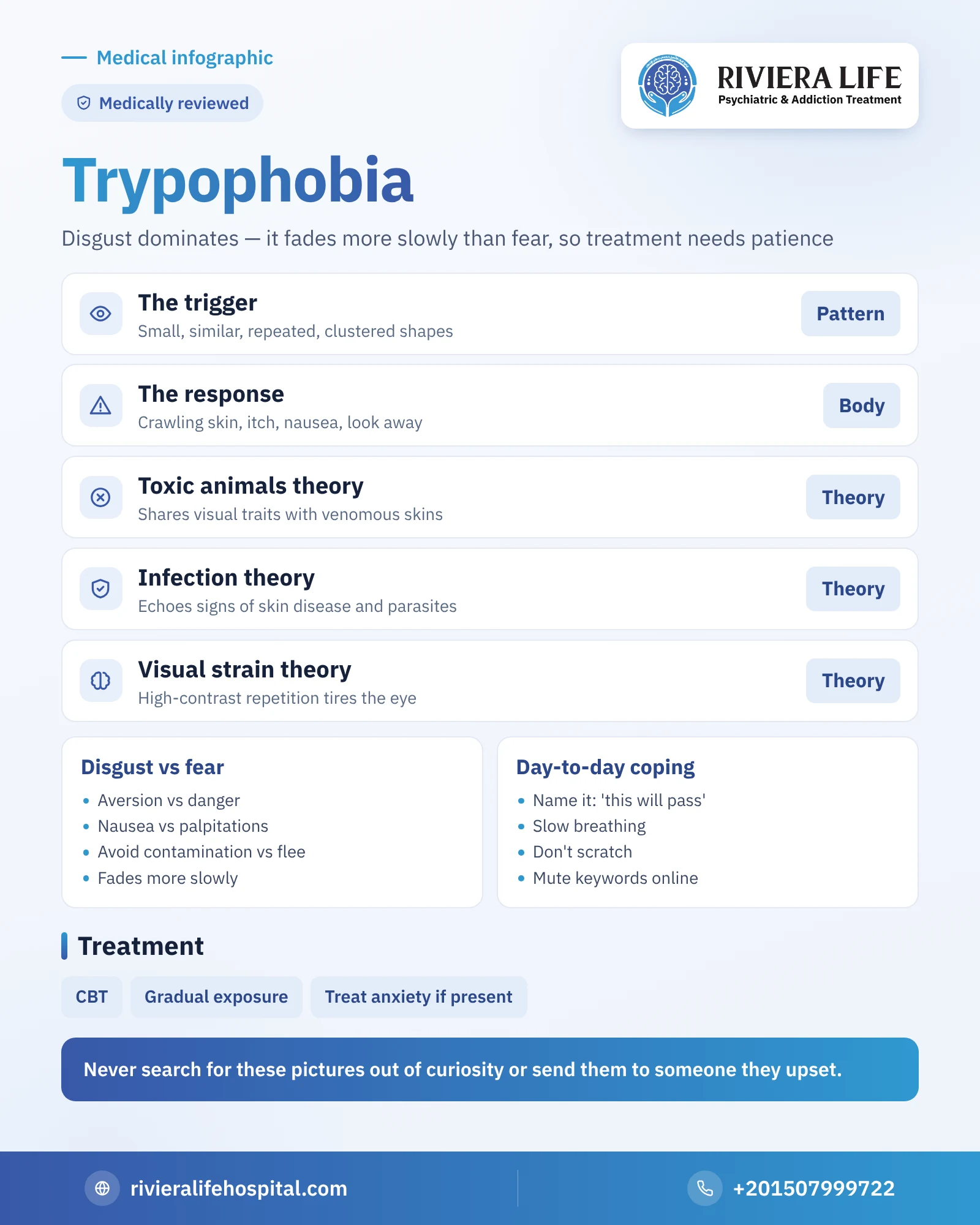
Disgust or fear? The difference that changes the picture
In most types of phobia fear is the dominant feeling: palpitations, alertness, and an urge to escape an expected danger. In trypophobia, though, the available studies indicate that disgust is the most prominent feeling in most people. The difference isn’t only linguistic; disgust is linked to nausea, a tightening of the face and an urge to move away from “contamination”, and the body deals with it differently from fear.
| Aspect | Fear | Disgust |
|---|---|---|
| Dominant sensation | Imminent danger and alertness | Aversion and revulsion |
| The body | Palpitations and faster breathing | Nausea, goosebumps and itching |
| The drive | Escape and survival | Moving away from a source of contamination |
| Example | An approaching dog | Rotten food |
This difference has a practical effect, as disgust usually fades with repeated exposure more slowly than fear, so treatment needs more patience.
Why does trypophobia happen? The proposed theories
There is no confirmed explanation so far, and research is limited, mostly on small samples. But three theories recur in the scientific literature:
The venomous creatures theory
Researchers noticed that some pictures that trigger trypophobia share visual features with the skins of venomous animals such as some snakes, octopuses and frogs. They suggest the brain may have inherited a quick sensitivity to this pattern because it signaled danger, so the response fires before we realize what we are seeing.
The infection and parasite avoidance theory
Another theory suggests that close clusters of holes or bumps remind the mind of signs of skin diseases, parasites and contaminated wounds, and that the disgust here is an ancient defensive system that keeps us away from sources of infection. This fits with the feeling of itching and crawling skin that many describe.
The visual strain theory
A third group believes that repetitive, high-contrast images are inherently tiring for the visual system, and cause discomfort in many people, and that some are more sensitive to this discomfort than others.
Most likely these factors may overlap, and general anxiety and sensitivity to disgust raise the readiness to respond. These all remain hypotheses that need more research.
Who is most at risk?
Some surveys indicate that a degree of aversion to these pictures is fairly common among people, while a severe response is much less common. It seems clearer in those who suffer from anxiety or depression, and in those with a high sensitivity to disgust in general. It may begin in childhood or adolescence, and the person often discovers it has a name when they come across a discussion of it online.
When does it become a problem that needs attention?
Ask yourself honestly:
- Do you regularly avoid foods, places or activities because of it?
- Do you spend a long time worrying about coming across the trigger?
- Has it affected your work, study or relationships?
- Is it accompanied by strong anxiety attacks or recurring disturbing thoughts?
If the answer is yes to more than one question, an assessment by a specialist may help you. These questions are for reflection, not diagnosis; the diagnosis is made by a psychiatrist or psychologist after a full interview.
Trypophobia and social media
A large part of the phenomenon’s spread came from the internet, where some circulate edited pictures intending to disturb or “test” friends. For those who suffer severely, browsing itself becomes a source of tension. We never advise searching for these pictures out of curiosity or to test your reaction, or sending them to someone who is known to be upset by them; therapeutic exposure is something completely different, done with a plan and under supervision. Practical steps include muting the keywords related to the subject on platforms, and turning off video autoplay.
How do you deal with it in your day?
- Name what is happening: saying “this is disgust and it will pass” eases its intensity and gives the mind distance.
- Slow breathing: breathing out longer than in for a minute or two calms the body.
- Don’t scratch your skin: the itching caused by the response calms on its own, and rubbing prolongs it.
- Reduce wide avoidance: staying away from deliberate pictures is understandable, but giving up many foods and materials widens the circle of fear.
- Take care of general anxiety: enough sleep, movement and cutting down stimulants lower the readiness to respond.
Treating trypophobia
When the condition affects life, treatment relies on the same methods that work in specific phobia. Cognitive behavioral therapy helps understand the accompanying thoughts, such as “this is something diseased that will pass to me”, and test them. Gradual exposure starts with very mild triggers, such as a written description or a simple drawing, then progresses slowly under the therapist’s supervision until the pictures lose their power to disturb. Because disgust fades slowly, it may need longer sessions and more repetition than an animal phobia, for example.
There is no specific medicine for trypophobia. But if it is accompanied by generalized anxiety disorder or depression, the doctor may suggest treatment for that disorder, and no medicine is started or stopped except with them.
How does Riviera Life help you?
At Riviera Life in Sheikh Zayed, the consultant psychiatrists listen to your description without belittling it, assess whether the response is passing aversion or a phobia that needs a plan, look for any accompanying anxiety or depression, then set a safe gradual exposure program. The first consultation is free and completely confidential on +201507999722.
More from the phobia guide
- Types of phobia: the complete guide
- Claustrophobia: symptoms and treatment
- Types of anxiety: the main disorders and the differences between them
- Anxiety symptoms: psychological and physical signs
- Cherophobia: the fear of happiness, its causes and how to get past it
Questions many people ask
It isn't a standalone diagnosis in official manuals, but the response is real. If it is severe, persistent and disrupts life, the doctor may consider it a type of specific phobia.
Disgust dominates trypophobia, and is linked to a crawling-skin feeling and itching. One theory suggests this is an echo of an ancient system that keeps us away from signs of infection and parasites.
The discomfort eases in many with time or when general anxiety lessens. A severe response that leads to wide avoidance improves more with cognitive behavioral therapy and gradual exposure.
Random exposure to shocking pictures may increase aversion. Therapeutic exposure starts with very mild triggers and progresses slowly with a plan set by the therapist.
There is no specific medicine for it. If it is accompanied by generalized anxiety or depression, the doctor may suggest treatment for that disorder after assessment.