Agoraphobia isn’t a fear of open spaces alone, as its name suggests. It is an intense fear of situations where it is hard to escape or get help if the person feels panic or illness: public transport, crowds, long queues, enclosed spaces such as lifts and cinemas, open spaces such as squares and bridges, or leaving home alone. Over time the person begins to avoid these situations, so their life narrows, and they may become a prisoner of their home. This article explains how it appears, why it spreads, and how doctors treat it. Diagnosis is made by a psychiatrist or specialist after assessment.
What exactly is agoraphobia?
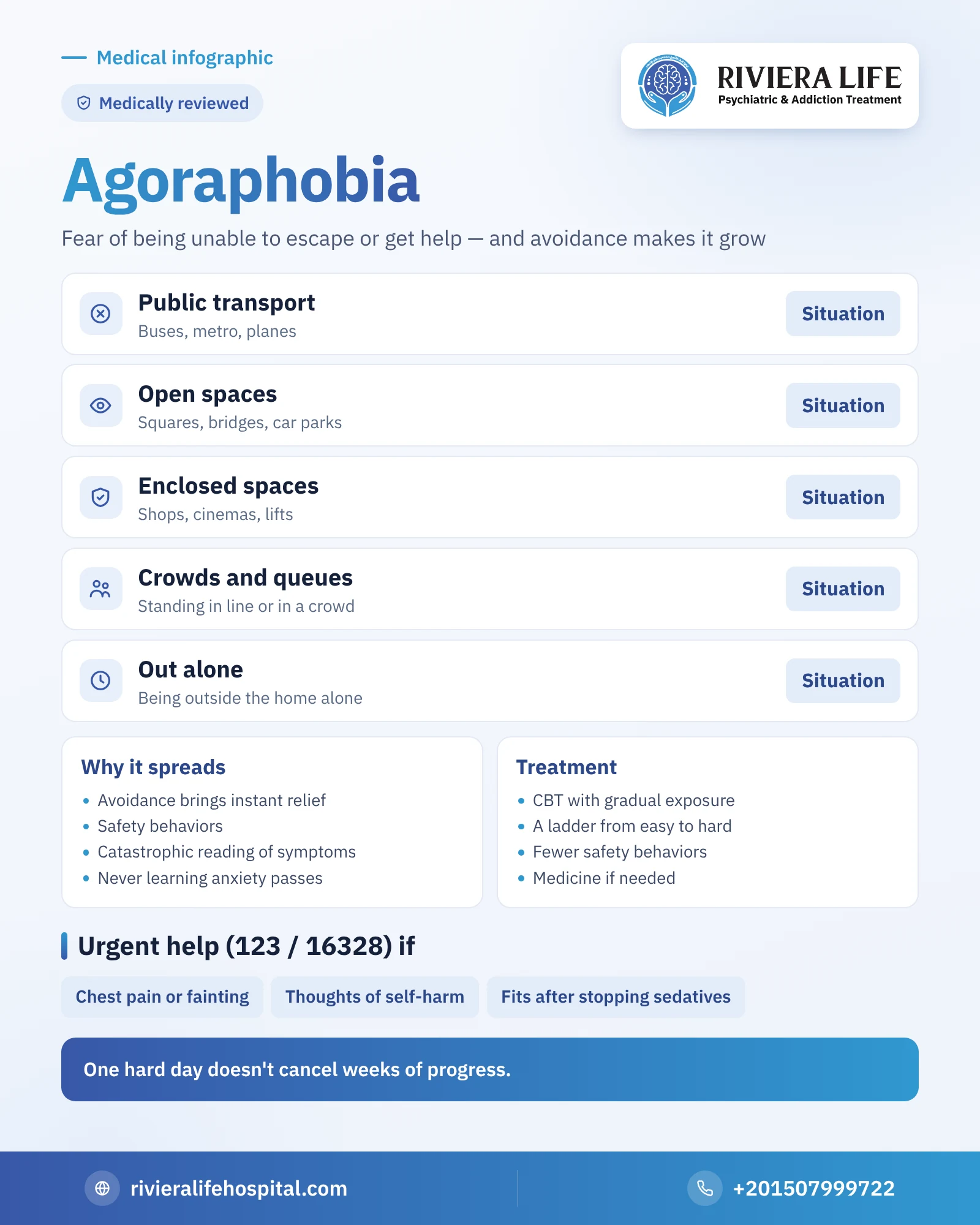
It is classified among anxiety disorders, and its diagnosis rests on clear fear of at least two of five situations: public transport, open spaces, enclosed spaces, standing in a queue or in a crowd, and being outside the home alone. The situation needn’t be dangerous; what matters is that the person fears that if panic, dizziness or shortness of breath strikes, they won’t be able to get out or won’t find anyone to help, or that they will be embarrassed in front of people. The fear usually lasts six months or more and clearly affects the person’s life.
How does it start? The link with panic attacks
In many cases the story begins with a sudden panic attack in a public place: palpitations, sweating and a feeling of suffocation in the supermarket or on the metro. The person leaves terrified, thinking something serious is wrong with their heart, then avoids the place next time for fear of the experience repeating. Here fear of the attack turns into fear of the place, then of similar places, and so the circle widens. Our article on panic attacks covers how an attack is distinguished from a heart attack. But some people with agoraphobia don’t have full panic attacks, but fear less severe symptoms such as dizziness, fainting or losing bladder control.
The signs that appear in the person
- Refusing to go out alone, and asking for a companion on every short trip.
- Choosing to sit by the door or at the end of the row to be near the exit.
- Avoiding public transport, malls, occasions and crowded restaurants.
- Carrying “safety” items such as a bottle of water, medicine or the phone, and not moving without them.
- Calculating routes, distances and nearby hospitals before every outing.
- Avoiding driving on highways or crossing bridges and tunnels.
- Possibly withdrawing from work and study, and relying on family for shopping and appointments.
These signs aren’t enough for self-diagnosis, as many people dislike crowds without having a disorder. The criterion is intense, persistent fear and a restricted life.
Why does agoraphobia persist and spread?
The mechanism is simple and harsh: each time the person avoids the situation they feel immediate relief, so their brain learns that avoidance is what saved them, and never experiences that the anxiety would have calmed on its own. “Safety behaviors” such as the companion, the bottle and sitting near the door strengthen this conviction. The cycle is fed by a catastrophic interpretation of ordinary physical symptoms: palpitations mean a heart attack, dizziness means fainting. That is why treatment relies on gradually breaking this cycle, not on courage or “storming” places all at once. Stress hormones explain part of these symptoms, as our article on adrenaline and anxiety explains.
What are the causes and risk factors?
There is no single cause. Genetics and anxious temperaments in the family play a part, as do childhood experiences such as losing a parent or overprotection, stressful life events, early panic attacks, and some physical illnesses that cause dizziness, such as inner ear disorders. It appears most in late adolescence and the twenties, and in most studies women are affected more than men. It may also worsen after trauma, violence or a road accident. You will find the classification of phobias in our guide to phobias.
The difference between it, claustrophobia and social phobia
Confusion is common, and distinguishing them matters for choosing treatment. In claustrophobia the person fears the tightness itself and suffocation inside the narrow space, even when accompanied by someone. In agoraphobia, the fear is of being unable to escape or get help, and it may ease a lot when a trusted person comes along. In social phobia the fear is of people’s judgment and evaluation, not of the symptoms themselves. All three may occur in one person, and the doctor determines which dominates.
How is it diagnosed?
The doctor starts with a detailed history: when the fear began, which situations are avoided, and how much it has limited your life. They rule out physical causes of the symptoms with a simple examination and perhaps tests such as thyroid tests and a heart check if needed, especially at the first attack, because chest pain and palpitations aren’t assumed to be anxiety before examination. Then they check for accompanying panic attacks, depression and substance use. No test published online replaces this assessment.
Treatment: what has proven useful?
The treatment with the strongest evidence is cognitive behavioral therapy with gradual exposure. The therapist and patient build a ladder of situations, from easiest to hardest: standing at the front door, then walking to the end of the street, then riding public transport for one stop, and so on. The patient learns that anxiety rises and then falls and that the symptoms don’t harm them, while gradually reducing safety behaviors.
The doctor may add a medicine from the class of antidepressants used in anxiety and panic attacks, by their decision and with their follow-up. Sedatives of the benzodiazepine class are used as little as possible because dependence on them is common and may undermine the success of exposure, and they aren’t started or stopped without the doctor. To compare the broader options for anxiety, see anxiety treatment.
Gradual steps the family can support
Don’t force your relative to go out or mock their fear, and don’t offer to do everything for them. Ask them about the small step they can manage today, encourage them in it and celebrate it. If they are working with a therapist, ask how to accompany them without becoming a permanent “safety behavior”. It may help to walk with them some distance and then reduce accompaniment gradually according to a plan. And remember that setbacks are possible, and that a hard day doesn’t cancel weeks of progress.
Phobia and addiction: a hidden danger
Some people with agoraphobia turn to a drink, a sedative or hashish before going out to bear the situation. The trick works two or three times, then going out becomes impossible without it, and the phobia combines with dependence. The substance may hide the original problem so it goes untreated. If you have started down this road, seek an assessment covering both, and learn about anxiety and addiction to understand how they are treated together.
Seek urgent help immediately if you see
Call an ambulance on 123 or go to the nearest emergency department, and you can contact the mental health hotline on 16328, in case of:
- Severe chest pain, shortness of breath that won’t settle, or fainting, especially the first time or with known heart disease
- Thoughts of self-harm or ending life
- Refusing food or drink, or total inability to leave the room
- Severe tremor or seizures after suddenly stopping alcohol or sedatives
How can Riviera Life help you?
At Riviera Life in Sheikh Zayed, Giza, consultant psychiatrists assess the case and set a suitable psychological and medication plan, with family sessions and follow-up after discharge, in complete confidentiality; the hospital is licensed by the Ministry of Health and has fourteen years of experience. Call for a free first consultation on +201507999722.
More from our phobia guide
- Phobias: the complete guide
- Claustrophobia: fear in lifts, MRI scanners and planes
- Panic attacks: how to tell them from a heart attack
- Types of anxiety: 7 main disorders
Questions many people ask
Not only. It is fear of situations where escape or getting help is hard, such as public transport, crowds, closed and open spaces, and going out alone.
It is often linked to them, as it may begin after a panic attack in a public place, which the person then avoids. But some don't have full attacks and fear milder symptoms.
Yes, many improve greatly with cognitive behavioral therapy and gradual exposure, with medicine when needed. Improvement needs patience and a plan.
No. Forcing increases fear. Small agreed steps and calm encouragement are better, preferably guided by a therapist.
They aren't a first choice, as dependence on them is common and may undermine the success of exposure therapy. If prescribed, it is by the doctor's decision and for a limited period.