Claustrophobia is an intense fear of being in a narrow or closed place that is hard to get out of, such as a lift, an MRI scanner, a plane or a windowless room. The person feels shortness of breath, palpitations and a sense that the walls are closing in, and the moment may turn into a full panic attack. It is a type of specific phobia falling under situational phobias, and it responds well to exposure therapy and cognitive behavioral therapy. In this article we explain how it appears in everyday situations, its link to panic, and how to prepare for an MRI scan in cooperation with the medical team.
What is claustrophobia?
Feeling some unease in a crowded lift is common. The phobia is when an employee climbs eight floors by the stairs every day to avoid the lift, a woman refuses to travel to visit her daughter abroad because the idea of the plane door closing paralyzes her, or a patient cancels a scan his doctor requested three times. The core of the fear here is two overlapping things: the fear of being trapped and unable to get out, and the fear of suffocating and running out of air, even when the place is well ventilated.
It differs from agoraphobia, which revolves around several places that are hard to escape from, such as crowds, transport and markets, and often extends to leaving home. Claustrophobia is linked specifically to tightness and enclosure. Our guide to types of phobia explains the differences between all the types.
Symptoms of claustrophobia
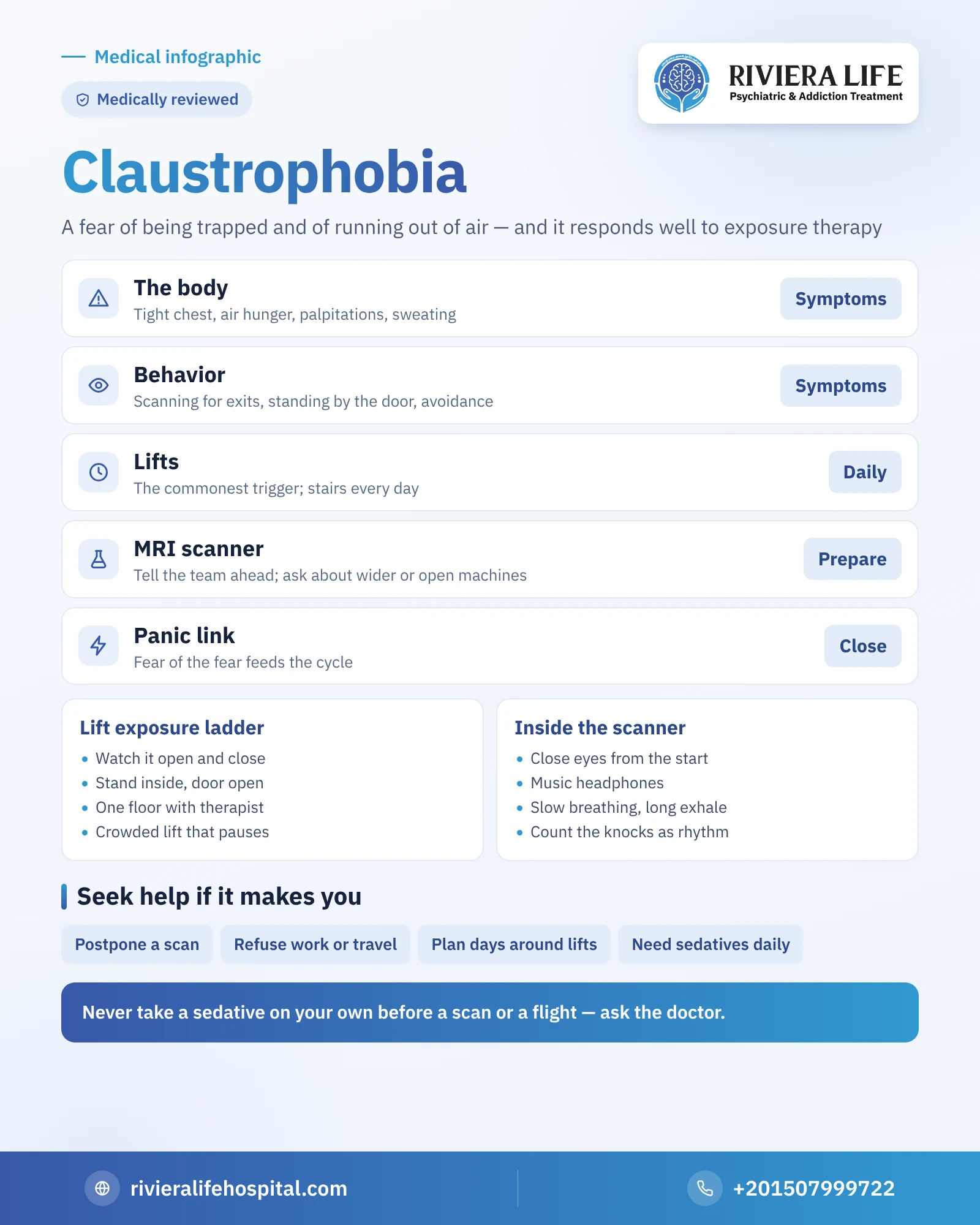
- In the body: tightness in the chest and a feeling of not enough air, palpitations, sweating, tremor, dizziness, nausea and sudden heat.
- In the feelings: terror, a feeling that the walls are closing in or the place is shrinking, and fear of losing control or fainting.
- In behavior: looking for exits as soon as one enters, standing near the door, leaving doors open, and avoiding lifts, tunnels and closed cars.
- Before the situation: anxiety that precedes travel or a scan by days, insomnia, and repeatedly thinking “what if I get stuck?”.
In the lift
The lift is the best-known trigger. Anxiety sometimes starts before it arrives: the sound of the door, seeing the small space, and the crowd of people inside. The symptoms intensify if the lift stops between two floors for seconds or its lights go off. Over time the person builds his life around this fear: he chooses a home on the first floor, refuses appointments in tower blocks, and arrives at work exhausted from the stairs. The irony is that this avoidance, although it relieves in the moment, is what keeps the fear alive.
In the MRI scanner
The traditional MRI scanner is a narrow tube in which the patient lies without moving for long minutes, with loud knocking sounds. That is why it is a harsh test even for those who didn’t know themselves to fear closed places before. A proportion of patients stop the scan before it is complete, or avoid it altogether, despite its importance in diagnosing diseases of the nerves, joints and tumors.
How do you prepare for an MRI in cooperation with the medical team?
- Tell your doctor and the radiology team in advance: say clearly that you fear closed places when booking the appointment, not inside the scan room.
- Ask about alternatives: some centers have wider-bore or open machines, and scanning certain parts may be possible with the head outside the machine. The decision here is the doctor’s and the radiology team’s according to the type of scan required.
- Ask about sedation: in some cases the doctor may decide to use a sedating medicine before the scan or under medical supervision. Don’t take any sedative on your own, and if one is prescribed, arrange for someone to take you home.
- Ask to know what will happen: the approximate duration, whether there is an alarm button, whether you can talk to the technician through the microphone, and whether a companion can be in the room.
- Inside the machine: close your eyes from the start, use headphones with music if available, breathe slowly with a longer exhale, and count the sounds as if they were a rhythm.
And if the fear is severe and you have time before the scan, a few sessions of focused behavioral therapy may make the experience possible.
On the plane
Many think their fear of flying is a fear of the plane falling, but some of them actually fear the door closing, the narrow aisle, and sitting in the inner seat without being able to get off for hours. It becomes harder on long flights. It helps here to know that symptoms, however intense, reach a peak and then calm, and that choosing an aisle seat near the front may ease the feeling of being trapped. Turning to sedatives or alcohol before the flight without consulting the doctor may cause heavy drowsiness and dangerous interactions, and doesn’t treat the fear.
Claustrophobia and panic attacks
The relationship between the two is close. A person may have a panic attack inside a narrow place, so his mind links the place with terror and he begins to avoid similar places. In the other direction, the phobia may escalate inside the lift into a full attack: a violently beating heart, a feeling of suffocation and fear of death. What feeds the loop is “fear of fear”, that is, anticipating the attack itself. You will find a detailed explanation of what an attack looks like, what to do during it and how to tell it apart from a heart attack in our article on panic attacks. And if attacks recur outside closed places too, there may be a panic disorder that needs its own assessment.
Why does it happen?
Many cases begin with a frightening experience: being trapped in a broken lift, being shut in a cupboard during childhood play, or a temporary suffocation. It may come from learning from a parent who avoids closed places. And some people seem to have a higher sensitivity to personal space and to changes in breathing, so they read any tightness as imminent suffocation. General anxiety, exhaustion and stimulants increase the intensity of the response.
Exposure therapy: the most successful route
Exposure therapy is based on facing closed places gradually, with a plan agreed with the therapist, until the mind learns for itself that staying is possible and that anxiety calms without escaping. An example of an exposure ladder for fear of lifts:
- Standing in front of the lift and watching it open and close.
- Going in and staying with the door open.
- Riding one floor accompanied by the therapist.
- Riding several floors with someone, then alone.
- Riding a crowded lift, then staying in it when it pauses briefly.
The patient doesn’t move to the next step until the previous one has lost most of its power to frighten him. Some therapists use virtual reality to simulate flying or the MRI scanner when it is hard to arrange the real situation.
Cognitive behavioral therapy
Cognitive behavioral therapy works on the thoughts that magnify the danger, such as “the air will run out” or “I’ll lose my mind if I stay”, and tests them through experience. The patient learns to give up hidden safety behaviors, such as clinging to the phone or watching the door the whole time, because they prevent him discovering that he is fine without them. The therapist adds breathing exercises as a helping tool, not as a way of escaping the feeling.
Do you need medicine?
Medicines aren’t the main treatment for claustrophobia. The doctor may prescribe an antidepressant if a panic disorder or depression accompanies it, or decide on short sedation for a specific medical situation such as an MRI. As for sedatives of the benzodiazepine class, their repeated use to face everyday situations obstructs treatment and carries a risk of dependence. No medicine is started, adjusted or stopped except with the treating doctor.
When should you seek help?
If the fear makes you postpone an important medical scan, refuse work or travel, rearrange your whole day around avoiding lifts, or need a sedative to face ordinary situations, it is time for an assessment. And if chest pain or severe shortness of breath appears with no known cause before, call an ambulance on 123 and don’t assume it is anxiety.
How can Riviera Life help you?
The psychiatry team at Riviera Life in Sheikh Zayed sets an exposure therapy plan that starts from where the patient stands, and it can be intensified before an upcoming scan or trip, with an assessment of any panic or sedative dependence that may accompany the fear. The first consultation is free and completely confidential on +201507999722.
More from our phobia guide
- Types of phobia: the complete guide
- Trypophobia: disgust, theories and treatment
- Panic attacks: what to do during an attack?
- Anxiety treatment: psychotherapy and medicines
- Fear of marriage: causes, symptoms and how it differs from hesitation
- Agoraphobia: fear of places hard to escape from and how it is treated
Questions many people ask
Claustrophobia is linked specifically to tightness and enclosure, such as lifts and tunnels. Agoraphobia is a wider fear of several places that are hard to escape from, such as crowds and transport, and may prevent leaving home.
Yes in most cases, with advance coordination with the doctor and the radiology team. A wider-bore or open scanner may be available, or sedation the doctor decides on according to the case.
Don't take any sedative without consulting the doctor, as it may cause heavy drowsiness or dangerous interactions, especially with alcohol. Exposure therapy is what eases the fear in the long term.
It varies with severity, but a specific phobia usually responds to a limited number of structured exposure sessions. Someone with accompanying panic or wide avoidance needs longer.
In the phobia, the feeling of suffocation is part of the anxiety response and calms with time. But if chest pain or severe shortness of breath appears with no known cause before, call an ambulance on 123.