Cherophobia is the fear of happiness: you feel joy and then wait for the blow, so you avoid joy altogether or spoil it yourself before it is complete. The word comes from the Greek root meaning “I rejoice”, and it isn’t an official diagnosis in the major medical manuals, but a description of a pattern of fear and avoidance that therapists notice and real people suffer from. The person doesn’t hate joy, but fears it because they have linked it with loss. Here we explain how it looks in daily life, how it differs from depression, why it arises, and what loosens its grip step by step.
What is cherophobia?
The usual phobia concerns something external: a dog, a height or a needle. Here, however, the trigger is a positive inner feeling. When joy approaches, an old thought stirs: “Don’t be too happy, sadness is coming”. Over time the person learns that safety lies in staying at a distance from everything that delights them.
Cherophobia doesn’t officially belong to the three major categories of phobia explained in the guide to types of phobia, but it resembles them in the same structure: fear that exceeds the danger, then avoidance that entrenches the fear. Scales of “fear of happiness” have been used in psychological research, and researchers found this fear is stronger in people with anxiety, depression and difficult early experiences, without this meaning it is an illness in its own right.
How does it look in daily life?
Take an example: a young woman got the job she dreamed of, and instead of celebrating she told her family “don’t announce the news until I’m sure”. An employee turned down a proposal because things were “too good”. And a mother doesn’t let herself laugh at her son’s birthday because she feels laughter invites disaster.
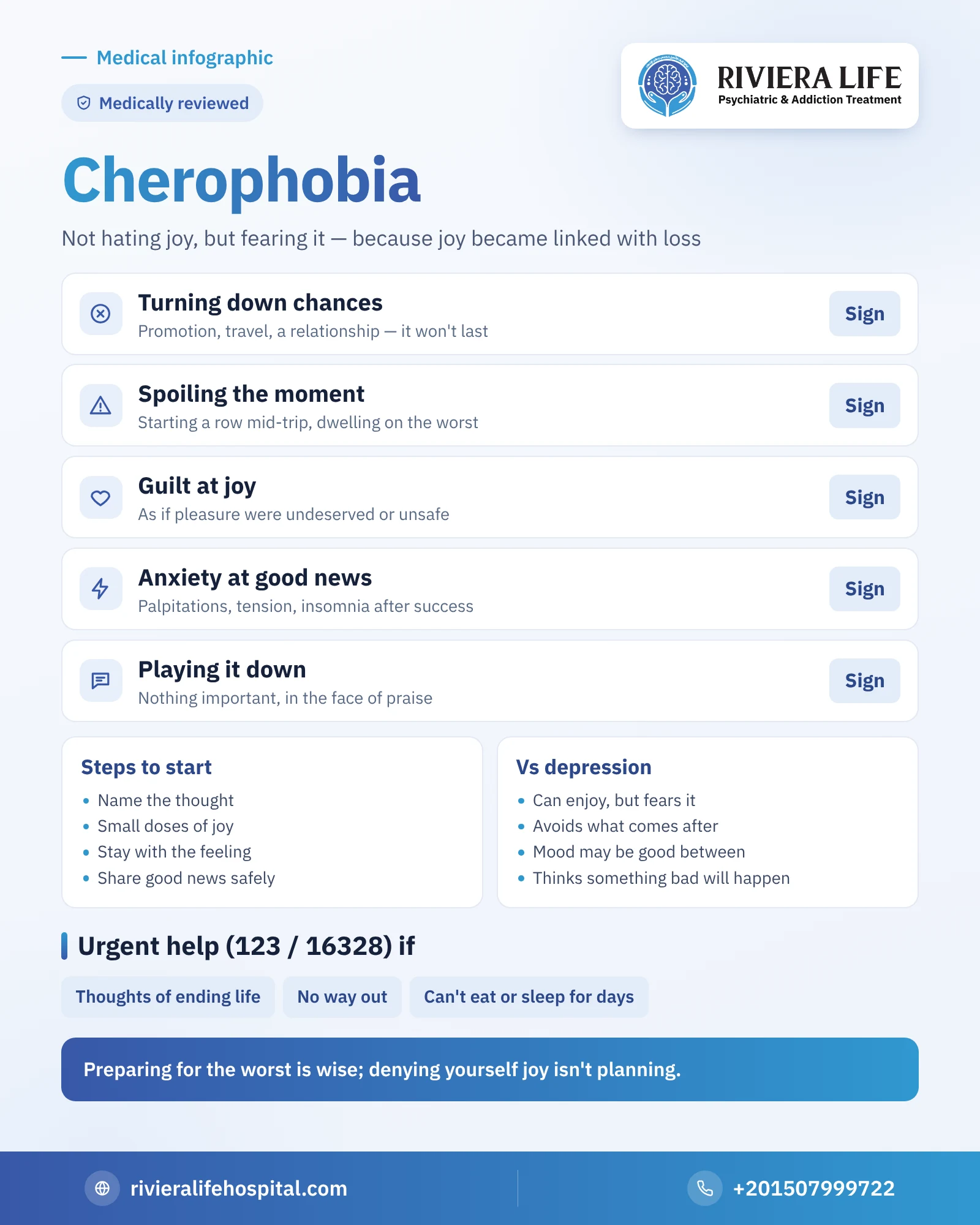
- Turning down good opportunities: a promotion, travel or a relationship, on the grounds that it “won’t last”.
- Spoiling the moment: starting an argument in the middle of a lovely trip, or dwelling on the worst during a celebration.
- Feeling guilty when happy: as if pleasure were undeserved or unsafe.
- Believing joy foretells bad things: and that it is better to anticipate disaster in advance to soften its shock.
- Anxiety symptoms at good news: palpitations, tension and insomnia the night after a success.
- Playing achievements down: “it’s nothing important” in the face of any praise.
Why would someone fear joy?
There is no single cause, but the picture repeats in many stories:
- An experience that linked joy with loss: a family celebration followed by a death, separation or financial crisis, so the link became fixed in memory.
- An unstable home: someone who grew up in a home where the mood switched suddenly between calm and anger learns that calm is a prelude to the storm.
- Perfectionism: someone who sees that success isn’t to be celebrated because “the work isn’t finished” finds it hard to enjoy.
- Believing that joy brings envy or bad luck: a folk belief widespread in many environments. Moderate caution is normal, but when it stops you celebrating your success and leads you to hide every piece of good news, it has become a fear ruling your life.
- Trauma and anxiety: when the body stays on alert for danger, relaxation itself seems an unsafe signal. The article on psychological trauma explains how painful experiences reshape this sense of safety.
Cherophobia and depression: the difference
| Aspect | Fear of happiness | Depression |
|---|---|---|
| Ability to enjoy | Present, but met with anxiety and guilt | Weak or absent even in lovely situations |
| Reason for avoidance | Fear of what will come after joy | Lack of energy and desire |
| General mood | May be good between episodes | Almost constant sadness or emptiness |
| Thoughts | “Something bad will happen” | “Nothing has value” or “I don’t deserve it” |
They may come together in the same person. If emptiness and loss of pleasure dominate, the article on depression symptoms is closer to your situation. And the difference between sadness and depression explains when sadness goes beyond its normal limit.
How does avoidance spoil the picture?
Each time you move away from an opportunity out of fear, you feel short relief. This relief is the reward that teaches your brain that avoidance is the solution. And in return you never get the opposite experience: being happy and then no disaster happening, or a disaster happening and you bearing it. This way the old belief stays untested, just as fear of dogs stays in someone who never goes near a dog.
The deeper problem is that life becomes colorless: short relationships ended before they deepen, lowered ambitions, and occasions that pass without leaving a mark. Some may turn to whatever numbs all feelings, good and bad together, such as excessive alcohol or sedatives, a road that makes things worse, some aspects of which are explained in the article on depression and addiction.
What really helps?
Steps you can start yourself
- Name the thought: write “when I’m happy I expect disaster”, then ask: how many times did that actually happen? And how many times did disasters happen with no joy before them?
- Start with small doses of joy: a cup of coffee you savor, a walk with a friend, or accepting a compliment with just “thank you”.
- Stay with the feeling for a minute: when anxiety comes in the middle of joy, don’t flee or create a problem. Breathe and wait until the anxiety falls on its own, as a wave falls.
- Separate preparing from predicting: making a backup plan is sensible, but denying yourself joy in anticipation of the worst isn’t planning.
- Share good news with a safe person: without waiting for punishment.
Psychotherapy
The therapist usually relies on cognitive behavioral therapy to examine the old belief and test it in practice through gradual exposure to positive experiences. If the roots of the fear lie in an old trauma, that origin is treated in parallel. There are also therapies based on acceptance and self-compassion. There is no medicine specifically for cherophobia, but the psychiatrist may treat accompanying anxiety or depression if there is a need.
How do you help someone you know fears joy?
Don’t tell them “just be happy”, as this sentence increases their guilt. Share small occasions with them without pressure, don’t mock their caution, and praise their efforts, not just their results. If they withdraw from an occasion, offer them a lighter alternative instead of insisting. And remember that slow change doesn’t mean refusing help.
Common thoughts about fear of joy
- “This is ordinary pessimism”: pessimism is an opinion about the future, while cherophobia is avoidance behavior that blocks real decisions.
- “The solution is always to expect the worst”: constant anticipation drains you and doesn’t ease the pain when it comes, and makes you lose the good days.
- “I don’t deserve it”: deserving isn’t a reward earned through suffering; this guilt thought needs examining, not believing.
When do you need a specialist?
Consult a psychiatrist or psychologist if fear of joy pushes you to turn down important opportunities or end relationships repeatedly, if it is accompanied by persistent sadness, loss of pleasure and disturbed sleep, or if you have started relying on substances to switch off your feelings. The first sessions are usually enough to know whether the problem is an independent fear or part of anxiety, depression or the effect of trauma.
Seek urgent help immediately if you see
Call an ambulance on 123 or the mental health hotline on 16328, or go to the nearest emergency department.
- Thoughts of ending your life or harming yourself
- A feeling that you don’t deserve to live or that there is no way out
- Inability to eat, sleep or do the simplest tasks for days
How can Riviera Life help you?
At Riviera Life you meet a consultant psychiatrist who listens to your story before any label, determines whether anxiety, depression or the effect of a painful experience lies behind the fear, and then a suitable psychotherapy plan is built. The first consultation is free and confidentiality is complete.
More from the phobia guide
Questions many people ask
It isn't an official stand-alone diagnosis in the major medical manuals, but a description of a treatable pattern of fear and avoidance, which may be linked to anxiety, depression or the effect of painful experiences.
Your mind may have linked joy with a past loss, so it expects punishment after it. Calmly testing this thought and gradual exposure to pleasant experiences ease this link.
In cherophobia you can feel pleasure but fear it, while depression weakens the ability to enjoy itself. They may come together, and then a doctor's assessment is needed.
There is no medicine specifically for it, and the foundation is psychotherapy. The doctor may treat accompanying anxiety or depression if present, and no one should start or stop a medicine without their doctor.
If you turn down important opportunities or end relationships out of fear of joy, if it is accompanied by persistent sadness and insomnia, or if you have started relying on a substance to switch off your feelings.