
The 12-step program for addiction treatment is a path to recovery led by groups of recovering people themselves. It began with the fellowship of Alcoholics Anonymous in the 1930s, then moved to Narcotics Anonymous and to groups for other substances and behaviors. It is based on twelve successive steps, regular meetings, and a sponsor who accompanies the new member. It doesn’t replace medical and psychiatric treatment, but it is one of the strongest tools for long-term support after the treatment stage ends. On this page: the program’s aim, its steps, its traditions, what happens in meetings, how effective it is, and how it is integrated into the treatment plan at Riviera Life.
What is the aim of the 12-step program?
The aim isn’t only to stop the substance, but to change the way of living that drove the person to it. The program asks the member to admit the problem, review their past honestly, repair what they damaged as far as they can, and then help others. This last kind of help isn’t a detail: many members say that accompanying a newcomer is what protects them themselves from going back.
The program rests on a simple idea: someone who has lived the experience understands it in a way others can’t. That is why meetings aren’t led by doctors or therapists, but by members further along in recovery. The twelve steps work best when they are part of a medical and psychological addiction treatment plan, not a substitute for it.
What are the twelve steps?
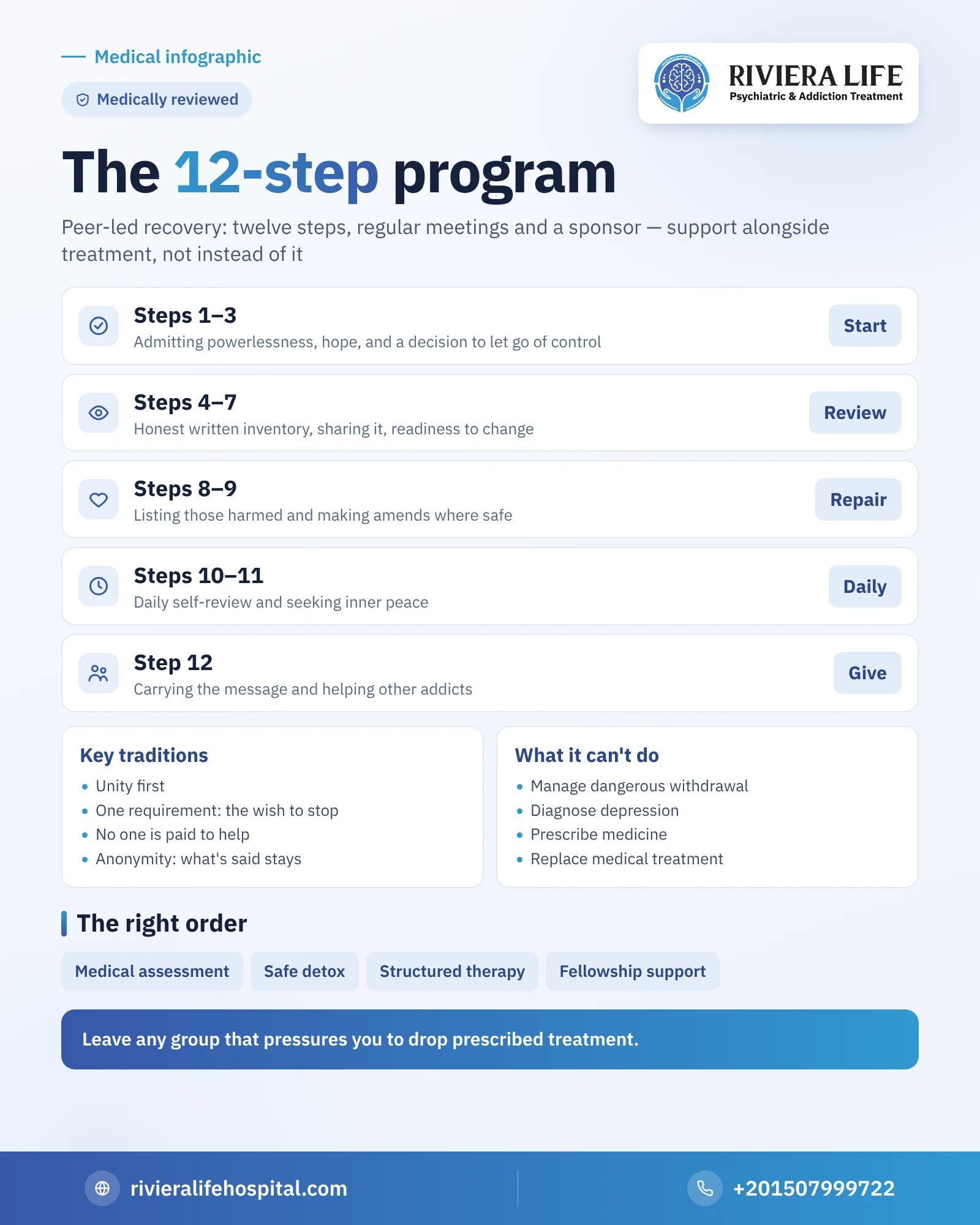
This is a simplified paraphrase of the meaning of the steps, not their literal text:
- Admitting powerlessness: acknowledging that the substance has taken over life and that willpower alone hasn’t worked.
- Hope: believing there is a power greater than oneself that can restore balance.
- The decision: handing the matter over to this power instead of trying to control everything.
- Personal inventory: an honest, written review of faults, fears and mistakes.
- Disclosure: sharing this inventory with a trusted person, usually the sponsor.
- Readiness: accepting that these faults can change.
- Humility: asking for help in getting rid of them.
- The list of harm: writing down the names of those harmed by the member’s behavior.
- Making amends: compensating or apologizing to them, unless doing so would harm them or others.
- Daily review: continuing to hold oneself to account and admitting a mistake as soon as it happens.
- Reflection and spiritual connection: seeking inner peace and clarity of direction.
- Carrying the message: helping other addicts and applying the principles in all areas of life.
What is meant by the higher power?
This is the point that raises the most questions. The program doesn’t impose a religion or a particular conception, but leaves each member to understand the “higher power” in the way that suits their convictions. Many in our communities understand it in its direct religious sense, while others see it in the group itself or in the principles of recovery. What matters is letting go of the idea that the person can control their addiction alone, an idea they have tried repeatedly and that has failed.
What are the program’s traditions?
Alongside the steps, which concern the individual, there are twelve traditions that concern the group itself and protect it from division. The most important of them:
- Unity first: the group’s interest comes before any individual’s opinion.
- One requirement for membership: the wish to stop, nothing more.
- Non-professionalism: no one is paid for helping others within the fellowship.
- Independence: the group isn’t tied to any body or institution, and relies on its members’ donations.
- Anonymity: what is said in the meeting stays there, and names aren’t mentioned outside it.
What happens in 12-step meetings?
Members sit in a circle, one of them opens the meeting with a short reading, then whoever wishes talks about their daily experience: a craving they resisted, a disagreement that nearly drove them back, or a day that passed in peace. No one interrupts, and no one gives direct advice to another. The periods members spend abstinent are celebrated, so the hard first days become an achievement everyone sees.
A member may return to using after a period of abstinence; they aren’t expelled or judged, but welcomed back to start counting again. But if the return is repeated, this indicates a need for professional intervention, such as the relapse treatment program.
Some meetings are open to relatives and interested people, and some are closed to members only. The newcomer usually chooses a “sponsor” further along in recovery, whom they call when the craving intensifies and who works through the steps with them.
Does the 12-step program work in treating addiction?
Measuring the program’s results precisely is difficult, because members are anonymous and no one records their data. But research indicates that regular attendance at meetings is linked to better chances of staying abstinent, especially with alcohol addiction. That is why a therapeutic approach called “twelve-step facilitation” was developed, in which the therapist helps the patient join the fellowship and benefit from it, and the US National Institute on Drug Abuse counts it among evidence-supported behavioral approaches.
On the other hand, the program doesn’t suit every person to the same degree. Some patients are put off by its spiritual character or by speaking in front of a group, and some first need treatment for a co-occurring psychiatric disorder within the dual diagnosis program. For these people there are alternatives and other paths, such as intensive individual therapy or support groups not based on a spiritual character.
Is the 12-step program enough on its own?
No. The fellowship doesn’t manage withdrawal symptoms, diagnose depression, or prescribe medicine. Someone who tries to start recovery from opioids, alcohol or sedatives with meetings alone may face dangerous withdrawal. So the right order is: a medical assessment, then safe detox when needed, then structured psychotherapy such as the Matrix program, and then the fellowship becomes part of the extended support.
How long does the 12-step journey take?
There is no set duration. Some members work through the steps in months, others take longer, and many return to particular steps whenever they go through a crisis. The program is designed to be an ongoing way of life, not a course that ends with a certificate. This is what makes it suitable for the aftercare stage that extends after intensive treatment ends.
What is the family’s role in the 12-step program?
There are independent groups for families of addicts that work on the same idea, in which relatives learn to stop trying to control the patient’s behavior and to look after themselves. This complements the family rehabilitation program that the treatment team offers in a professional and structured way.
Narcotics Anonymous (NA): what is it and how do you reach it?
Narcotics Anonymous, or NA, is the best-known fellowship applying the 12-step program to all kinds of addiction, and it grew out of Alcoholics Anonymous. It takes no fees and isn’t affiliated with any religious, political or medical body, and the only requirement for membership is the wish to stop using. It is based on anonymity: full names aren’t mentioned outside the meeting, and what is said inside it stays there.
The fellowship has a presence in a number of Arab countries, publishes its literature in Arabic, and the times of nearby meetings or online meetings can be found through its official website. Attending is especially useful after leaving hospital, when the person in recovery needs a daily environment that understands them without justification. But the fellowship isn’t a treatment provider, and doesn’t offer detox or treatment for co-occurring psychiatric disorders.
Support groups in recovery: their types and how to choose
The 12-step program isn’t the only support group. There is a wide range of groups, and what suits one person may not suit another. What matters is that the person in recovery finds an environment where they feel safe and keep attending.
- 12-step fellowships: based on shared experience, the sponsor and regular meetings.
- Family groups: teach relatives to look after themselves without trying to control the patient.
- Skills groups: such as SMART Recovery, based on cognitive behavioral therapy tools rather than a spiritual side, some held online.
- Hospital groups: group sessions led by a specialist therapist during and after treatment.
Try more than one meeting before you judge, as a group’s character changes with its members. And watch for signs that call for stepping away: pressure to give up a prescribed medicine or medical treatment, requests for money, or a promise of quick, guaranteed recovery. A good group doesn’t oppose the doctor.
However valuable this support is, it is an addition to treatment, not a substitute. To see its place in the whole journey, read the stages of addiction recovery, and for continuing after discharge see the aftercare program.
The right hospital for 12-step addiction treatment: how to choose
The right hospital here is one that uses 12-step principles as a bridge to long-term recovery, within a complete medical and psychological plan, not a substitute for it. Ask:
- Does treatment start with a medical assessment and safe detox before talking about the steps?
- Is there an introduction to the fellowship and real help in joining it, not just advice?
- Does the program respect the patient’s beliefs and not impose a particular interpretation?
- Is there individual psychotherapy alongside the group sessions?
- Are co-occurring psychiatric illnesses assessed and treated?
- Is there follow-up after discharge that connects the patient to support groups?
And don’t trust a place that promises a guaranteed recovery rate or claims the twelve steps can be completed in days.
How Riviera Life meets these standards
This is what the patient and their family find at Riviera Life in practice:
- Official licensing: a hospital licensed by the Ministry of Health.
- Fourteen years of experience: and thousands of recovered cases.
- A safe medical start: round-the-clock supervision during detox.
- Specialist consultants: in psychiatry and addiction treatment, treating what the fellowship doesn’t.
- A family program: helping relatives support without controlling.
- Aftercare: connecting the patient to ongoing support after discharge.
- Complete confidentiality: consistent with the principle of anonymity on which the program is based.
Book your free first consultation, or call us around the clock on +201507999722. The hospital is in Sheikh Zayed, Giza.
Read also
- The Matrix program for addiction treatment
- The aftercare program after treatment
- The relapse treatment program
- Alcohol addiction treatment