
The Matrix program for addiction treatment is a structured outpatient treatment model originally designed to deal with stimulant addiction such as ice (shabu) and cocaine. It combines cognitive behavioral therapy, education about addiction, relapse prevention, family involvement and regular testing in a single plan. It is one of the models that the US National Institute on Drug Abuse classes among evidence-based approaches for treating stimulant addiction. It usually suits someone whose medical condition is stable and who can attend regular sessions while living at home. On this page you will find the program’s components and stages, who it suits, what distinguishes it from others, and how Riviera Life Hospital provides it.
What is the Matrix program for addiction treatment?
The model appeared in the United States in the 1980s, when therapists were looking for an approach suited to patients with cocaine and then methamphetamine addiction, for whom there is still no approved medicine that blocks craving as there is for opioids. The solution was for treatment to become an intensive, structured behavioral program instead of relying on medication.
The name “Matrix” refers to a grid: treatment isn’t a single method, but a network of tools working together. The therapist plays the role of coach, not judge, so there is no hurtful confrontation or blame, but a relationship based on respect that helps the patient stay in treatment. Matrix is usually used within a broader plan on the path of drug addiction treatment that starts with assessment and detox.
Who does the Matrix program suit?
- Those with stimulant addiction: ice, cocaine, amphetamine and captagon.
- Those who have finished the detox stage and are stable, and want treatment that lets them continue working or studying.
- Those leaving a full inpatient program who need a structured transitional stage before fully returning to life.
- Patients using other substances such as hashish or alcohol in some cases, as the model’s principles have been adapted and applied to multiple substances.
It isn’t usually the first choice for someone with active psychosis, suicidal thoughts or physical complications that need close monitoring. These patients start with care inside the hospital, then move to Matrix after stabilizing.
What does the program consist of?
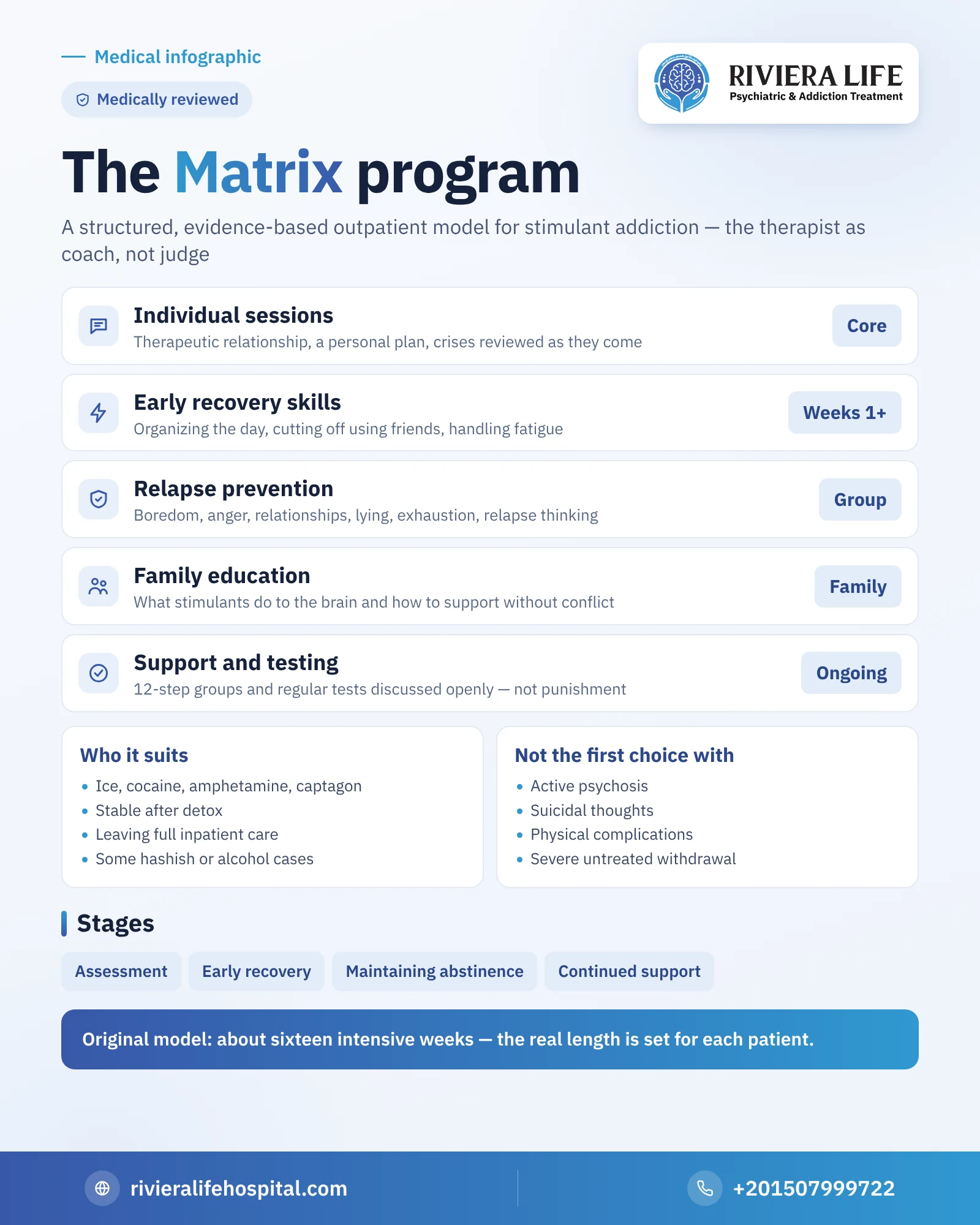
The Matrix program usually includes several types of session working in parallel, each with a specific function:
Individual sessions
The therapeutic relationship is built here, a personal plan is drawn up, and crises are reviewed as they come. A family member may attend some of these sessions.
Early recovery skills group
It focuses on the first weeks: how to organize your day, how to cut off a using friend, and how to deal with the disturbed sleep and fatigue that follow stopping stimulants.
Relapse prevention group
Group sessions covering successive topics: boredom, anger, relationships, lying, exhaustion, and the thinking that precedes going back to using.
Family education
Meetings that explain to the family what stimulants do in the brain, why the patient’s state fluctuates in the first months, and how to support them without conflict.
Support groups and regular testing
The patient is encouraged to join support groups such as the 12-step program, and regular tests are carried out whose results are discussed frankly, not as a means of punishment but as part of the plan.
How does the program proceed in stages?
- Assessment: the substance used, the length of use, the psychological state, accompanying illnesses and the family situation.
- Early recovery: organizing the day, identifying triggers, removing the tools of use, and getting through the period of exhaustion and depression that follows stopping.
- Maintaining abstinence: the period in which many think they are cured and relax. Here work focuses on preventing relapse and building alternative activities.
- Continued support: less intensive meetings and support groups, with a gradual move to the aftercare program.
How long does the Matrix program take?
The original model was designed as an intensive outpatient program of about sixteen weeks, followed by a lighter period of support. But this is a general framework, not a fixed rule. The actual length for each patient is set by the team after assessment, and may be longer with repeated relapse, an accompanying psychiatric disorder or use of more than one substance. The number of weekly sessions depends on the stage: more intensive at first, then gradually fewer.
What is the role of cognitive behavioral therapy in Matrix?
Cognitive behavioral therapy is the backbone of the program. The patient learns to notice the thought that precedes the craving, such as “I’ll use just once to finish the work”, then examines it and replaces it with a more realistic thought. They draw a map of their triggers: places, people, times and feelings. If you want to understand this approach in depth, read our guide to cognitive behavioral therapy.
The program adds motivational interviewing techniques to strengthen the patient’s desire to change, and rewards for small achievements such as a full week of clean tests, because a stimulant patient needs tangible reinforcement at a time when they lose the sense of pleasure.
Are medicines used within the Matrix program?
Matrix doesn’t rely on a specific medicine, because there is still no approved medicine for treating stimulant addiction itself. But the doctor may prescribe medicines to treat accompanying symptoms, such as severe insomnia, depression or anxiety, depending on each case. If clear psychiatric symptoms appear and persist after stopping, the patient is assessed for a possible independent disorder that needs the dual diagnosis program.
What is the difference between Matrix and other programs?
| Comparison | The Matrix program | Detox | The 12-step program |
|---|---|---|---|
| Goal | Changing behavior and preventing relapse | Getting through withdrawal safely | Ongoing support through fellowship |
| Who leads it | A specialized treatment team | A medical team | The recovering members themselves |
| Length | Weeks to months depending on the case | Usually days | Open-ended |
| Relationship to other programs | Completes detox and draws on the fellowship | A beginning that isn’t enough alone | A complement to professional treatment |
So the three programs aren’t competing; they complement one another in a single plan.
What if a relapse happens during the program?
A slip doesn’t mean the program has failed. Matrix treats it as information: what happened the day before? What link did the patient miss? Then the plan is adjusted, and sessions may increase temporarily. If relapses repeat or last longer, the patient needs a deeper path offered by the relapse treatment program.
What is the family’s role in the Matrix program?
In Matrix the family is a party that learns, not an observer that holds to account. It is asked to understand that exhaustion and irritability in the first weeks are part of recovering from stimulants and not evidence of going back to using, and to avoid humiliating searches and constant reminders of the past. For those wanting deeper work with the whole family, the family rehabilitation program offers a separate path.
The right hospital for the Matrix program: how to choose
The right hospital for applying the Matrix program is one that delivers it as it was actually designed, with all its components, not scattered sessions that merely carry the name. Ask before you decide:
- Does the place offer individual, group and family sessions together, or one session a week?
- Does the team have experience in treating stimulant addiction specifically, such as ice, cocaine and captagon?
- Are there regular tests whose results are discussed clearly?
- Can the patient be moved quickly to full inpatient care if psychosis appears or their condition deteriorates?
- Is there a psychiatric assessment to detect accompanying depression or anxiety?
- Is there a clear plan for after the intensive stage ends?
And avoid any program that promises a complete cure or claims that stimulant addiction ends within a few days.
How Riviera Life meets these standards in the Matrix program
Riviera Life delivers the Matrix program according to all of these conditions:
- Official license: a hospital licensed by the Ministry of Health.
- Years of experience: the team has worked for fourteen years in addiction treatment and has helped thousands of patients recover.
- A decision made by a consultant: consultants in psychiatry and addiction decide whether the Matrix program suits each patient’s case.
- Round-the-clock supervision: for those who need to start inside the hospital before moving to outpatient follow-up.
- A family program: explains the nature of recovery from stimulants and teaches support without conflict.
- Aftercare: continues after the intensive stage ends.
- Complete confidentiality: protects the patient’s data, work and studies.
Your first consultation with us is free; call +201507999722 at any time of day to ask about the Matrix program, or visit us in Sheikh Zayed, Giza.
Read also
- Ice (shabu / crystal) addiction treatment
- Cocaine addiction treatment: stages and follow-up
- The relapse treatment program
- The 12-step program for addiction treatment