The short answer
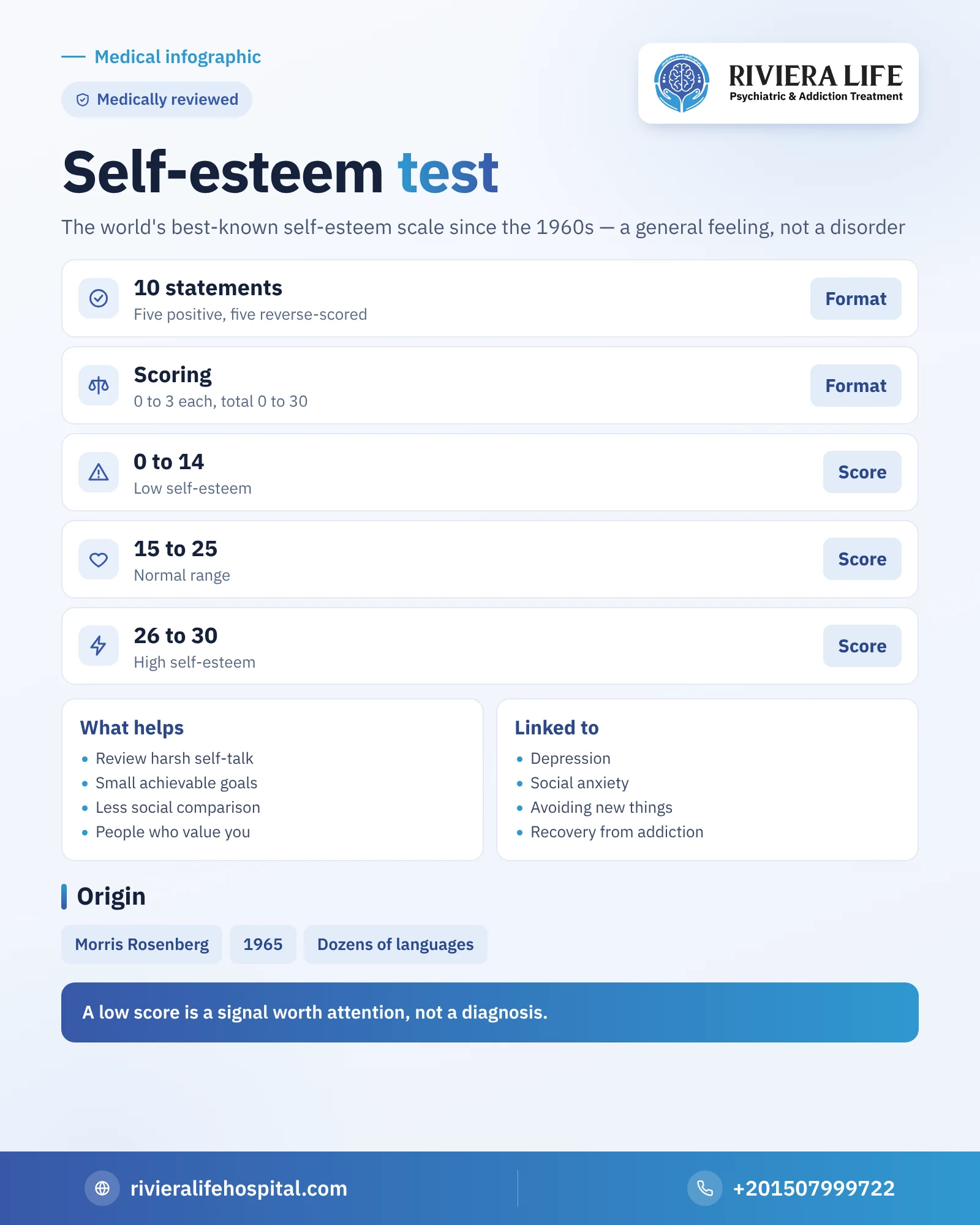
The Rosenberg self-esteem test is ten statements about how you see yourself, for each of which you choose between “strongly agree” and “strongly disagree”. Five statements are positive and five negative, scored in reverse, so the result ranges from 0 to 30. A score below 15 indicates low self-esteem, 15 to 25 is the normal range, and above 25 is high self-esteem. It has been the world’s best-known self-esteem scale since the 1960s, and it measures a general feeling, not a psychiatric disorder.
- Statements10 statements, half scored in reverse
- ScoreFrom 0 to 30
- Below 15Low self-esteem
Self-esteem is the inner voice that tells you your worth: do you deserve success? Does your opinion matter? Do your mistakes mean you are a failure, or that you are a person who is learning? When this voice is constantly harsh, it affects your choices, your relationships and your ability to try. This test helps you listen to that voice clearly.
Start the self-esteem test
Self-esteem test (Rosenberg)
How much do you agree with each statement?
To discuss your result with a psychiatrist in confidence, the first consultation is free on +201507999722.
This is an initial screening test for awareness, not a diagnosis. Your answers are not saved or sent to anyone; the calculation happens on your device only.
How is the result calculated?
In the positive statements, such as “I am satisfied with myself”, “strongly agree” scores three and “strongly disagree” zero. In the negative statements, such as “I sometimes feel useless”, the scoring is reversed. Then the scores are added up:
| Score | Meaning |
|---|---|
| 0 to 14 | Low self-esteem |
| 15 to 25 | Self-esteem in the normal range |
| 26 to 30 | High self-esteem |
What does low self-esteem mean?
A low score isn’t a diagnosis, but it is a signal that deserves attention, especially if accompanied by persistent sadness, social anxiety or avoiding new experiences. Low self-esteem is often linked to depression, and may be a result of it or one of its causes. If you feel sad and have lost interest, also try the depression test.
Steps that usually help include: noticing harsh inner talk and reviewing it fairly, setting small achievable goals, stepping away from constant comparison on social media, and spending time with people who value you. The article on low self-confidence covers these steps in detail.
Self-esteem and addiction
Many people recovering from addiction discover that their self-esteem was shattered during the years of use, because of broken promises and losses. Rebuilding it is an essential part of recovery and relapse prevention. Read self-confidence after recovery from addiction.
About the Rosenberg scale
It was developed by the American sociologist Morris Rosenberg in 1965, and is still the most widely used self-esteem scale in research around the world, translated into dozens of languages. The version here is a simplified translation for awareness, and the boundaries of its levels are approximate.
How can Riviera Life help you?
If low self-esteem is affecting your life or is accompanied by depression or anxiety, the therapists at Riviera Life can help you with a suitable psychotherapy program. The first consultation is free and confidential on +201507999722.
Read also
- Low self-confidence and a “weak personality”
- The SCOFF eating disorder test
- The GAD-7 anxiety test
- Psychological tests: the complete guide
Questions many people ask
Most results fall between 15 and 25, and a score below 15 indicates low self-esteem.
No, it is a general feeling, not a diagnosis, but it is often linked to depression and anxiety and deserves attention if it affects your life.