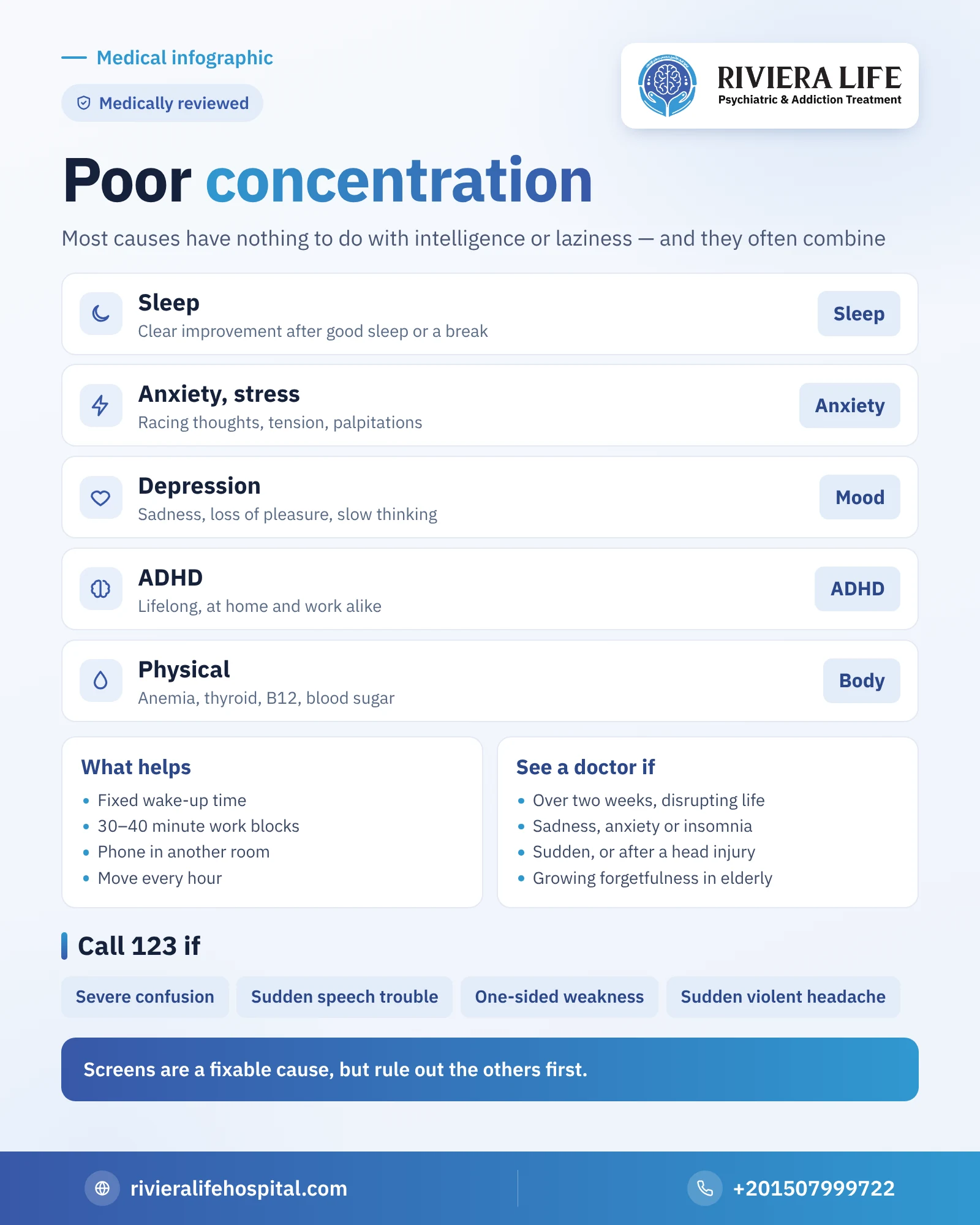
The causes of poor concentration are many, and most have nothing to do with low intelligence or laziness: short sleep, anxiety occupying the mind with side thoughts, depression slowing thinking, attention deficit hyperactivity disorder, anemia and thyroid disturbance, or a substance or medicine affecting attention. Sometimes the cause is an environment full of notifications that stops the brain staying on one task. This article arranges the causes in groups that make it easy to check yourself against them, and explains what deserves a visit to the doctor; it doesn’t replace a medical assessment.
What do we mean by concentration in the first place?
Concentration isn’t a single ability. When someone says they “can’t concentrate”, they may mean they can’t start studying, or start and then get lost after five minutes, or read the whole page and then remember nothing of it, or don’t catch what is said to them in a meeting. These are different problems, and each points in a different direction.
Attention includes the ability to choose a target, stay on it, ignore distractions, and bring yourself back to it after drifting. Working memory is the small space where you hold information for moments while you use it. Taking part in this network are the frontal lobe, which plans and inhibits, and neurotransmitters such as dopamine and noradrenaline. Anything that upsets this network shows up for you as distraction.
Sleep: the first cause we ignore
A single night of short sleep is enough to slow response, increase mistakes and make the mind wander. When this repeats for weeks, distraction becomes almost constant, and in a student or employee it may be mixed up with the picture of another illness. The point is that the number of hours alone isn’t enough: someone who sleeps eight broken hours because of snoring or pauses in breathing during sleep may wake up exhausted. If the tiredness comes with snoring and daytime sleepiness, ask a doctor about sleep apnea. To tell the types of problem apart, see sleep disorders, and if insomnia itself is the problem, you have the insomnia guide.
Anxiety and stress: a mind occupied with danger
Anxiety doesn’t steal concentration because the person isn’t interested, but because their attention is already taken. Part of the brain is monitoring possible threats: a message not answered, a payment coming due, a relative’s health. What attention is left for you isn’t enough for a paragraph in a book. Under severe stress the inner alarm rises, so attention becomes wide and shallow instead of deep, as the article on noradrenaline and stress explains. Someone who also has palpitations, muscle tension and thoughts that won’t stop may benefit from reading about anxiety symptoms and talking to a specialist. Burnout has its own picture in burnout.
Depression: slowness, not laziness
Many don’t link depression and concentration, but difficulty thinking and making decisions, and forgetting what you read a moment ago, are among its known symptoms. The person doesn’t wander because of excitement, but because thinking itself has become heavier and slower, and because the mind keeps returning to thoughts of guilt and failure. The family usually notices that the person was excelling and then their performance suddenly declined. If this comes together with sadness or loss of pleasure for more than two weeks, it is appropriate to read about depression symptoms and ask for an assessment. The ability to concentrate usually improves with treatment, although it sometimes lags behind the improvement in mood.
Attention deficit hyperactivity disorder
The essential difference between this disorder and the other causes is that it starts in childhood and continues across different situations, not in a particular period of stress. Among its signs: the person constantly forgets belongings and appointments, leaves tasks half done, and is distracted by any sound, but may concentrate for hours on something they love or that is exciting. Many adults don’t know they have it until their children are diagnosed. Diagnosis needs assessment by a specialist, not an online test; you will find the details in the ADHD guide, and the treatment options in ADHD treatment.
Physical causes worth checking
Before you attribute the problem to the mind, ask your doctor about these possibilities:
- Anemia and iron deficiency: cause fatigue and difficulty thinking, and are common in women and teenagers.
- Thyroid disturbance: an underactive thyroid may come with slowness and fogginess, and an overactive one with tension and restlessness.
- Vitamin B12 and vitamin D deficiency: testing for them is considered when other symptoms support it.
- Diabetes and blood sugar disturbance: low blood sugar quickly upsets attention.
- Migraine and chronic pain: they consume a large part of attention.
- Hormonal changes: such as pregnancy, after childbirth and menopause, which may be accompanied by depression or anxiety.
Simple blood tests detect most of these causes, and treating them brings back clarity in a relatively short time.
Substances and medicines that affect attention
Caffeine in large amounts gives apparent alertness followed by jitteriness and anxiety, and cutting it causes headache and dullness, as detailed in the article on caffeine and energy drink addiction. Nicotine gives a short boost, then distraction sets in as its level falls. Marijuana weakens short-term memory and attention even after the high wears off in someone who uses it regularly.
Sedatives and sleeping pills, including benzodiazepines, cause mental dullness and forgetfulness, as do some old antihistamines and other medicines. After stopping stimulants such as Captagon and shabu, weeks pass in which the mind feels heavy, which usually improves with time. If the problem appeared after starting a new medicine, talk to the doctor before any change, and don’t stop it yourself. On the other hand, don’t rely on “memory-boosting” pills passed around among students, as their evidence is weak, as the article Lucidril: does it strengthen memory? explains.
Screens and multitasking
The brain doesn’t perform two complex tasks together, but switches between them quickly, and each switch costs time and effort. Someone writing a report with their phone vibrating beside them pays this cost dozens of times an hour. Continuous scrolling on platforms trains attention to settle for short, quickly rewarding content, so books and lectures seem slow afterwards. You will find the details of this cycle in social media addiction. This cause is less serious than the others because it can be changed with small decisions, but it shouldn’t be assumed before ruling out the ones above.
How do you tell the causes apart?
| If you notice | The closest cause |
|---|---|
| Clear improvement after good sleep or a holiday | Lack of sleep or exhaustion |
| Racing thoughts, tension and palpitations | Anxiety or stress |
| Sadness or loss of pleasure with slow thinking | Depression |
| A long-standing problem since childhood, showing at home and work alike | ADHD |
| Tiredness, pallor, sluggishness and feeling cold, or tension and sweating | A physical cause such as anemia or the thyroid |
| Started after a substance or medicine | A side effect or withdrawal |
This table is approximate, for guidance only, as causes often come together: anxiety with insomnia, or depression with anemia.
Call an ambulance on 123 immediately if you see
Sudden distraction unlike the usual kind, especially if accompanied by:
- Severe confusion or not knowing the place and time
- Sudden difficulty speaking or understanding speech
- Weakness or numbness on one side of the body, or a drooping face
- A sudden violent headache, fainting or a seizure
What really helps?
Treatment follows the cause, but some steps usually help: fix your wake-up time, work in short periods of thirty to forty minutes with short breaks between them, put your phone in another room during an important task, and move a little every hour. Write down what is on your mind before you start so it doesn’t follow you while you work. And try opening only one file. If the problem continues for weeks despite these steps, or affects your study, work or relationships, an assessment is better than experiments. Reading about how to increase dopamine naturally also helps, as does the article on acetylcholine, which explains the neurotransmitter of attention and learning.
When should you consult a doctor?
- If the distraction continues for more than two weeks and starts disrupting study or work.
- If it is accompanied by clear symptoms of sadness, anxiety or insomnia.
- If it appeared suddenly in someone whose concentration was good, or after a head injury.
- If the family notices increasing forgetfulness in an older person.
- If a child is struggling at school and teachers describe them as constantly drifting off.
How can Riviera Life help you?
The consultant psychiatrists at Riviera Life assess sleep, mood, anxiety, and the medicines and substances the patient takes before deciding whether the problem is psychological, physical or both. The first consultation is free, confidentiality is complete, and our number is +201507999722.
More from the mental health guide
- ADHD: the complete guide
- Noradrenaline and stress
- Psychological stress: its signs and effect on the body
- Anxiety: the complete guide
Questions many people ask
Not always. It may result from little sleep, stress or anemia, but it can accompany depression, anxiety and ADHD. If it lasts weeks and affects your life, that is reason enough for an assessment.
Concentration is the ability to attend to something and stay on it, while memory is storing information and recalling it. Forgetting what you read often looks like poor memory when the cause is that you never attended to it in the first place.
This may happen with iron or vitamin B12 deficiency, for example, and the deficiency is confirmed by a test the doctor orders. Don't take supplements randomly, as extra doesn't improve concentration in someone without a deficiency.
Yes. Some sedatives, sleeping pills, old antihistamines and others may cause mental dullness. Discuss it with the doctor before any change and don't stop the medicine yourself.
If it starts suddenly with severe confusion, difficulty speaking, weakness on one side of the body or a violent headache, call an ambulance on 123 immediately.