Body dysmorphic disorder is a psychological condition in which a person is exhaustingly preoccupied with a flaw they see in their appearance, while others don’t notice it or see it as very minor: a “crooked” nose, skin “full of flaws”, hair “falling out”, or “small” muscles. It isn’t vanity or excessive interest in appearance, but real distress that may consume hours of the day and push the person to isolation. The important news is that it is a known disorder with effective treatment. Here we explain its symptoms, its relationship to the mirror and cosmetic surgery, its particular form in men known as muscle dysmorphia, its link to OCD, and methods of treatment.
What is body dysmorphic disorder?
The American Diagnostic Manual classifies this disorder within the family of OCD and related disorders. Its essence is two elements: preoccupation with an imagined or exaggerated flaw, and repetitive behaviors the person performs in response to this preoccupation, such as checking in the mirror, comparing or hiding.
It usually begins in adolescence, when awareness of the body and of others’ views increases, and it affects males and females. Many live with it for years without knowing it has a name, because they are embarrassed to talk about it or think the solution is in changing their appearance, not in treatment.
The difference between ordinary dissatisfaction and the disorder
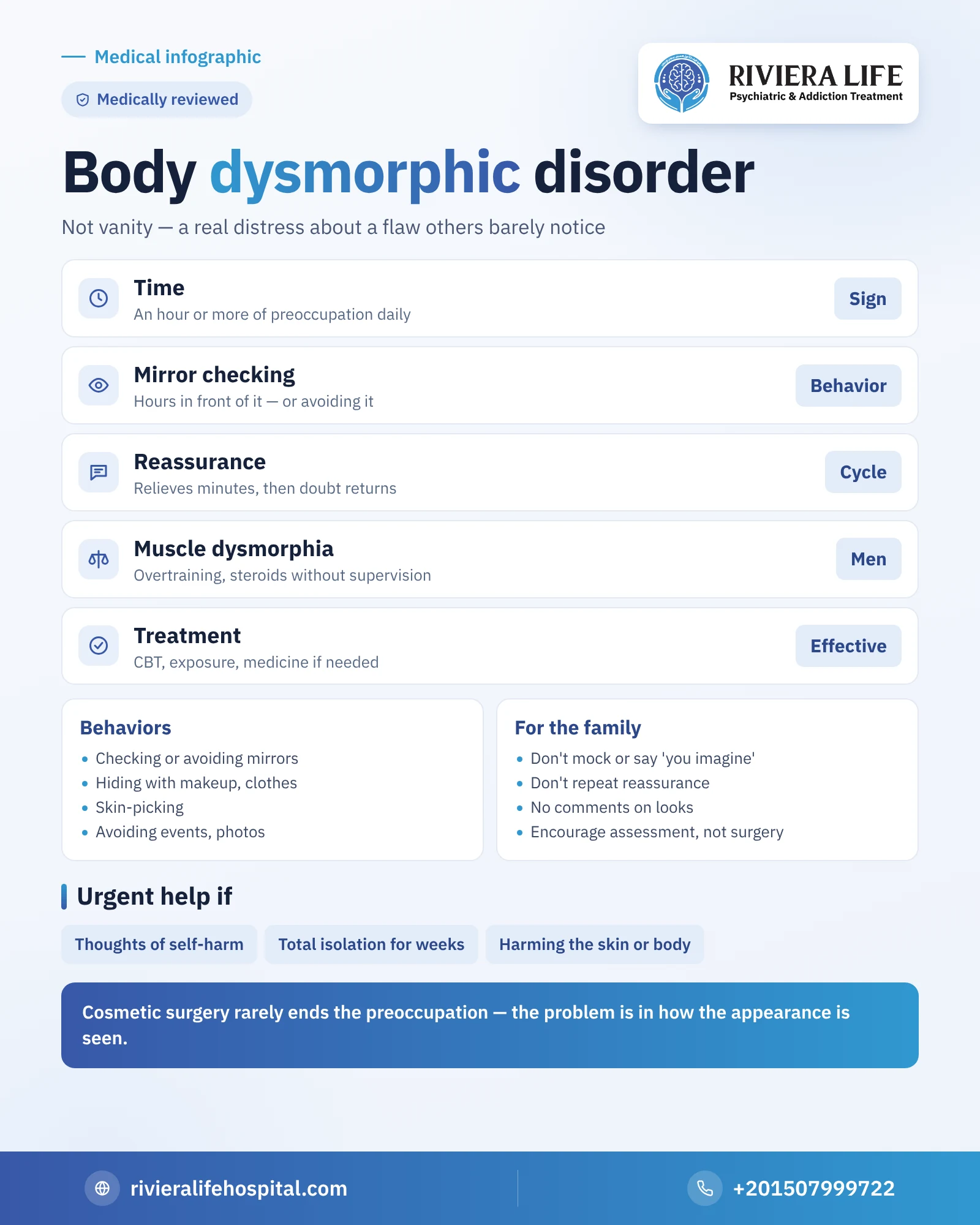
Most people don’t like something about their appearance. This is normal. It becomes a disorder when it turns into a daily burden:
| Comparison | Ordinary dissatisfaction | Body dysmorphic disorder |
|---|---|---|
| Time | A passing thought | Preoccupation that consumes an hour or more daily |
| Feeling | Mild annoyance | Shame, anxiety and intense self-disgust |
| Behavior | Doesn’t change life much | Checking, hiding and avoiding social situations |
| Reassurance | Relieves | Relieves for minutes then the doubt returns |
| Impact | Limited | Study, work and relationships are affected |
Common symptoms and behaviors
Thoughts
- A conviction that a part of the body is ugly, deformed or out of proportion.
- A feeling that people notice this flaw and talk about it or mock it.
- Constant comparison with others and with pictures on social media.
Behaviors
- Checking in the mirror: hours in front of the mirror or the camera, or on the contrary avoiding mirrors completely.
- Hiding: heavy makeup, hats, loose clothes and particular poses in photos.
- Seeking reassurance: asking family repeatedly “Is my nose big?” without being convinced by the answer.
- Picking at the skin: repeatedly picking spots or pulling hair in a way that may leave real wounds.
- Avoidance: refraining from occasions and photos, or going out only by day or only at night.
Many of these behaviors resemble rituals in OCD: the person performs them to ease their anxiety, feels relief for moments, then the anxiety returns stronger.
The mirror: a false friend
A young man stands in front of the mirror to make sure his skin is “acceptable” before going out. He sees a spot. He comes closer. He tries other lighting. Forty minutes pass and he is late for his appointment, then cancels it. This scene repeats daily for many.
The mirror here provides no information, but feeds the cycle. Long staring at a small detail magnifies it in perception, as if you were looking at it through a magnifying glass. That is why treatment works gradually to reduce checking, not to prove that the appearance is beautiful.
Why doesn’t cosmetic surgery solve the problem?
Many of those affected turn to dermatologists and cosmetic doctors before any psychiatrist. But the problem isn’t in the nose or the skin, but in the way of seeing them. That is why this story repeats often:
- The person has an operation and feels relief for weeks.
- Then the preoccupation moves to the same flaw “that wasn’t fixed well”, or to another part.
- They ask for a second and third operation, and may become angry with the doctor or feel their appearance got worse.
That is why many cosmetic doctors advise a psychological assessment when they notice repeated requests or exaggerated dissatisfaction. This doesn’t mean preventing every cosmetic procedure, but that psychological treatment comes first for someone who has this disorder.
Muscle dysmorphia: the form that affects men more
Among the forms of body dysmorphic disorder is what is known as muscle dysmorphia, in which the person sees their body as small or weak even though they may be muscular. It usually appears in young men who practice bodybuilding, and among its signs:
- Excessive daily workouts even with injury or illness.
- A very strict eating regimen and severe anxiety when it is broken.
- Avoiding the beach and wearing loose clothes to hide the body.
- Resorting to hormonal steroids or supplements without medical supervision, with the risks they carry to the heart, liver, hormones and mood.
Those around often think it is sporting commitment, while it is psychological distress that needs attention. The difference that helps the family notice: the enthusiastic athlete enjoys training and can miss it for a day without anxiety, while someone with muscle dysmorphia trains to escape a feeling of inadequacy, and is severely upset if they miss a workout or a meal.
The relationship with OCD and other disorders
The two disorders share intrusive thoughts and repetitive behaviors, and respond to similar treatment methods. Body dysmorphic disorder is often accompanied by depression and social anxiety, and sometimes eating disorders. It differs from eating disorders in that the preoccupation in it usually focuses on specific features, not on weight alone, though distinguishing them needs a doctor.
What causes the disorder?
There is no single cause, but an interaction between factors:
- A genetic predisposition, especially with OCD in the family.
- A difference in the way the brain processes visual details, so it focuses on the part and overlooks the whole picture.
- Experiences of bullying or mockery of appearance in childhood and adolescence.
- Perfectionism and extreme sensitivity to others’ evaluation.
- The culture of edited pictures and filters on social media, which sets an unrealistic standard of beauty.
How is body dysmorphic disorder treated?
Treatment begins with an assessment by a psychiatrist who determines the severity of the condition and what accompanies it. The most evidence-supported treatments:
- Cognitive behavioral therapy: helps examine thoughts about appearance and modify rigid convictions, and the article on cognitive behavioral therapy explains its basis.
- Exposure and response prevention: gradually facing the situations the person avoids, while reducing mirror checking, seeking reassurance and hiding.
- Medicines: the doctor may suggest one of the selective serotonin reuptake inhibitors, a class also used in OCD. The doctor alone determines the medicine and its duration, and it isn’t adjusted or stopped except under their supervision.
- Family support: the family learns how to stop repeated reassurance gently, and how to encourage without mockery or pressure.
Improvement comes gradually, and many regain their social and academic lives after treatment even if some thoughts remain in a lighter form.
How does the family deal with a son or daughter who has this disorder?
- Don’t mock the preoccupation, and don’t say “you’re imagining it”; the feeling is real to them even if you don’t see it.
- Don’t enter a long discussion about the flaw, and don’t repeat reassurance every time; it feeds the cycle.
- Avoid commenting on appearances and weights at home, even as a joke.
- Talk about the impact, not the appearance: “I notice you no longer go out with your friends, and that worries me”.
- Encourage them toward a psychological assessment instead of promises of cosmetic surgery.
When do you seek help? And an important warning
Seek an assessment if preoccupation with appearance takes an hour or more of your day, or has made you avoid people and occasions, or pushed you to repeated cosmetic procedures, or to steroids without supervision. In severe cases the distress may reach despair and thoughts of self-harm, and this is a symptom of suffering, not of the person’s weakness, and deserves immediate help. The article on suicidal thoughts explains how you or your family should act.
Seek urgent help immediately if there appear
Call an ambulance on 123 or the mental health hotline 16328, or go to the nearest emergency department.
- Thoughts of self-harm or that life isn’t worth it because of appearance
- Complete isolation at home and refusing to go out for weeks
- Harming the skin or body by trying to change the flaw yourself
At Riviera Life the psychiatry consultants assess the condition in complete confidentiality, and put together a plan combining psychotherapy and medicine when needed, with sessions for the family. The first consultation is free.
Read also
- OCD: the complete guide
- OCD treatment
- Symptoms of social anxiety
- Loneliness and social isolation
- Exercise addiction: when does training turn into a harmful attachment, and how does recovery begin?
- Anabolic steroids: the harms of steroids, dependence and treatment
Questions many people ask
It is classified within the family of OCD and related disorders, and shares intrusive thoughts and repetitive behaviors with it, but it is a separate diagnosis.
Usually not, because the problem is in how the appearance is perceived. The person may feel relief temporarily, then their preoccupation moves to the same flaw or to another part.
It usually begins in adolescence or early youth, and may continue for years without diagnosis because of embarrassment about talking about it.
A form of the disorder in which the person sees their body as small or weak even though they may be muscular, so they overdo exercise and may resort to steroids without supervision.
Many improve clearly with cognitive behavioral therapy and exposure and response prevention, and with a medicine the doctor determines when needed.