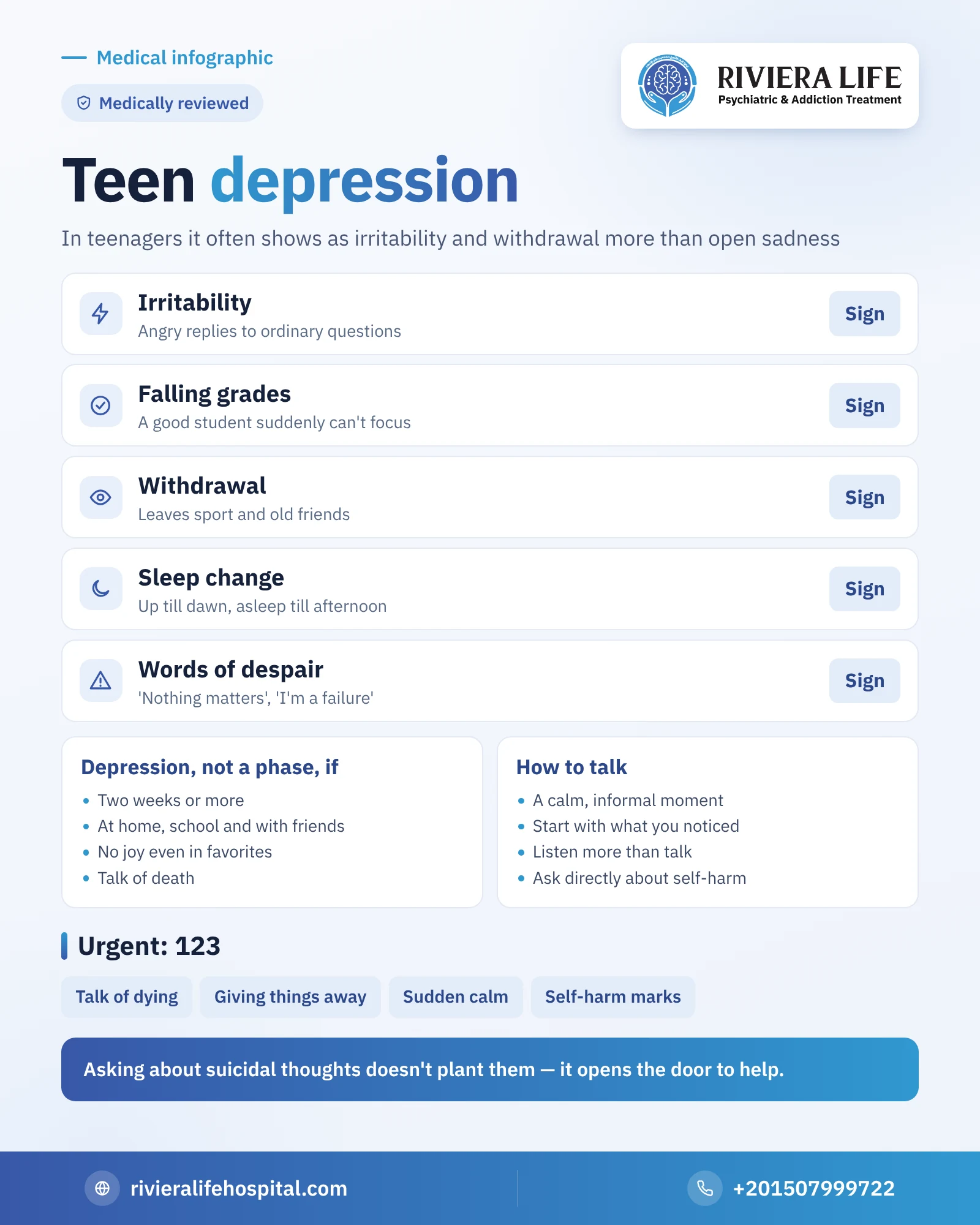
Teen depression is a real disorder that affects a not-small proportion of young people between about twelve and eighteen, and is often wrongly explained as “a phase” or “bad manners”. The difference is that normal teenage moods come and go, while depression lasts weeks and changes the child’s functioning at school, at home and in friendships. In teenagers it usually shows as irritability and withdrawal more than open sadness. This guide is for fathers and mothers: how to recognize the signs, how to open the conversation, and what safe treatment looks like.
Why is teen depression different from adult depression?
A depressed adult usually says they are sad or have lost hope. A teenager, however, may not have the words, or may not want to look weak in front of family and friends. So the pain comes out in behavior: quick temper, a closed bedroom door, and falling grades. That is why diagnostic criteria allow mood in young people to be “irritable” rather than sad. The general list of depression symptoms at all ages is in the article on depression symptoms; here we focus on what is specific to this stage.
Signs of teen depression that parents notice
- Irritability and outbursts: angry replies to ordinary questions, and impatience with siblings.
- A sudden drop in studies: a top student whose grades collapse, who is often absent, or who says he “can’t focus”.
- Withdrawal: leaving training or sport, moving away from old friends, and spending the day in his room.
- Changed sleep: staying up until dawn and sleeping until the afternoon, or clear insomnia.
- Repeated physical complaints: headaches and stomach aches, especially on school mornings.
- Extreme sensitivity to criticism or rejection.
- Words of despair: “Nothing makes a difference”, “I’m a failure”, “I wish I’d never been born”.
Normal teenage moods or depression?
A healthy teenager may be grumpy, prefer friends to family, and close the bedroom door. This is part of growing up. Three things point towards depression: duration, meaning two weeks or more on most days; pervasiveness, meaning the change appears at home, at school and with friends together; and loss of pleasure, so he no longer enjoys even what he used to love. If your son is irritable with you but laughs with his friends and studies acceptably, it is most likely a phase. But if he has switched off everywhere, this deserves an assessment. The difference between passing sadness and depression is detailed in the article on sadness vs depression.
Online behavior: what does it reveal?
The phone isn’t always the cause, but it is often a mirror. Pay attention to:
- Long late nights on the screen that wipe out sleep, then exhaustion at school.
- Sad posts or statuses, or phrases about death or disappearing.
- Intense following of content about sadness or self-harm.
- Mood collapsing after a message or comment, or suddenly deleting his accounts.
- Complete isolation from real friends in favor of a virtual world only.
Hidden monitoring and surprise searches usually destroy trust. It is better to ask with genuine curiosity about what he watches and whom he talks to, and to agree together on limits for night-time use.
Bullying and social media
Bullying at school or online is one of the strongest triggers of teen depression, and its effect continues inside the home because the phone doesn’t switch off. Many teenagers don’t talk about it out of shame or fear that the parents will intervene in a way that makes things worse. Signs that raise suspicion: refusing to go to school, missing or damaged belongings, and tension when a notification arrives. Constant comparison with other people’s “perfect” pictures adds a feeling of being less attractive or successful. If you discover bullying, listen first, then agree with your child on steps for dealing with the school.
Teenagers at higher risk than others
There is no single cause, but doctors pay more attention when certain factors come together:
- A family history of depression, bipolar disorder or addiction.
- Sharp conflict between the parents, divorce, or losing one of them.
- Constant academic pressure, especially in exam years and the final secondary year, with the child’s worth tied to their total score.
- Another accompanying disorder such as anxiety, ADHD or learning difficulties.
- A chronic physical illness, or a traumatic experience.
Having these factors doesn’t mean the child will inevitably become depressed, but it is a reason for early attention.
Depression and drugs in teenagers
Some depressed teenagers try hash, alcohol or sedative pills to escape their feelings, and some become depressed after starting to use. The result is a cycle that is hard to break without help. If you notice a strange smell, money disappearing, or new friends he refuses to talk about, read the article on how to know if my son is addicted to drugs, which distinguishes signs of use from teenage changes. And when the two come together, the child needs treatment that deals with both, as in the addiction treatment program for students and teenagers.
How do you talk with your teenager?
- Choose a calm, informal moment: in the car or on a walk, as face-to-face confrontation frightens some teenagers.
- Start with what you noticed, not with judgment: “I’ve noticed you don’t go out with your friends like before, and I’m worried about you”.
- Listen more than you talk, and don’t interrupt to correct or advise.
- Avoid sentences like “You have everything, what are you depressed about?” or “That’s just being spoiled”.
- If he refuses to talk, leave the door open: “I’m here whenever you want to talk”.
- Ask him directly whether he has thoughts of harming himself. The question doesn’t plant the idea; it opens the door to help.
Treating teen depression: psychotherapy first
Treatment starts with an assessment by a child and adolescent psychiatrist or a psychiatrist experienced with this stage, who rules out physical causes and assesses risk. In mild and moderate cases, psychotherapy is usually the first step, especially cognitive behavioral therapy and interpersonal therapy adapted for teenagers, with sessions for the parents. Treatment includes regulating sleep, a gradual return to activity and sport, and coordinating with the school if needed.
In moderate cases that don’t improve, or in severe ones, the doctor may add an antidepressant. The medicines used with this age group are specific, and need close follow-up in the first weeks, because some young people may feel increased tension or dark thoughts at the start. That is why parents are asked to watch for any change and report it immediately, and the dose isn’t adjusted or the medicine stopped except by the doctor’s decision. More about this class of medicines is in the article on antidepressants.
Seek urgent help immediately if you see
Call the ambulance on 123 or go to the nearest emergency department, don't leave your child alone, and keep medicines and dangerous tools out of reach. You can ask for guidance from the mental health hotline 16328.
- Talk of death, of wanting to disappear or end their life
- Giving away personal belongings or writing goodbye messages
- Sudden, unexplained calm after a period of severe depression
- Signs of self-harm on the body
When should you seek help?
Ask for an assessment if the signs continue more than two weeks, his school performance clearly declines, he withdraws from all his relationships, or he starts using any substance. Don’t wait for him to “grow up and forget”; untreated depression in adolescence may recur in young adulthood. With early treatment most teenagers improve and return to their lives. The details of treatment options for adults and young people are in the article on depression treatment.
How can Riviera Life help you?
At Riviera Life in Sheikh Zayed, our consultant psychiatrists assess your child calmly and confidentially, and set a plan that starts with psychotherapy and includes the family, with careful follow-up if medication is needed, and round-the-clock medical supervision for cases that need protection. The first consultation is free on +201507999722.
More from the depression guide
- Depression: the complete guide
- Depression symptoms
- Sadness vs depression
- Depression and addiction
- Psychological changes in adolescence: what is normal and what is worrying?
- Bullying: its forms, signs and how parents and schools should act
Questions many people ask
No, a calm, direct question doesn't plant the idea; it makes them feel someone cares and opens the door to help.
Irritability alone may be part of adolescence. But if it continues for two weeks or more with withdrawal, falling grades and loss of pleasure at home and school together, it is better to ask for an assessment.
Doctors use specific medicines for this age group when needed, with close follow-up in the first weeks to watch for any increase in tension or dark thoughts. They aren't adjusted or stopped except by the doctor's decision.
Explain that the aim is for him to feel better, not to be punished, and offer to let him choose the appointment or go with someone he trusts. If danger signs appear, seek urgent help without waiting for his agreement.
Late nights on screens, cyberbullying and constant comparison may contribute to depression in some teenagers, but the phone is rarely the only cause.