The causes of anxiety and its disorders aren’t limited to one factor. What usually happens is that an inherited predisposition, a sensitive temperament and an easily triggered alarm system in the brain meet with pressures or hard experiences, and anxiety begins. Then come habits that seem logical, such as avoidance and seeking reassurance, turning passing anxiety into a lasting state. And sometimes a physical illness, a substance or a medicine may be behind the symptoms. This article explains the biological, psychological and social factors, then the loop that makes fear continue even after its cause has gone.
The alarm system in the brain: where does anxiety start?
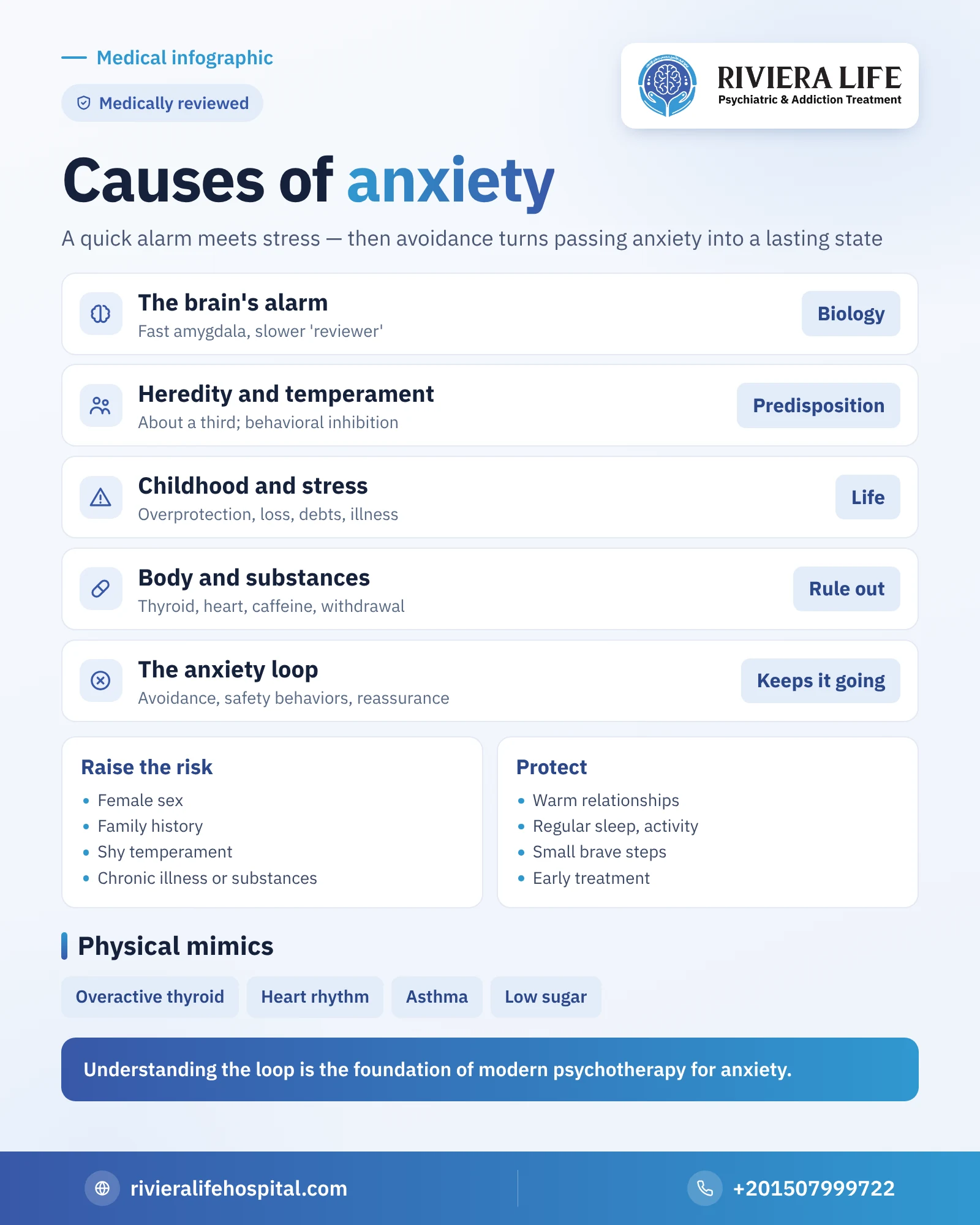
Deep in the brain is a small area called the amygdala, whose job is to pick up any danger signal very quickly, before we think about it consciously. When its signal fires, the body prepares immediately: the pulse rises, breathing speeds up, and attention is alerted. In contrast, areas at the front of the brain, the prefrontal cortex, work like a “reviewer” that assesses the situation and calms the alarm if it turns out to be false. Imaging research indicates that this balance is disturbed in many anxiety patients: an alarm that fires quickly, and a slower review in stopping it.
Is anxiety hereditary?
Anxiety disorders are more widespread in certain families than others. Twin studies estimate that heredity explains a moderate part of vulnerability, about a third for some types and a little more for others such as panic disorder. But what is inherited isn’t “anxiety illness” itself, but a general sensitivity to stress that may appear as generalized anxiety in the mother, social phobia in the son and depression in the uncle. More importantly, genes alone aren’t enough; many carry the predisposition and never develop it.
A sensitive temperament since childhood
Some children are born with a temperament researchers call “behavioral inhibition”: a child who stops and watches for a long time before approaching something new, is tense with strangers, and needs longer to adapt. This temperament isn’t a flaw, but it raises the likelihood of anxiety disorders appearing later, especially social phobia. And the way the parents deal with this temperament, with calm encouragement or with overprotection, greatly affects its course.
Brain chemistry and neurotransmitters
Several neurotransmitters take part in regulating anxiety, most prominently serotonin, noradrenaline and the calming gamma-aminobutyric acid known by the abbreviation “GABA”. The idea of “a chemical deficiency” is an oversimplification, as the matter is closer to a disturbance in the regulation of whole neural circuits. But these transmitters explain why some medicines, such as serotonin reuptake inhibitors, help many patients, and why sedatives calm symptoms quickly then cause dependence.
Childhood experiences and parenting styles
A child learns fear by observation before speech. When he sees his mother trembling at dogs, or hears his father expecting catastrophe in every news item, he absorbs that the world is a dangerous place. Among the factors linked to increased anxiety later as well: overprotection that prevents the child from trying hard situations himself, constant criticism, family instability, the loss of a parent, bullying, and exposure to abuse. These experiences don’t sentence the child to anxiety, but they make his alarm system more alert.
Pressures and life events
The disorder often starts after a specific event: the death of a relative, divorce, losing a job, accumulated debts, a chronic illness, or the birth of a child. Pressure may also accumulate quietly without a big event, such as continuous work pressure with lack of sleep for years. And severe traumas such as accidents and violence may lead to a different picture, post-traumatic stress disorder, which has a separate chapter in modern classifications.
Physical causes and organic illnesses
A number of illnesses can cause symptoms almost identical to anxiety, or make it worse, including:
- An overactive thyroid.
- Heart rhythm disorders.
- Asthma and chronic lung diseases.
- Episodes of low blood sugar in diabetics.
- Some rare tumors that secrete stress hormones.
- Chronic pain and long illnesses in general.
That is why the doctor is careful to rule out these causes before diagnosing an anxiety disorder, especially if the symptoms started at a later age without any previous history.
Substances and medicines that may set off anxiety
Caffeine in large amounts, energy drinks, and some decongestant, asthma and cortisone medicines may be enough to ignite anxiety in someone predisposed to it. Stimulants such as cocaine and amphetamines cause clear anxiety and panic. Cannabis and hash may calm some temporarily, but set off panic attacks in others. And among the strongest causes of anxiety is also withdrawal from alcohol or sedatives, when either is used regularly then stopped suddenly.
Ways of thinking: beliefs that feed anxiety
It isn’t only about what happens to us, but how we read it. Many anxiety patients have a familiar pattern of thinking: great difficulty tolerating uncertainty, so “maybe” becomes equal to “probably”. And an exaggerated estimate of the likelihood of danger, with an underestimate of the ability to deal with it if it happens.
There is also a hidden belief that keeps anxiety going, which is the feeling that anxiety itself is useful, and that stopping thinking about the problem is negligence that may bring catastrophe. On the other side, some fear anxiety itself, believing it will lead them to madness or illness. These beliefs usually form with temperament and early experiences, and the good thing is that they can be changed through training.
Why does fear continue? The anxiety loop
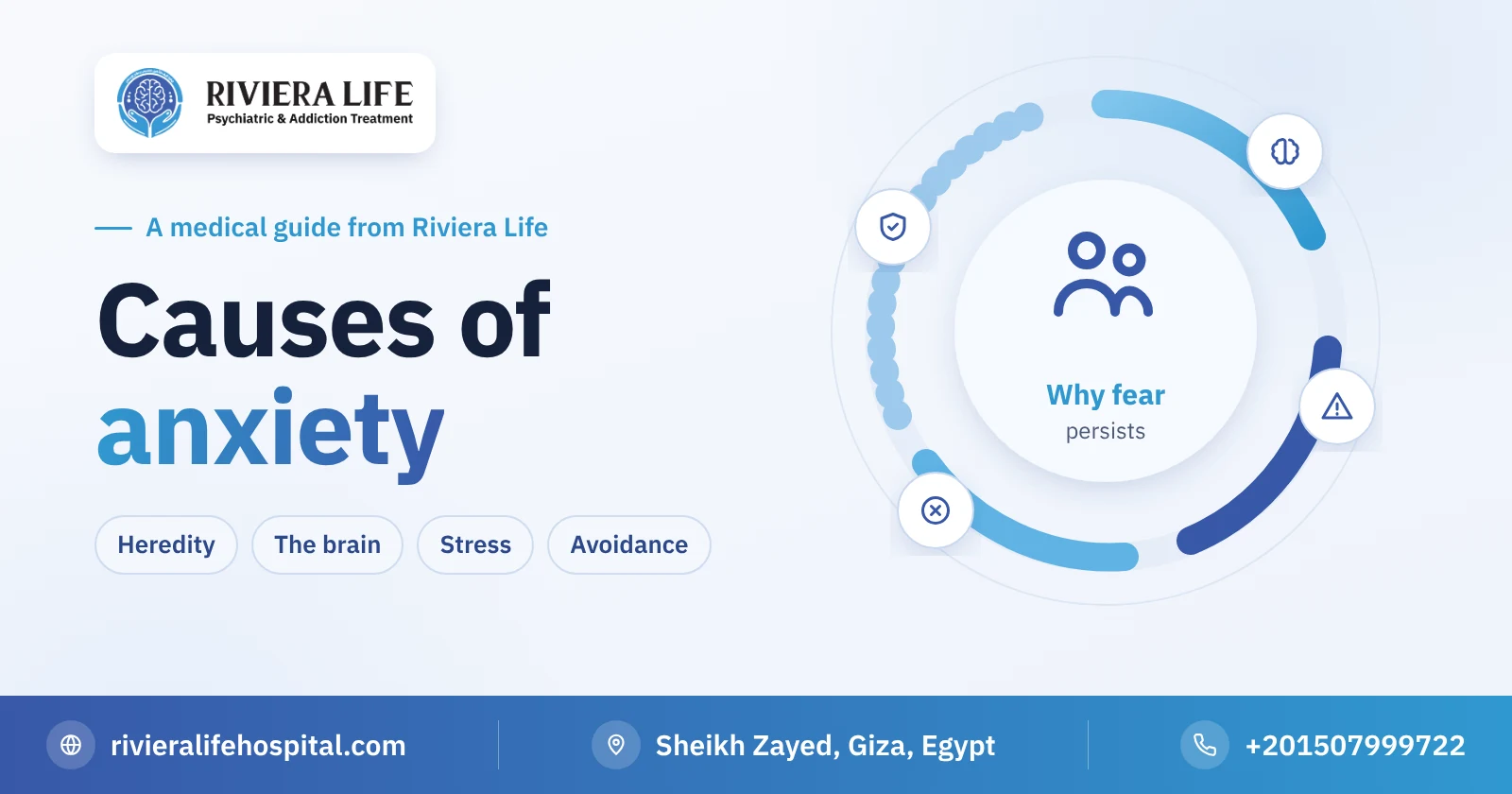
This is the part many overlook. Even if the first cause goes away, anxiety may continue because the way of dealing with it feeds it. Imagine a woman who had a panic attack in the supermarket. The next time she avoids going, and feels immediate relief. This relief “rewards” avoidance, and fixes in the brain that the place really is dangerous. After months she may avoid all crowded places. The loop works through several mechanisms:
- Avoidance: relieves in the moment but prevents the brain from discovering that the danger is exaggerated.
- Safety behaviors: such as carrying a bottle of water or a sedative “just in case”, so the person attributes their survival to it, not to the situation being safe.
- Seeking reassurance: calms for minutes, then the doubt returns stronger and needs new reassurance.
- Catastrophic interpretation: reading palpitations as a heart attack, so fear increases, so palpitations increase.
- Excessive monitoring of the body: constant focus on sensations makes them seem stronger and more dangerous.
Understanding this loop is the basis of modern psychotherapy, as we explain in the article on anxiety treatment.
Factors that raise the risk of developing it
- Females are more prone than males to most types of anxiety.
- A parent, sibling or child having anxiety or depression.
- A shy or reserved temperament since childhood.
- Chronic pressures, trauma or abuse in childhood.
- Chronic physical illnesses.
- Substance use or misuse of sedatives.
- Another psychiatric disorder such as depression or obsessive-compulsive disorder.
What protects against anxiety?
Protective factors don’t cancel predisposition, but they lessen its effect: warm relationships in which the person finds someone to listen, regular sleep, physical activity, encouraging the child to try new situations in small steps instead of protecting them from them, and learning problem-solving skills. And early treatment when the first symptoms appear, before the pattern of avoidance forms, protects against a long course.
How does Riviera Life help you?
Knowing the cause changes the plan. That is why the consultant psychiatrists at Riviera Life start with an assessment that rules out organic causes and substances, and looks for the factors that feed your anxiety specifically, then build treatment that targets them. The first consultation is free and takes place in complete confidentiality.
More from the anxiety guide
- Anxiety: the complete guide
- Anxiety symptoms
- Types of anxiety
- Anxiety treatment
- Negative thinking and negative feelings: its patterns and how to free yourself from it
- Fear of the future: why it happens and how to stop expecting the worst
Questions many people ask
Yes, anxiety often starts from an accumulation of small factors with a personal predisposition, without a big event that can be pointed to. The absence of a clear cause doesn't mean the symptoms aren't real.
Anemia and a deficiency of some elements may cause palpitations, tiredness and dizziness that resemble anxiety or increase it. That is why the doctor may ask for simple tests before diagnosis.
Caffeine in large amounts raises the pulse and increases tension and insomnia, and may set off panic attacks in those with a predisposition. Reducing it gradually helps many patients.
Because avoidance gives you immediate relief, so the brain learns that the situation is dangerous and that escape is the solution. Over time the fear widens to include more situations.
Children inherit a predisposition, not a certain illness, and they also learn ways of dealing with fear from their parents. Encouraging upbringing and treating the parents' anxiety reduce the chances of it passing on.