Negative thinking isn’t being sad or worried sometimes; these are normal feelings for every human being. The problem is when the inner voice turns into a permanent interrogator: it expects the worst, magnifies the small mistake, belittles any success, and convinces you tomorrow will be like today. And you may live with this voice for years thinking it is “your nature”. In this article we distinguish between normal negative feelings and harmful negative thinking, present its best-known patterns, explain how to deal with thoughts step by step, and when the matter becomes a sign of depression or anxiety that deserves treatment.
Negative feelings and negative thinking: not the same thing
Anger, fear, sadness and jealousy are feelings with a function. Fear alerts you to danger, sadness points to a loss, and anger shows you a limit someone has crossed. Trying to drive all these feelings away doesn’t work, and often magnifies them.
Negative thinking is a way of interpreting events that automatically leans towards the worst possible interpretation. Someone didn’t reply to your message: the feeling may be worry, but negative thinking jumps to “I’ve annoyed him” or “no one cares about me”. The difference matters because feelings pass, while thoughts, when they repeat, entrench feelings and reproduce them.
The best-known patterns of negative thinking
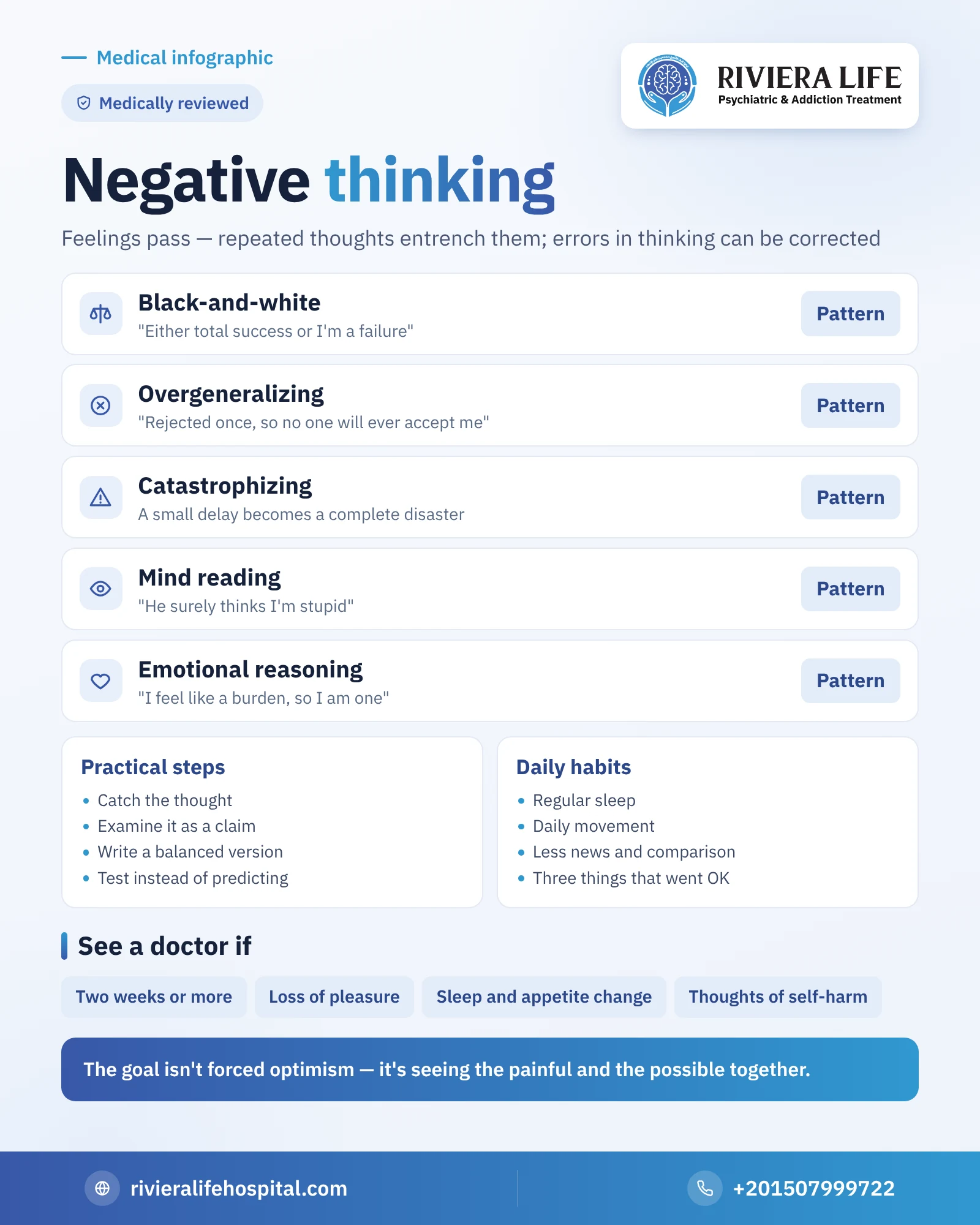
Cognitive psychologists have described a set of recurring errors in thinking, called cognitive distortions. Here are the best known with examples you will recognize:
- Black-and-white thinking: “Either I succeed completely or I’m a failure”.
- Overgeneralizing: “My request was rejected once, so no one will ever accept me”.
- Catastrophizing: turning a small delay into a complete disaster.
- Mind reading: “He surely thinks I’m stupid” without him saying anything.
- Predicting the worst: “I’ll fail the interview, so there’s no point going”.
- Negative filtering: remembering the single criticism among ten compliments.
- Emotional reasoning: “I feel like a burden, so I am a burden”.
- Excessive self-blame: holding yourself responsible for something that wasn’t in your hands.
You may find yourself in more than one pattern, and this is normal. What matters is knowing they are errors in thinking that happen to everyone, and that an error can be corrected.
Why does the mind cling to the negative?
There is a common evolutionary explanation: our ancestors who paid attention to danger more than beauty survived more. So the mind gives painful events more weight than good ones. Alongside that, other factors play their role:
- Childhood experiences, such as constant criticism, comparison or bullying.
- Long psychological stress, exhaustion and lack of sleep.
- Depression and anxiety, as both color thinking dark.
- Excessive following of the news and comparing oneself with others’ images on platforms.
- Substance use, especially in the withdrawal period, when dark thinking increases.
For more on the effect of stress see psychological stress: its signs and effect on the body.
What is the effect of negative thinking on the body and relationships?
Dark thoughts don’t stay in the head. They may raise the body’s tension so muscle tightness, headache, and disturbed sleep and digestion appear. And they push their owner to avoidance: he avoids opportunities for fear of failure, and avoids people for fear of rejection, so the positive experiences that would have corrected the thought decrease, and the negativity confirms itself. In relationships it may appear as constant suspicion, sensitivity to criticism or expecting to be let down.
How do you deal with a negative thought? Practical steps
1. Catch the thought
The first step is to notice that a thought has passed. Ask yourself: what was I telling myself before my mood changed? Writing the sentence down word for word reduces its power.
2. Examine it as if it were a claim
Ask: what is the evidence for it and what is the evidence against it? Would I say this to a friend in my position? And what would be the fairest interpretation of the situation? The aim isn’t forced optimism, but getting closer to reality.
3. Form a balanced alternative
Instead of “I’m a failure” say “this performance wasn’t what I wanted, and I’ll find out what I need to improve”. An honest sentence that neither beautifies nor punishes.
4. Experiment instead of predicting
If the prediction says “no one will care about my project”, show it to one person and watch what happens. A small experiment changes the thought more than arguing with it.
5. Step away from ruminating on the thought
Ruminating on a thought for hours doesn’t solve it. Set a short time to think about the problem and after it start an activity that occupies your hands and attention: a walk, tidying or a call. And if this keeps you awake at night, think about sleep disorders and their link with magnified thoughts.
Daily habits that ease negativity
- Regular sleep; an exhausted mind is harsher on its owner.
- Suitable daily movement, even a short walk.
- Reducing hours of news and comparisons on platforms.
- Writing down three things that went well or acceptably at the end of the day, not to convince yourself everything is beautiful but to train your attention on a balanced view.
- Connecting with someone who listens to you without judgment.
- Staying away from alcohol and sedatives as a way to silence thoughts; they calm for an hour and increase anxiety later.
Is the goal to think positively all the time?
No. The advice “think positively” makes many feel guilty because they can’t, and turns normal sadness into an extra failure. The realistic goal is balanced thinking: seeing the painful side and the possible side together. If a dear person dies, sadness is completely appropriate, and if you lose a job, worry is understandable. Harmful negative thinking is what goes beyond the situation: it generalizes, judges the future and is harsh on the self.
How do you help those around you get rid of negativity?
If a member of your family repeats dark phrases all the time, don’t start by arguing with him or saying “you’re exaggerating”. Try acknowledging his feelings first: “You’re clearly very tired”. Then gently ask about the evidence he relies on, and suggest a small step with him such as going for a walk. And if it goes on for long or withdrawal and changes in sleep and eating appear, encourage him to see a doctor, without pressure or mockery.
When is it more than negative thinking?
Ask for an assessment by a psychiatrist if low mood or dark thoughts continue for two weeks or more, are accompanied by loss of pleasure and changes in sleep and appetite, disrupt your work and relationships, or anxiety and tension increase to an unbearable degree. These may be signs of depression or anxiety, both treatable conditions. In such cases don’t rely on willpower alone.
And if thoughts of ending life or self-harm appear, this deserves immediate help. Call an ambulance on 123 or the mental health hotline on 16328 or go to the nearest emergency department, and don’t stay alone.
The role of cognitive behavioral therapy
The most studied psychotherapy in this area is cognitive behavioral therapy. In it the patient learns with the therapist how to catch automatic thoughts, test them and replace them with phrasings closer to reality, and tries new behaviors that reinforce change. Its sessions are structured with homework between sessions, and it is used in depression, anxiety, panic attacks and others. The doctor may add a medicine when symptoms are severe, as our article on depression treatment explains, and the medicine isn’t changed or stopped except by the doctor’s decision.
How can Riviera Life help you?
If you feel your negative thoughts are too heavy to deal with alone, you can request a free first consultation with a consultant psychiatrist at Riviera Life in Sheikh Zayed, Giza. The hospital is licensed by the Ministry of Health, and the service is provided in complete confidentiality. Call +201507999722.
Read also
Questions many people ask
Negative feelings such as fear and sadness are normal and temporary, while negative thinking is a repeated tendency to interpret things in the worst light, which entrenches feelings and prolongs them.
It isn't an illness in itself, but it may be a symptom of depression or anxiety if it lasts two weeks or more and affects life.
There is no off switch, but you can catch the thought, write it down, examine the evidence for it and form a balanced alternative, then move to an activity that shifts your attention.
No. The goal is balanced thinking that sees the painful and the possible together, not forced optimism.
Yes, it trains you to discover automatic thoughts, test them and replace them, and is used a lot in depression and anxiety.