Fear of the future is constant worry about events that haven’t happened yet: a job that may be lost, money that may run out, children who may not be raised well, illness that may come. It is a human feeling everyone knows to some degree, and it becomes a problem when it steals the present, exhausts sleep and prevents decisions. The basic idea of this article is that the future itself isn’t what is frightening, but what we can’t predict and control. Here you will find how to distinguish useful caution from disabling anxiety, where the fear comes from, practical exercises for dealing with it, and when the matter needs a doctor.
Useful caution and disabling anxiety
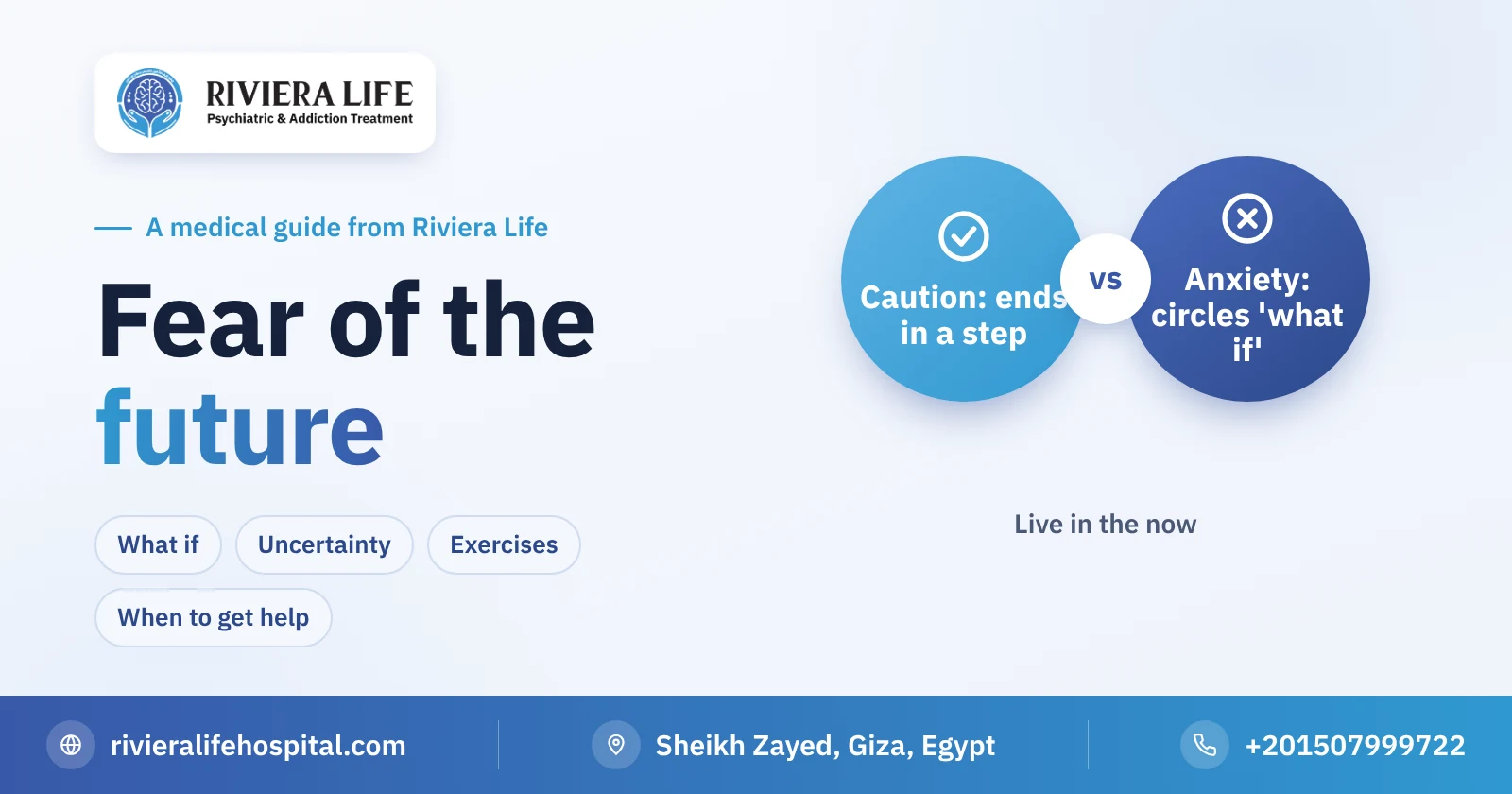
Thinking about tomorrow is a human strength: we save money, learn a new skill, and get a regular check-up. This is worry that turns into action and then calms down. Pathological anxiety, however, runs in a loop: a frightening thought, then searching and imagining the worst possibilities, then a feeling of tension, then a new thought, without ever ending in a decision.
Try this question: is what is preoccupying me now something I can take a step on today? If the answer is yes, it is a problem to solve; if no, it is a possibility to guess at, and guessing doesn’t change it however much you do it.
What does fear of the future look like in daily life?
- You find yourself living in “what if” more than in “now”.
- You postpone important decisions such as marriage, changing jobs or traveling because you can’t guarantee the outcome.
- You picture the worst scenario as if it were the only possibility.
- You wake at dawn or fall asleep late with your mind busy planning.
- You feel tightness in your chest or shoulders, or palpitations, at economic news or when comparing yourself with others.
- You don’t enjoy a success or a holiday because you are thinking about what might spoil it.
- You need repeated reassurance from others that doesn’t last.
Where does this fear come from?
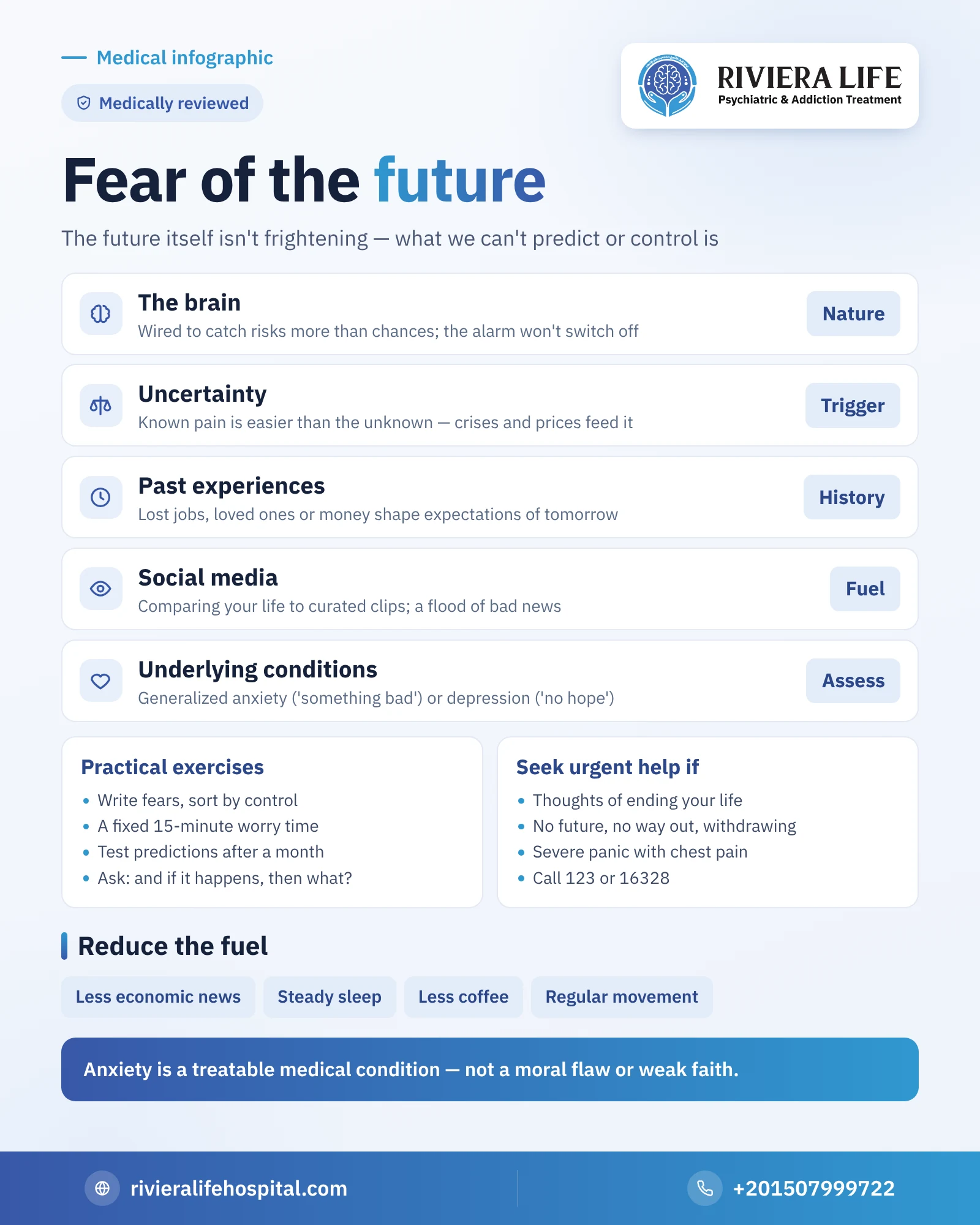
The nature of the brain
The brain is programmed to catch risks more than opportunities, because ignoring danger is more costly. But when this alarm works without stopping, it becomes an instrument of torment rather than protection.
Uncertainty
Many people tolerate known pain more easily than ambiguity. That is why anxiety intensifies in times of economic crisis, fluctuating prices and changing jobs.
Past experiences
Someone who has lost a job or a loved one, or lived through financial hardship, builds their expectation of the future on what has passed, and tries to prevent the pain repeating by thinking about it excessively.
Temperament and upbringing
A person sensitive to threat, a perfectionist, or someone raised in a home full of warnings usually carries more anxiety. This is explained in our article on the causes of anxiety.
Social media
Comparing your life with selected snapshots of others’ lives gives you a feeling of being behind. A flood of bad news pushes the brain to expect more of it.
Psychological conditions that may lie behind it
Constant fear of the future may be a face of generalized anxiety disorder, or may appear with depression as despair and pessimism about tomorrow. The difference is that anxiety says “something bad will happen”, while depression says “there is no hope in anything”.
Why does the fear differ with the stage of life?
Fear of the future takes different forms depending on age and circumstances. A young person at the start of life fears not finding a suitable job or failing in marriage. A father worries about his children, their education and the cost of living. A mother may worry about her children stumbling or about safety tomorrow. Older people fear illness, depending on others and loneliness. In all cases the core idea is the same: a feeling that what is coming is bigger than one’s ability. That is why treatment starts by naming the fear precisely: is it financial, health or social? A fear without a name seems endless.
This fear is sometimes accompanied by guilt or helplessness, so the person thinks they are “weak in faith” or “ungrateful”. The truth is that anxiety is a treatable medical condition, not a moral flaw or a weak personality, and planning and taking practical steps don’t conflict with peace of mind.
Practical exercises for dealing with it
1. Write down your fears, then sort them
Take a sheet of paper and divide it into two columns: things I can influence, and things outside my hands. In the first, write one step for each item. In the second, write “I accept that I don’t control this right now”. This simple practice turns the energy of anxiety into a plan.
2. A set time for worry
Choose a fixed quarter of an hour each day, away from bedtime, in which you think deeply about all your fears. For the rest of the day, if the thought knocks at your door, say: “Our appointment is at six o’clock.” Many are surprised that some fears lose their intensity when their appointment comes.
3. Test your predictions
Write down your negative predictions with their dates, then review them after a month. Most people discover that most of them didn’t happen, and that they dealt with those that did better than they imagined. This gap is the basis of cognitive behavioral therapy, which you will find in our article on cognitive behavioral therapy.
4. Ask: and if it happens, what will I do?
Anxiety stops at “what if the worst happens?” and doesn’t answer. Complete the question: and what will I do then? Who will help me? What resources are available? When you realize you have a backup plan, the fear eases.
5. Come back to the present through your body
Slow your breathing with a longer out-breath, look around and name five things you see and four you hear, then do a small task with your hands. The body brings you back to the moment faster than arguing with thoughts.
6. Reduce the fuel
Cut down the hours spent browsing economic news and comparisons, regulate sleep and coffee, and move regularly. If insomnia gets the better of you, read about anxiety at bedtime.
What do you say to someone afraid of tomorrow?
If it is your relative who is anxious, avoid the phrase “don’t think about it”, because it doesn’t work. Ask them what exactly frightens them, listen without rushing to solutions, then ask together: what small step can we take this week? Your calm presence is more useful than a hundred promises that “everything will be fine”, as promises no one can keep don’t reassure anxiety for long.
When is specialist treatment needed?
Consult a psychiatrist if the fear lasts for weeks and affects your work, relationships or sleep, or comes with panic attacks, repeated physical symptoms or using substances to calm down. Psychotherapy is usually the foundation, and the doctor may add medicine when needed; no medicine is used without their supervision. Sedatives taken without a prescription ease the fear for hours, then leave it worse, and may lead to dependence. Substance use itself may hide a fear of the future, and if so, dual diagnosis is the way, as in the dual diagnosis program.
When despair turns into danger
Fear of the future mixed with severe despair and a feeling that there is no way out may require immediate help. This isn’t weakness, and it is a temporary feeling that changes with treatment and support.
Seek urgent help immediately if you see
Call an ambulance on 123 or go to the nearest emergency department, and you can contact the mental health hotline on 16328, with:
- Thoughts of ending your life or wanting to disappear
- A feeling that there is no future and no way out, with withdrawal from family
- A severe panic attack with chest pain or shortness of breath
Tell someone you trust now and don’t stay alone; thoughts that seem fixed today change with treatment.
How can Riviera Life help you?
Riviera Life’s consultant psychiatrists in Sheikh Zayed assess whether the fear is generalized anxiety, depression or part of substance use, and set a suitable plan of psychotherapy and medication in complete confidentiality. The first consultation is free and you can reach us on +201507999722.
More from our anxiety guide
- Anxiety: the complete guide
- Anxiety treatment: psychotherapy and medicines
- Overthinking: rumination, worry and techniques to stop it
- Psychological stress: its signs and how to deal with it
Questions many people ask
Not always. It is a human feeling that becomes a disorder when it persists and disrupts sleep, decisions and relationships. It may be a face of generalized anxiety disorder or depression.
Planning ends in a specific step and then calms down, while anxiety circles around 'what if' without a decision. Ask yourself: can I do something about this today?
Yes. Sorting them into what I control and what I don't, then setting a small step for the first, turns anxiety into a plan. Recording predictions and reviewing them later also reveals how exaggerated they were.
When it lasts for weeks and affects your sleep or work, or comes with panic attacks, despair or using substances to calm down. If thoughts of ending your life appear, seek urgent help immediately.
Care that distinguishes anxiety, depression and substance use and treats the cause with psychotherapy first. Riviera Life in Sheikh Zayed meets these standards, with consultants, complete confidentiality and a free first consultation.