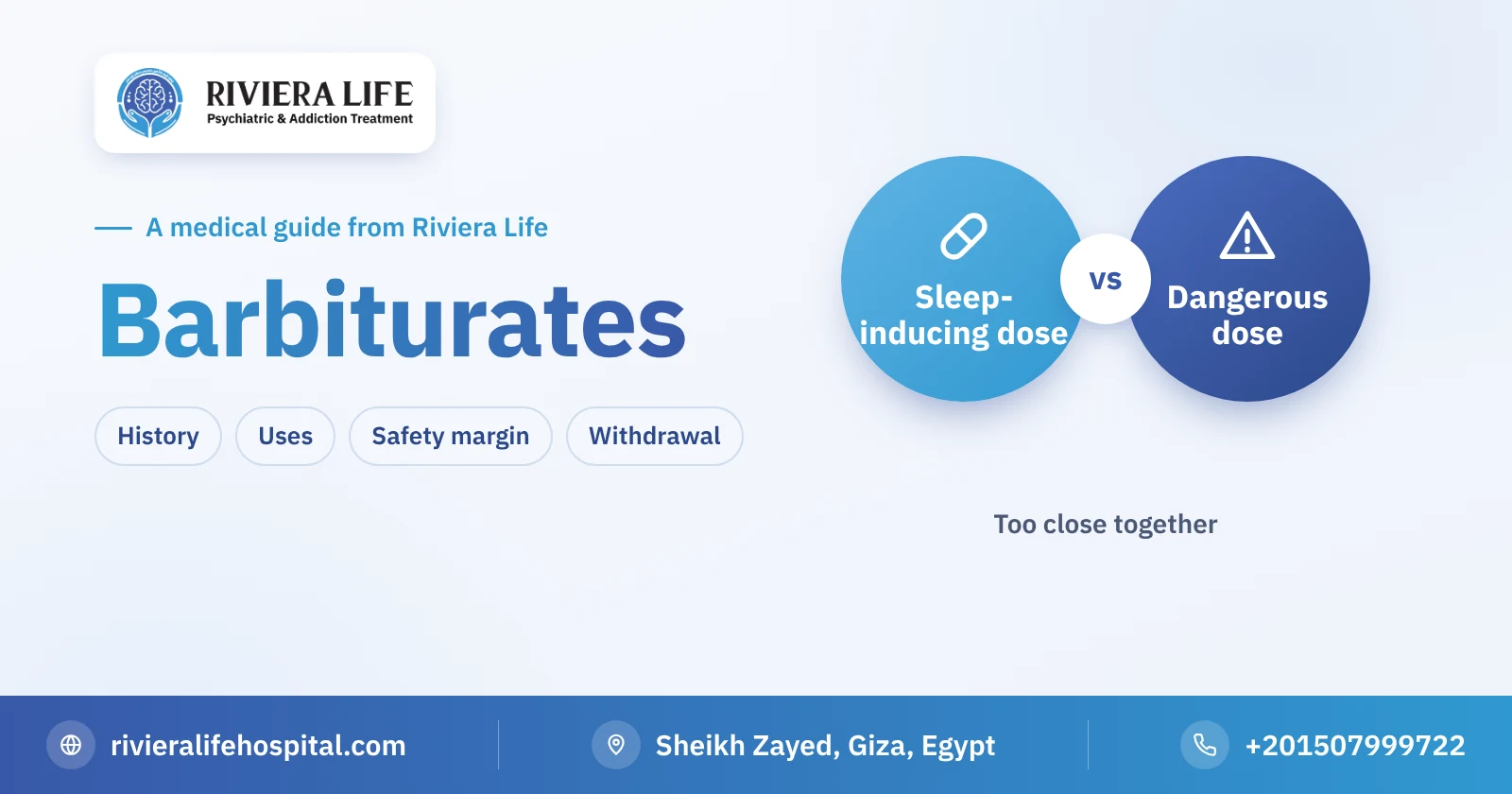
Barbiturates are a group of medicines that depress the nervous system, and for many decades they were the world’s first sleeping pill and sedative, then declined after it became clear that the distance between the sleep-inducing amount and the lethal amount in them is very small. Today they retain a limited use in treating some types of epilepsy, in anesthesia and in some intensive care situations, under close medical supervision. Their main danger is an overdose that stops breathing with no specific antidote to reverse it, and a withdrawal that may be life-threatening after dependence on them. This article explains their history and how they work, and why benzodiazepines replaced them.
What are barbiturates?
Barbiturates are medicines derived from a substance called barbituric acid, and they all work by slowing brain activity. Doctors classify them by the duration of their effect: long-acting barbiturates whose effect lasts a day or more, the best known being phenobarbital; others of intermediate or short action that were used for sleep; and a third, ultra-short-acting group whose effect starts within seconds and was used to induce anesthesia. The shorter a medicine’s action, the more attractive it is to someone who misuses it, and the more severe its withdrawal.
The history of barbiturates: from discovery to decline
Barbituric acid itself was made in the 1860s, but it wasn’t a sleep-inducing drug. In the early twentieth century the first medicinal barbiturate for sleep was introduced, followed a few years later by phenobarbital, which was quickly found to prevent epileptic seizures. Between the 1920s and the 1950s dozens of types spread, and they were prescribed for insomnia, anxiety and tension, and even for very active children.
With this spread came the other face: thousands of cases of accidental and deliberate poisoning, deaths from mixing them with alcohol, and widespread dependence that doctors at the time described as more dangerous in its withdrawal than opium addiction. When benzodiazepines appeared in the 1960s they seemed a safer alternative, so barbiturates declined gradually until they almost disappeared from prescriptions for insomnia and anxiety.
How do barbiturates work in the brain?
Barbiturates act on GABA-A receptors, the gates the brain uses for calming. When the neurotransmitter GABA binds to these gates they open and let chloride ions in, so the cell’s activity calms. Barbiturates prolong how long these gates stay open, which explains their calming and sleep-inducing effect.
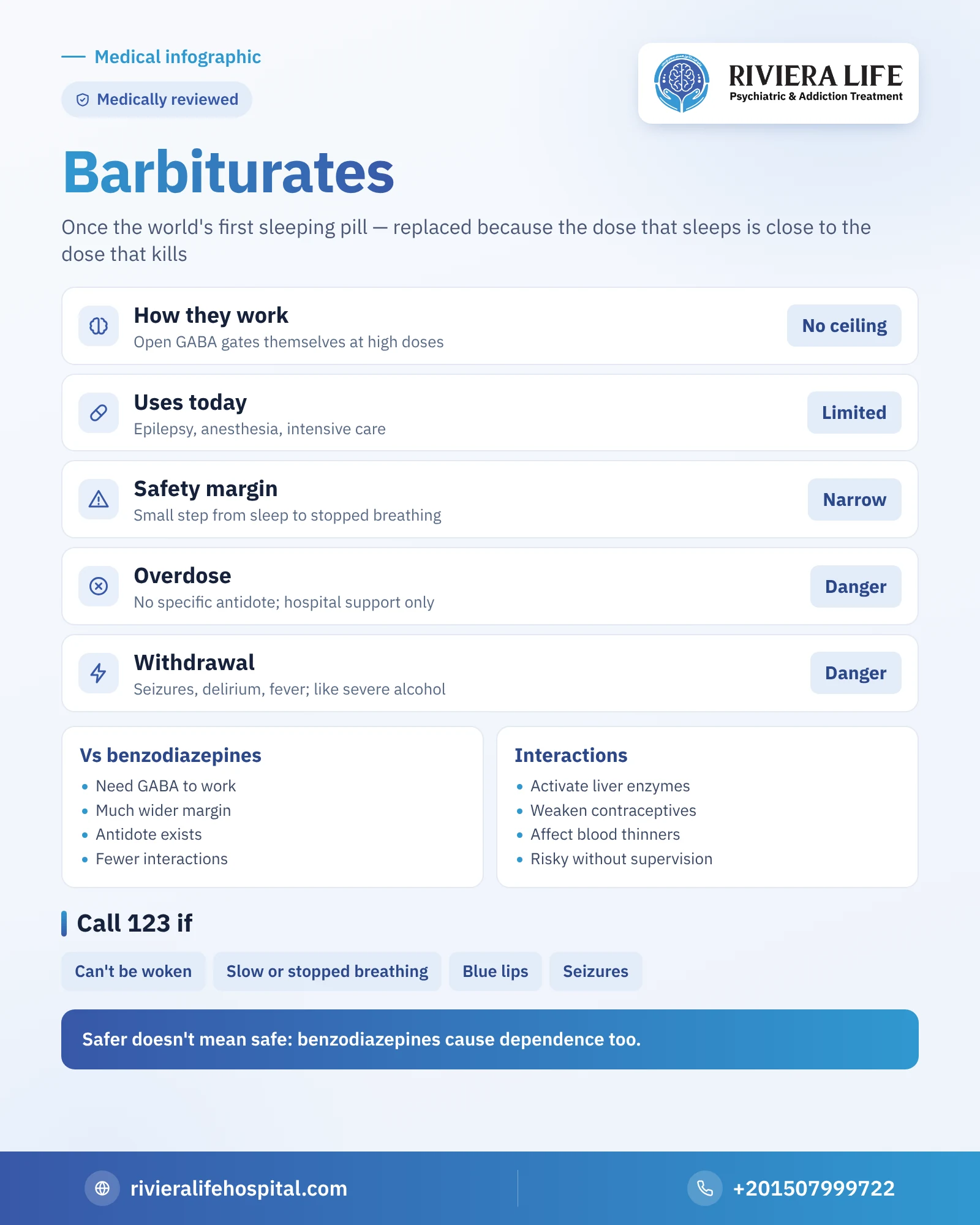
But the decisive difference appears with large amounts: barbiturates can then open the gates themselves even without GABA present, and also depress excitatory neurotransmitters. So there is no natural ceiling to their effect: the more the amount increases, the more the depression increases, from drowsiness to coma to breathing stopping. Here lies the essence of their difference from benzodiazepines, which need GABA present to work, which is why their effect alone stays relatively limited.
The current medical uses of barbiturates
Barbiturates haven’t disappeared from medicine, but they have been confined to particular situations decided by doctors:
- Epilepsy: phenobarbital is still used for some types of seizure, especially seizures in newborns, in some cases of ongoing seizures that don’t respond to other medicines, and in many countries because it is cheap and available. The World Health Organization lists it among the essential medicines for treating epilepsy.
- Anesthesia: ultra-short-acting barbiturates were among the best-known medicines for inducing general anesthesia, then newer medicines replaced them in most hospitals, and some are still used in specific situations.
- Intensive care: they are sometimes used to lower brain activity in cases of raised pressure in the brain or resistant seizures, within intensive care units only.
- Withdrawal from some sedatives or alcohol: some hospital protocols turn to them in selected cases under close monitoring.
Someone taking phenobarbital for epilepsy shouldn’t stop it or change the amount except with the neurologist, because stopping suddenly may bring back seizures more severely.
The narrow safety margin: why are barbiturates considered dangerous?
In medicine a drug’s safety is measured by the distance between the amount that treats and the amount that harms. This distance in barbiturates is very short, so a not very large increase above the sleep-inducing amount may be enough for dangerous depression of breathing. Making matters worse, tolerance develops quickly to the sleep-inducing and calming effect, while it develops more slowly to their effect on the breathing center. So the person raises the amount looking for the old effect, and the amount they take approaches the lethal amount without them feeling it.
Barbiturates have another problem: they activate liver enzymes, so they speed up the breakdown of many other medicines and weaken their effect, including some contraceptives and blood thinners, which makes taking them without medical supervision an additional risk.
Barbiturate overdose
Overdose begins with a picture resembling severe drunkenness: slurred speech, an unsteady walk, deep drowsiness and confusion. Then breathing slows, blood pressure and body temperature fall, blisters may appear on the skin at pressure points, and it ends in coma and breathing stopping. The risk multiplies with alcohol, opioids or benzodiazepines. Unlike opioids, whose effect naloxone reverses, there is no specific antidote for barbiturates, so treatment relies on supporting breathing and circulation in hospital until the body clears the medicine.
Call an ambulance on 123 immediately if you see
Suspected barbiturate overdose, or mixing them with alcohol, sedatives or opioids, is an emergency.
- Deep drowsiness or no response when trying to wake them
- Very slow, shallow or stopped breathing
- Blue lips or cold, pale skin
- Slurred speech and severe loss of balance resembling drunkenness
- Seizures or loss of consciousness
Don’t try to wake the person with cold water or coffee, and don’t leave them alone. If they are unconscious and breathing, put them on their side, and give the paramedics everything you know about what they took.
Addiction and dependence on barbiturates
Barbiturates cause euphoria and relaxation resembling the effect of alcohol, which made them a common substance of misuse in the mid-twentieth century. With daily use, tolerance and dependence develop within weeks. Today their misuse has become much less common after their prescribing declined, but it hasn’t disappeared, and it may appear when someone obtains a medicine prescribed for a relative with epilepsy, or within a mix of sedatives.
Barbiturate withdrawal: why is it considered dangerous?
Barbiturate withdrawal is one of the most dangerous types of withdrawal, and resembles severe alcohol withdrawal. After dependence on them, stopping suddenly may cause anxiety, insomnia, tremor, sweating and weakness, then in severe cases seizures, delirium, hallucinations and raised temperature, and may threaten life. Symptoms appear faster and more severely with short-acting types. That is why this medicine is only withdrawn in hospital, with a gradual reduction plan set by the doctor and followed around the clock. The article on alcohol withdrawal symptoms explains a picture close to it in terms of danger.
Why did benzodiazepines replace barbiturates?
| Aspect | Barbiturates | Benzodiazepines |
|---|---|---|
| How they work | Open GABA gates themselves at large amounts | Need GABA present to enhance its effect |
| Safety margin alone | Very narrow | Much wider |
| Specific antidote for overdose | None | An antidote exists that doctors use in specific cases |
| Drug interactions | Many, because they activate liver enzymes | Fewer in general |
| Current use | Limited to epilepsy, anesthesia and intensive care | Anxiety, insomnia, seizures and alcohol withdrawal |
But “safer” doesn’t mean safe: benzodiazepines also cause dependence and dangerous withdrawal, and become lethal when mixed with opioids or alcohol. You will find their full picture in the benzodiazepines guide, and their harms in the harms of benzodiazepines.
Barbiturates and the law
Internationally, barbiturates are subject to psychotropic substance controls to degrees that differ by type, and in Egypt they are only dispensed on prescription and are subject to special dispensing rules. Trading in or possessing them outside the medical setting is a violation that may expose the person to legal accountability, while seeking treatment voluntarily remains a safe road.
How can Riviera Life help you?
If a member of your family depends on barbiturates or on a mix of sedatives, withdrawal at home isn’t a safe option. At Riviera Life, consultants in psychiatry and addiction treatment assess the case in complete confidentiality, and withdrawal takes place in hospital under round-the-clock medical supervision, in coordination with the neurologist if the medicine is prescribed for genuine epilepsy. The first consultation is free on +201507999722.
More from the benzodiazepines guide
- Benzodiazepines: the complete guide
- Benzodiazepine withdrawal symptoms
- The harms of benzodiazepines
- Sleeping pill addiction
- Valium vs Rivotril: use, how long they stay, dependence and withdrawal
Questions many people ask
Yes, but in a limited range, most notably phenobarbital for some types of epilepsy, and some uses in anesthesia and intensive care under close medical supervision.
Both act on GABA receptors, but in large amounts barbiturates can depress the brain with no ceiling, so their safety margin is much narrower and there is no specific antidote for their overdose.
Yes, phenobarbital is a long-acting barbiturate, and it is the most used of them today in treating some types of epilepsy.
Yes, after dependence it may cause seizures, delirium and raised temperature, and may threaten life, so withdrawal is done in hospital under medical supervision.
Because the sleep-inducing amount is close to the dangerous amount, and because they cause rapid dependence and many drug interactions, so medicines with a wider safety margin replaced them.