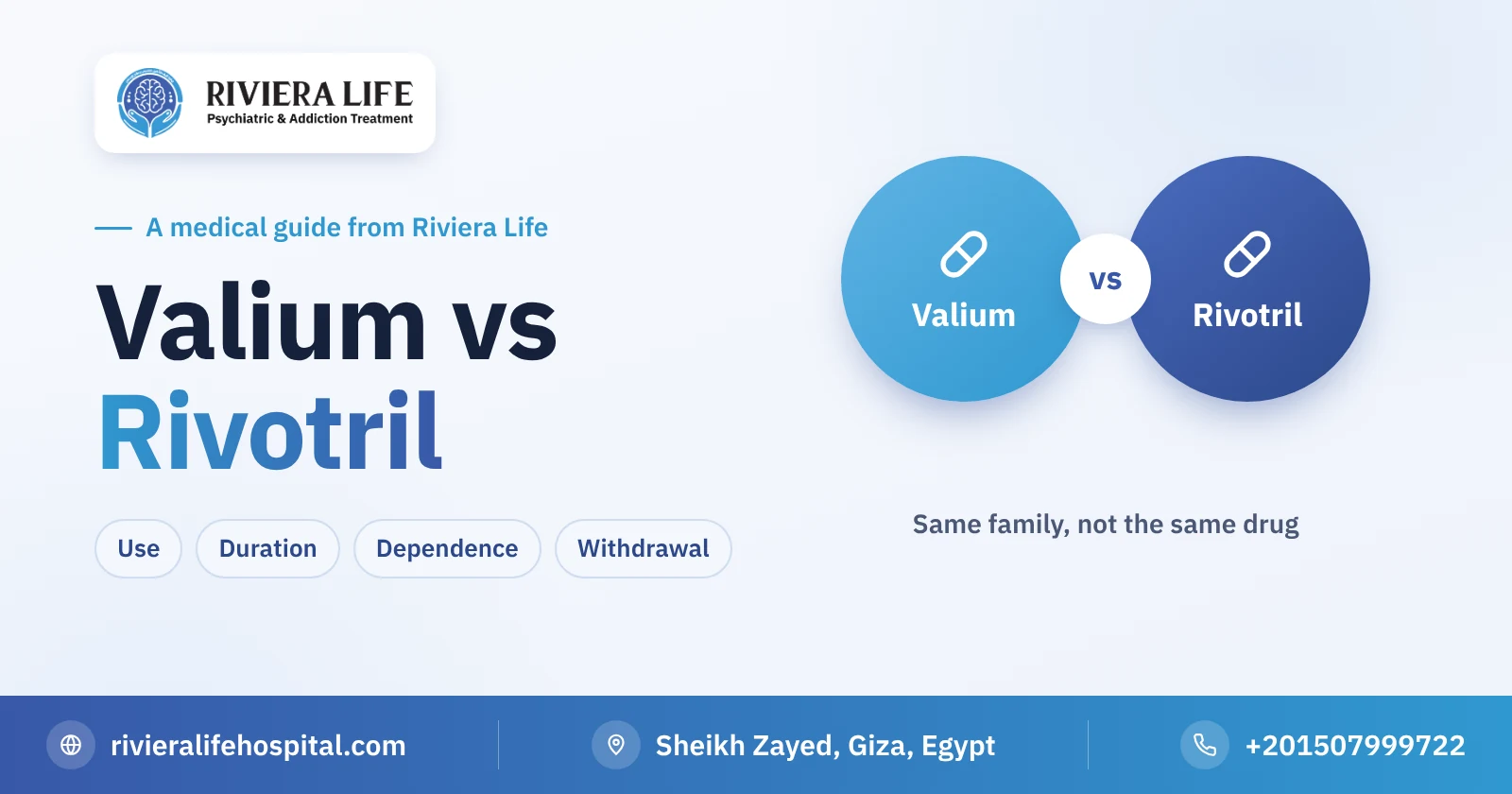
The difference between Valium and Rivotril starts from the fact that they are two medicines from the benzodiazepine family, but they aren’t two versions of one thing. Valium (diazepam) starts faster and is prescribed for anxiety, muscle spasm and alcohol withdrawal, while Rivotril (clonazepam) has a longer effect in the body and is prescribed mainly for epilepsy and panic attacks. What the two share is the most important: both cause tolerance and dependence, and neither is stopped suddenly. This is a comparison of the two medicines: what differs, what is similar, and where the danger lies.
Valium vs Rivotril in brief
| Comparison | Valium (diazepam) | Rivotril (clonazepam) |
|---|---|---|
| Family | Benzodiazepine | Benzodiazepine |
| Speed of onset | Relatively fast | Medium |
| Duration in the body | Very long, with an active by-product that stays for days | Long, but usually shorter than Valium |
| Best-known use | Anxiety, muscle tension, alcohol withdrawal and preparation for procedures | Epilepsy and panic attacks |
| Potency per milligram | Lower | Clearly higher |
| Drowsiness and lethargy | Clear, and extends to the next day | Clear, and may come with emotional flatness |
| Onset of stopping symptoms | Sometimes delayed because of its long duration | Within days |
| Risk of dependence | Present | Present |
These differences are general, and vary from person to person according to age, liver and other medicines.
What are they?
Diazepam is one of the oldest benzodiazepines and best known by the name Valium. Clonazepam is known in Egypt as Rivotril, and there are other names such as Apetryl and Amotril containing the same substance; Apetryl vs Amotril explains what they share and how they differ. Both are prescription-only in Egypt, but Rivotril in particular has become notorious for misuse.
How does each work?
The mechanism is the same: both medicines strengthen the action of GABA, the calming transmitter in the brain, so excessive nerve signals calm down. The difference is in the details: speed of reaching the brain, strength of binding to receptors, and duration. Clonazepam binds more strongly, meaning a small amount of it equals in effect a larger amount of diazepam, which is exactly what makes comparing tablets “pill for pill” wrong and dangerous. Details of the mechanism are in GABA and anxiety.
Medical use: why does the doctor choose one of them?
Valium
- Severe short-term anxiety.
- Painful muscle spasm for a short period.
- Alcohol withdrawal under medical supervision, because its long duration smooths out the fluctuation of symptoms.
- Stopping acute seizures in the emergency department.
- Calming before some medical procedures.
Rivotril
- Some types of epilepsy, where it is part of a long plan managed by the neurologist.
- Panic disorder, in which it may be used for a limited period until another main treatment takes effect.
- Sometimes anxiety or insomnia for a short period by the doctor’s decision.
So the difference in medical use isn’t a coincidence. If the doctor prescribed you one of them, he chose according to your condition, so don’t swap one for the other yourself.
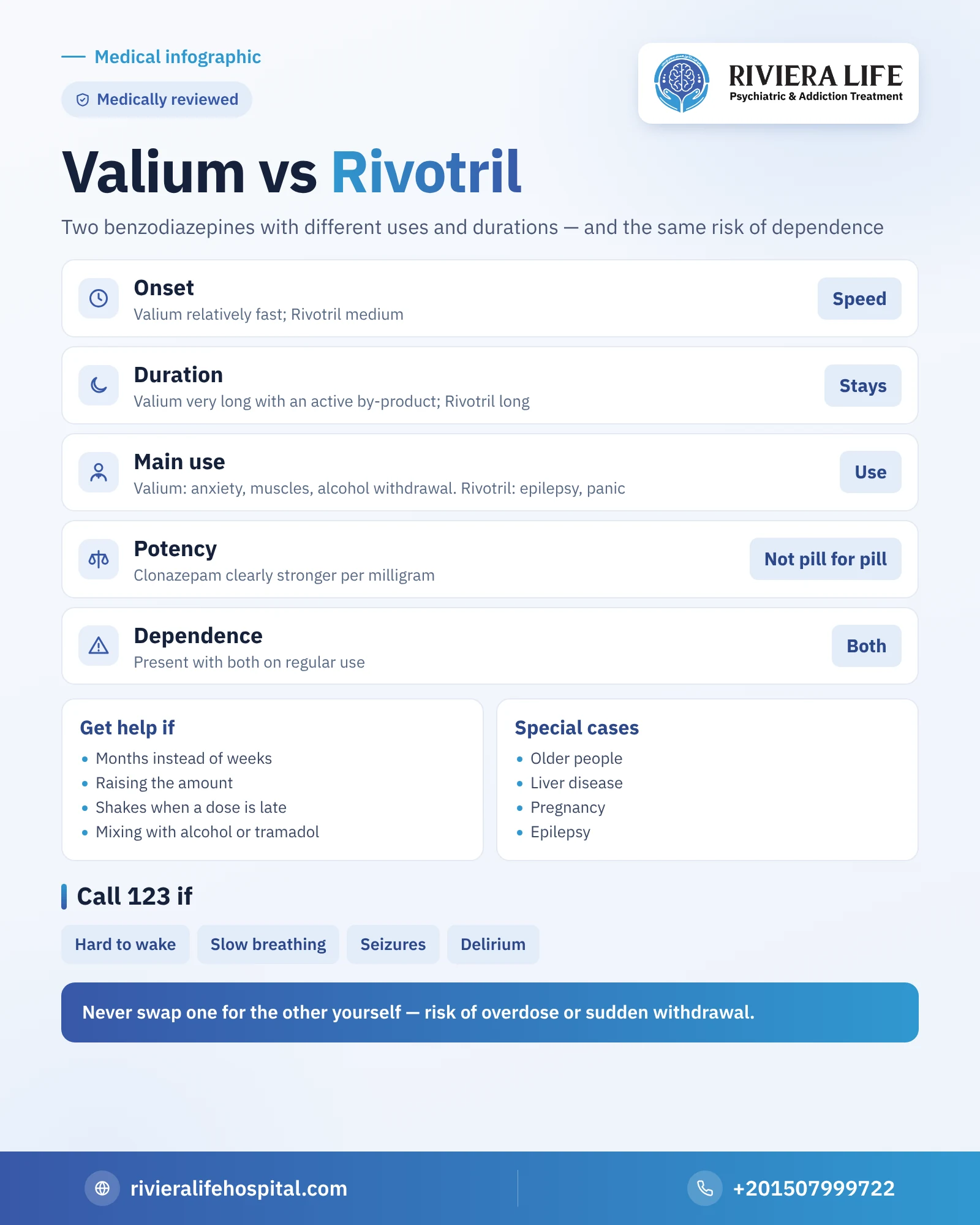
Side effects: what is shared and what is more
The basic effects are shared: drowsiness, slow reactions, dizziness, weak concentration and memory, and dulled feelings. Valium adds that the lethargy may extend into the next day because of its long-lasting by-product, increasing the risk of driving accidents and falls in older people. With Rivotril, a proportion of users complain of emotional blunting and loss of motivation, and some describe it as “switching off” feeling. The medicines agree in the danger of combining them with alcohol and opioid painkillers.
Addiction: which is more dangerous?
There is no answer that reassures anyone. Both cause tolerance and physical and psychological dependence if used regularly for weeks or more. The fine differences:
- Valium starts quickly, so relief appears quickly, which makes it more attractive to someone looking for an immediate effect.
- Rivotril is strong per tablet and long-acting, so the amount can easily rise without the user noticing, and it is often prescribed for long periods.
- Both quickly turn from a medical prescription into a daily habit, especially with chronic anxiety and insomnia.
For details see Rivotril addiction and Valium addiction treatment.
Withdrawal: timing and severity
Because both durations are long, stopping symptoms don’t appear as soon as a tablet is missed, but after a day or several days. The patient feels rebound anxiety, insomnia, tremor, sweating, palpitations and sensitivity to sound and light, and seizures or hallucinations may occur in severe cases, especially after long use or if the medicine is combined with alcohol. The plan can’t be “stop the tablets and see”. Instead, the doctor sets a gradual reduction schedule in which he may switch the patient to a longer-acting medicine, a medical decision that mustn’t be copied from internet comparisons. Rivotril withdrawal symptoms sets out the timeline.
Call an ambulance on 123 immediately if you see
After mixing either of them with alcohol or painkillers, or after stopping suddenly:
- Severe drowsiness that makes waking difficult, or slow breathing
- Fainting or blue lips
- Seizures or loss of consciousness
- Delirium, hallucinations or violent shaking
Can you switch from one to the other?
Switching between the two medicines does happen in medicine, but only by the doctor’s decision. The doctor sometimes moves the patient from a short-acting medicine to a long-acting one to ease gradual reduction, or changes the medicine for a reason linked to epilepsy. This relies on approximate conversion tables that don’t replace following the case. Swapping tablets yourself or on a friend’s advice exposes you to an overdose of one or sudden withdrawal from the other.
Which is better for you?
The right question isn’t which is better, but for what reason it is prescribed and for how long. Someone who needs it for epilepsy differs from someone who needs it for anxiety, and someone with liver disease or over sixty differs from a healthy young man. In anxiety specifically, modern guidelines put psychotherapy and antidepressants first, and limit sedatives to a short period. For more, read anxiety treatment.
When do you need help?
- If use of either has continued for months after the prescription was for weeks.
- If you have raised the amount or shortened the time between tablets without consultation.
- If you feel anxiety or tremor when a tablet is late.
- If you have obtained it from more than one source or doctor.
- If you mix it with alcohol, tramadol or others.
Asking for help here is a safe step, because gradual reduction under medical supervision mostly passes without severe symptoms.
Special cases: older people, the liver and pregnancy
In older people the risk of falls and confusion increases with either medicine, and the risk with diazepam is clearer because its active by-product accumulates for days. In liver disease the breakdown of both medicines is delayed, so the patient’s sensitivity to their effect increases, and the doctor needs to adjust his plan. In pregnancy, benefit and risk are discussed with the doctor before any decision, and the medicine isn’t stopped suddenly. And in epilepsy patients specifically things are different, as stopping clonazepam suddenly may cause seizures, which is why the patient doesn’t make a decision alone.
Do they show up in a drug test?
Yes, as long as the test includes benzodiazepines. But the result for clonazepam may differ from diazepam depending on the type of test, because some rapid tests detect some members of the family better than others. The detection time varies between blood, urine, saliva and hair, and is affected by the duration of use, the person’s age, and liver and kidney function. For details see how long benzodiazepines stay in the body. And if you are taking one of them on prescription, tell the person doing the test.
How can Riviera Life help you?
At Riviera Life, licensed by the Ministry of Health, consultants in psychiatry and addiction treatment assess dependence on Valium or Rivotril in complete confidentiality, and set a safe gradual withdrawal plan with round-the-clock medical supervision for those who need a stay, a family program and follow-up after discharge. The first consultation is free on +201507999722.
More from our benzodiazepines guide
- Benzodiazepines: the complete guide
- How long benzodiazepines stay in the body
- Rivotril addiction treatment
- Benzodiazepine addiction treatment
Questions many people ask
No, the first is diazepam and the second is clonazepam; both are benzodiazepines but they differ in potency, duration in the body and medical use.
Clonazepam is stronger per milligram, which is why the tablets aren't compared pill for pill, and the doctor sets conversion equivalents when needed.
Both cause dependence with regular use, and the differences in speed of onset and duration in the body don't make either of them safe.
Doctors sometimes do this to ease gradual reduction or for epilepsy reasons, but only by the doctor's decision and with his follow-up.
They show up in benzodiazepine tests, and the result and detection time vary with the type of test, the duration of use, and liver and kidney function.