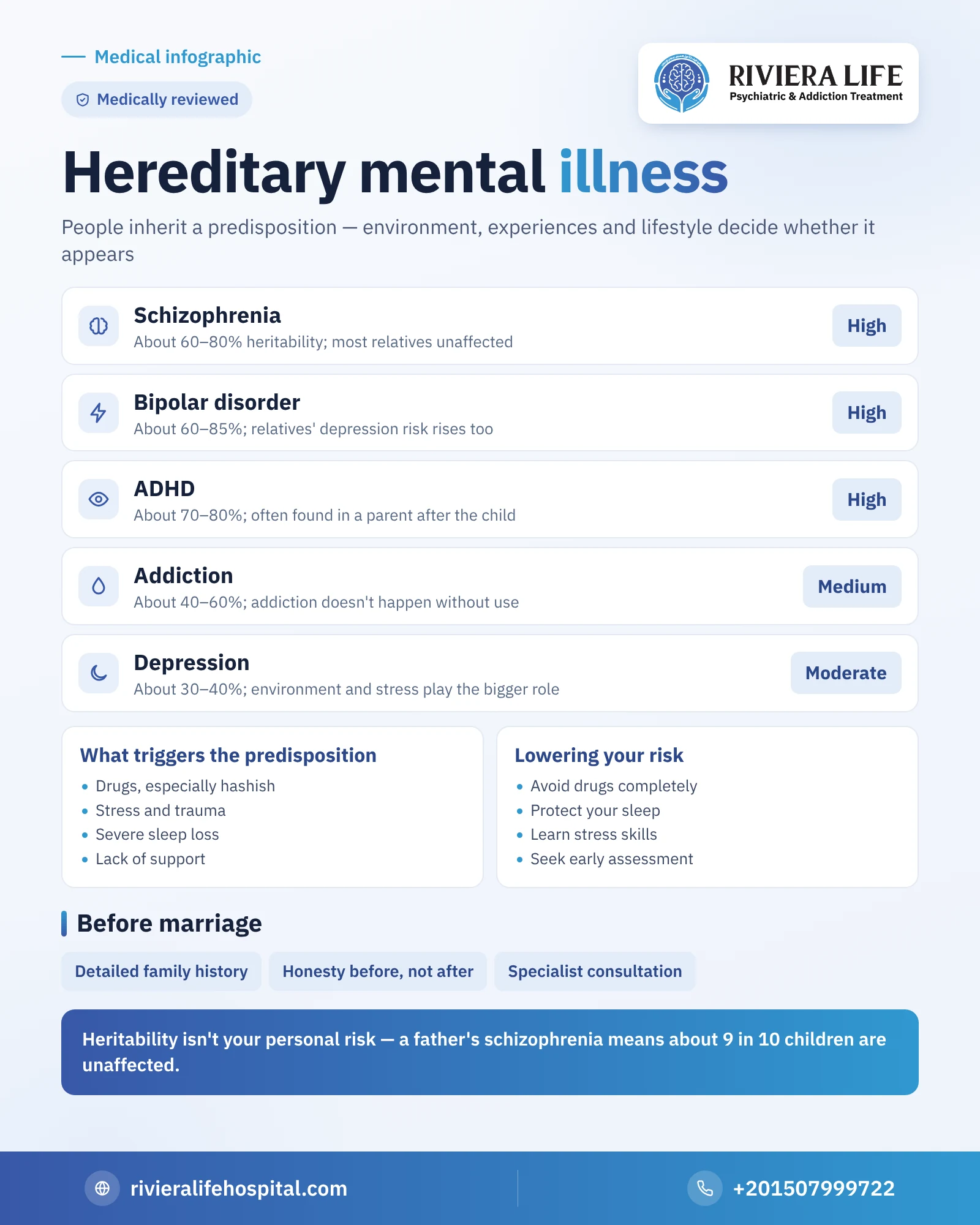
Hereditary mental illnesses aren’t illnesses passed from father to son as eye color is passed on, but disorders in which a person inherits a greater or lesser predisposition, and then environment, experiences and lifestyle decide whether this predisposition will appear or not. Heredity carries great weight in schizophrenia, bipolar disorder and attention deficit hyperactivity disorder, and medium weight in depression and addiction. Even so, most children of those affected don’t develop the same illness. In this article we explain what heritability figures really mean, present the estimates for each disorder, answer questions about marriage and having children, and explain what can be done to reduce the risk.
What does it mean that a mental illness is hereditary?
When doctors say a disorder is “70% hereditary”, they don’t mean that the patient’s son has a 70% chance of being affected. This figure is called “heritability”, and measures the extent to which genetic differences explain people’s variation in the illness within a particular society. The risk of a particular person being affected is a completely different figure, and is usually much lower than people imagine.
The reason is that common mental illnesses aren’t caused by one gene, but by hundreds or thousands of small genetic changes, each adding a tiny weight. That is why there is still no genetic test today that can tell you whether you will develop depression or schizophrenia. We have set out the full picture of the causes of illness, from the brain to childhood and stress, in our article on the causes of mental illness, and here we focus on the question of heredity specifically.
How did scientists learn the role of heredity?
Research relied on three types of studies. Twin studies compare identical twins, who share almost all their genes, with non-identical twins. Adoption studies compare children with their biological parents and the families who raised them. And genome-wide studies examine the DNA of hundreds of thousands of people looking for regions linked to the illness.
The striking observation is that even among identical twins, if one develops schizophrenia, the other isn’t affected in a large proportion of cases. This alone is strong evidence that genes aren’t the whole story.
Heritability estimates in the best-known disorders
The following figures are approximate estimates drawn from twin and family studies, and vary from study to study. Their purpose is to understand the relative weight of heredity, not to calculate anyone’s fate:
| Disorder | Approximate heritability | What does this mean? |
|---|---|---|
| Schizophrenia | About 60–80% | Among the most hereditary disorders, but most patients’ relatives aren’t affected |
| Bipolar disorder | About 60–85% | Large hereditary weight, and the risk of depression in relatives also rises |
| ADHD | About 70–80% | Often discovered in a parent after the child is diagnosed |
| Addiction | About 40–60% | Heredity raises susceptibility, but addiction doesn’t happen without use |
| Depression | About 30–40% | Environment and stress play the larger role |
To go deeper into a particular disorder, see the causes of schizophrenia, the causes of bipolar disorder and the causes of depression, and to understand ADHD see our guide to attention deficit hyperactivity disorder.
Heredity prepares the ground, and environment decides what grows
A hereditary predisposition is like prepared soil, but other factors often decide when and how the illness appears. Among the most important of these factors:
- Drugs: using hashish in adolescence raises the risk of psychosis, especially in those with a family history, and stimulants may reveal latent disorders.
- Stress and trauma: abuse in childhood, loss and chronic stress stir up a latent predisposition.
- Disturbed sleep: severe lack of sleep may be the spark for a manic episode in those predisposed.
- Conditions of pregnancy and birth: some complications are linked to a slight increase in risk.
- Relationships and support: a warm family and safe friendship act as a real protective factor.
Modern science adds an important idea: experiences can change the way genes work without changing the genes themselves, meaning that environment talks to heredity constantly.
My father or mother has a mental illness: will I inevitably be affected?
No. This is the most important message of the article. Let’s take schizophrenia as an example, one of the most hereditary disorders: it affects roughly 1% of people, and the risk for the child of an affected person rises to roughly 10%. That means about nine out of every ten children aren’t affected. The picture is similar in bipolar disorder, where the risk rises but the majority remain free of the illness.
What children sometimes inherit isn’t the illness itself, but a higher sensitivity to stress or a tendency toward anxiety, which can be dealt with early. And living with an untreated ill parent adds environmental stress that may be heavier than the genes, so treating the parent is in itself protection for the children.
Marriage and hereditary mental illness
The psychiatrist is often asked before marriage: should I marry someone with a mental illness in their family? And should I tell the other party about my illness? The answer needs calm, not fear:
- Having an affected relative in the fiancé’s family isn’t reason enough to refuse marriage, as it raises the predisposition slightly and doesn’t decide the children’s fate.
- If one of the partners is affected, receiving treatment and stable, a successful marriage is very possible, and what matters is commitment to treatment.
- Frankness before marriage is better than discovery after it, and can happen in a session attended by the treating doctor to answer questions.
- If both partners have the same disorder, or there is a strong history in both families, the risk rises clearly, and specialist consultation becomes more important.
- Marriage between relatives raises the risk of some rare genetic diseases, while its effect on common psychiatric disorders is less clear, and it deserves discussion with a specialist when there is a family history.
The usual premarital medical examination doesn’t reveal a predisposition to mental illness. What helps here is a detailed family history and genetic and psychiatric consultation.
Planning a pregnancy with a psychiatric disorder
If the wife is receiving psychiatric treatment, the most important decision is to see the doctor before pregnancy, not after it. Some mood medicines need adjusting or replacing before pregnancy, and stopping them suddenly without supervision may cause a serious relapse. The period after childbirth is also sensitive for those with a history of bipolar disorder or depression, and needs an advance follow-up plan, which we have explained in our article on postpartum depression.
Are there genetic tests for mental illness?
So far there is no test that predicts a person developing common psychiatric disorders. Some laboratories offer tests “to determine the right medicine”, but their benefit is still limited and they don’t replace the doctor’s assessment. Diagnostic genetic tests are used in special cases, such as the presence of intellectual disability or features of a genetic syndrome alongside psychiatric symptoms, and here the role of genetic counseling is clear.
How do you reduce the risk if there is mental illness in your family?
You can’t change your genes, but you have a lot of control over what decides whether the predisposition will appear:
- Stay away from drugs completely, especially hashish and stimulants, as they are among the strongest triggers in those predisposed.
- Protect your sleep, and treat continuous staying up as a warning sign, not an ordinary habit.
- Learn skills for dealing with stress early, as they can be acquired at any age.
- Watch for early signs: changed sleep, withdrawal, unusual suspicion and sharp mood swings.
- Tell your doctor about the family history, as this changes his decisions in diagnosis and choice of medicines.
- Ask for assessment early, as treatment at the start is easier and works faster.
In the case of addiction specifically, a family history makes the first experience more dangerous, which we have detailed in the causes of alcohol addiction.
How can Riviera Life help you?
If there is a psychiatric history in your family and you want to understand your position, or you are thinking about marriage or having children and need a specialist opinion, you can book a free first consultation with a psychiatry consultant at Riviera Life in Sheikh Zayed. We discuss the family history in detail, assess current signs if there are any, and set with you a realistic prevention plan, in complete confidentiality.
Read also
- Mental illness: symptoms, types and treatment
- Causes of mental illness
- Mental illness in children
- Myths about mental illness
Questions many people ask
Schizophrenia, bipolar disorder and ADHD are among the disorders with the highest heritability estimates, but that doesn't mean the relatives of those affected will inevitably be affected.
The risk rises to roughly ten percent compared with about one percent for the general population, meaning the great majority of children aren't affected.
There is currently no reliable test that predicts common psychiatric disorders. A detailed family history and specialist consultation are the most useful tools.
Yes, as long as he is stable and committed to treatment. It is preferable to plan a pregnancy with the doctor in advance because some medicines need review.
Marriage between relatives raises the risk of some rare genetic diseases, while its effect on common psychiatric disorders is less clear, and it deserves a consultation when there is a strong family history.