The short answer
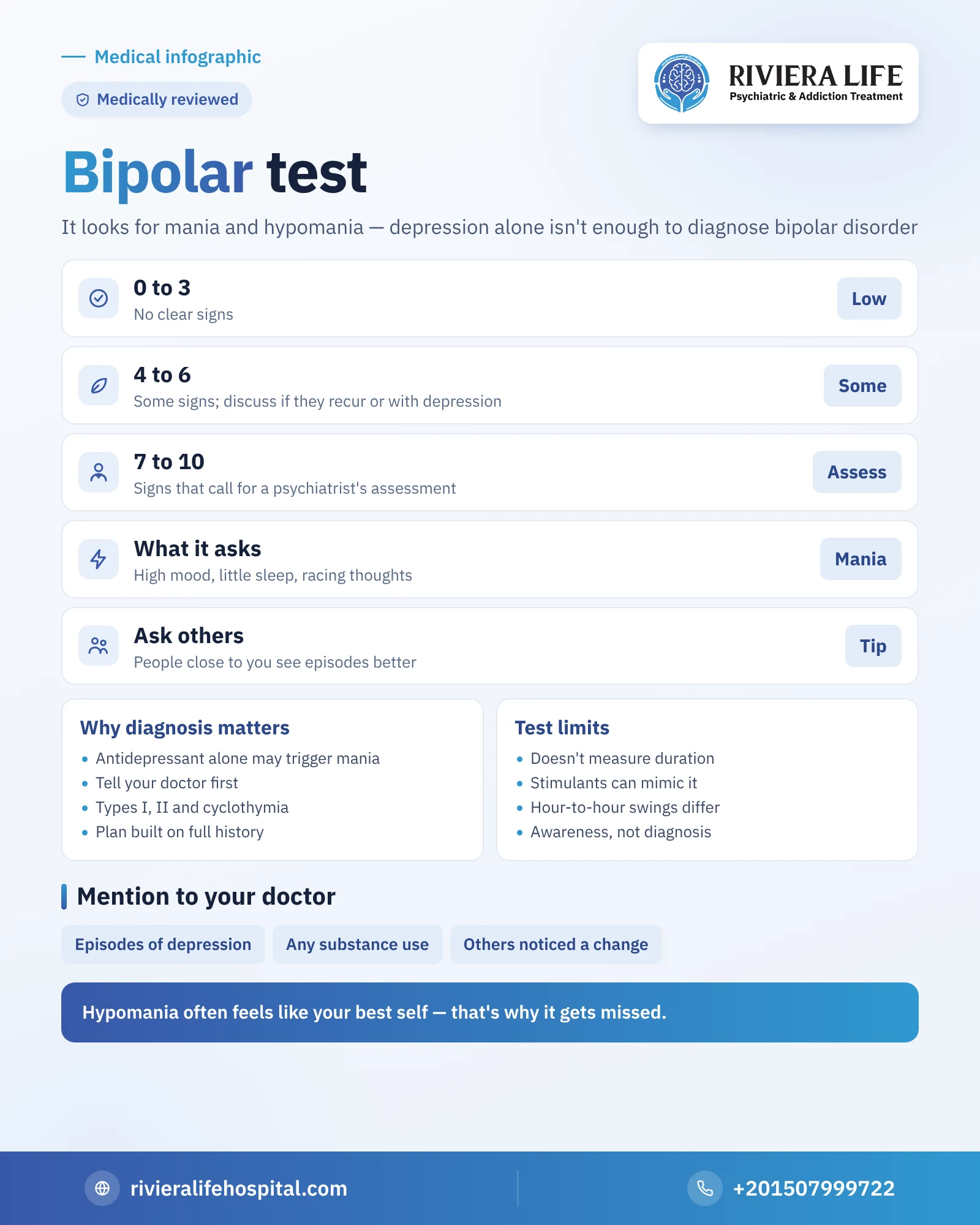
The Riviera Life bipolar test is ten yes-or-no questions about a period lasting several days in which you weren’t your usual self: elevated mood, little sleep without tiredness, fast speech, racing thoughts, exaggerated confidence, and reckless spending or decisions. Each yes scores a point, and the score runs from 0 to 10: 0 to 3 means no clear signs, 4 to 6 some signs, and 7 or more signs that call for an assessment by a psychiatrist. The test looks for mania and hypomania, because depression alone isn’t enough to diagnose bipolar disorder.
- DurationAbout one minute
- ScoreFrom 0 to 10
- 7 or moreAssessment by a psychiatrist
Most people with bipolar disorder go to the doctor during a depressive episode, not a manic one. In hypomania a person feels at their best: energy, activity and lots of ideas, so they don’t see it as a problem and don’t mention it. That is why depression alone may be treated for years before anyone notices the full picture. We designed these questions to capture the high side that is usually missed.
Start the bipolar test
Bipolar test (episodes of elevated mood)
Have you had a period lasting several days in a row in which you were different from your usual self in the following ways?
To discuss your result with a psychiatrist in confidence, the first consultation is free on +201507999722.
This is an awareness test prepared by the medical team at Riviera Life; it is not a research-standardized scale or a diagnosis. Your answers are not saved or sent to anyone; the calculation happens on your device only.
How is the result read?
| Score | Meaning | Suitable step |
|---|---|---|
| 0 to 3 | No clear signs | Usually no action needed |
| 4 to 6 | Some signs | Discuss them with a doctor if they recur or come with depression |
| 7 to 10 | Signs that call for assessment | Assessment by a psychiatrist |
Ask those around you too
Someone going through a manic or hypomanic episode often doesn’t see themselves clearly, so your answers may understate the truth. Try retaking the test with someone close who knows you well, such as a spouse or sibling, and ask them: was there a period when I was different in this way? The last question in the test, about others noticing, was included for this reason. For those living with a patient, our article on how to deal with a person with bipolar disorder helps.
Why does the right diagnosis matter?
Treating depression with an antidepressant alone in a person with bipolar disorder may flip mood into mania or increase its instability. So if you have depressive episodes and your score here is high, tell your doctor about it before starting any treatment. You will find the difference between type I, type II and cyclothymia in types of bipolar disorder.
The limits of the test
- It doesn’t accurately measure the duration or severity of an episode, which are the basis for telling mania from hypomania.
- Stimulants, cocaine and some medicines may cause similar symptoms.
- Mood swings within hours differ from bipolar episodes, and may point to another disorder, as in bipolar disorder vs borderline personality.
About this test
The medical team at Riviera Life prepared these questions based on the description of manic episode symptoms in the diagnostic manuals, and phrased them in language the patient and their family understand. It is an awareness test, not a research-standardized scale or a diagnostic tool.
How can Riviera Life help you?
Our doctors assess the full history of your episodes, and set a plan based on mood stabilizers, psychotherapy and relapse prevention, dealing with substance use if it is present too. The details are in bipolar disorder treatment. The first consultation is free and confidential on +201507999722.
Read also
Questions many people ask
Because manic or hypomanic episodes are what distinguish bipolar disorder from ordinary depression, and they often pass without the patient noticing.
Yes, stimulants, cocaine and some medicines may cause similar symptoms, so any substance use must be mentioned to the doctor.