The short answer
The PHQ-9 depression test is nine questions about the past two weeks, each answered by choosing between “not at all” and “nearly every day”, giving a score from 0 to 27. A score of 0 to 4 means very mild symptoms, 5 to 9 mild symptoms, 10 to 14 moderate, 15 to 19 moderately severe, and 20 or more severe. It is one of the most widely used depression scales in the world, but it is a screening tool, not a diagnosis. And if you answer anything other than “not at all” to the ninth question about thoughts of death or self-harm, this deserves talking with a specialist today, whatever your total score.
- DurationAbout two minutes
- ScoreFrom 0 to 27
- 10 or moreDeserves assessment by a psychiatrist
Depression doesn’t always come as crying and obvious sadness. Sometimes it appears as tiredness that sleep doesn’t fix, a loss of desire for things you used to love, or slowed thinking the person mistakes for laziness. This test helps you see the picture more clearly in two minutes, and tells you whether what you are going through deserves talking about with a doctor.
Start the depression test
Depression test (PHQ-9)
Over the last two weeks, how often have you been bothered by any of the following problems?
To discuss your result with a psychiatrist in confidence, the first consultation is free on +201507999722.
This is an initial screening test for awareness, not a diagnosis. Your answers are not saved or sent to anyone; the calculation happens on your device only.
How is the depression test result calculated?
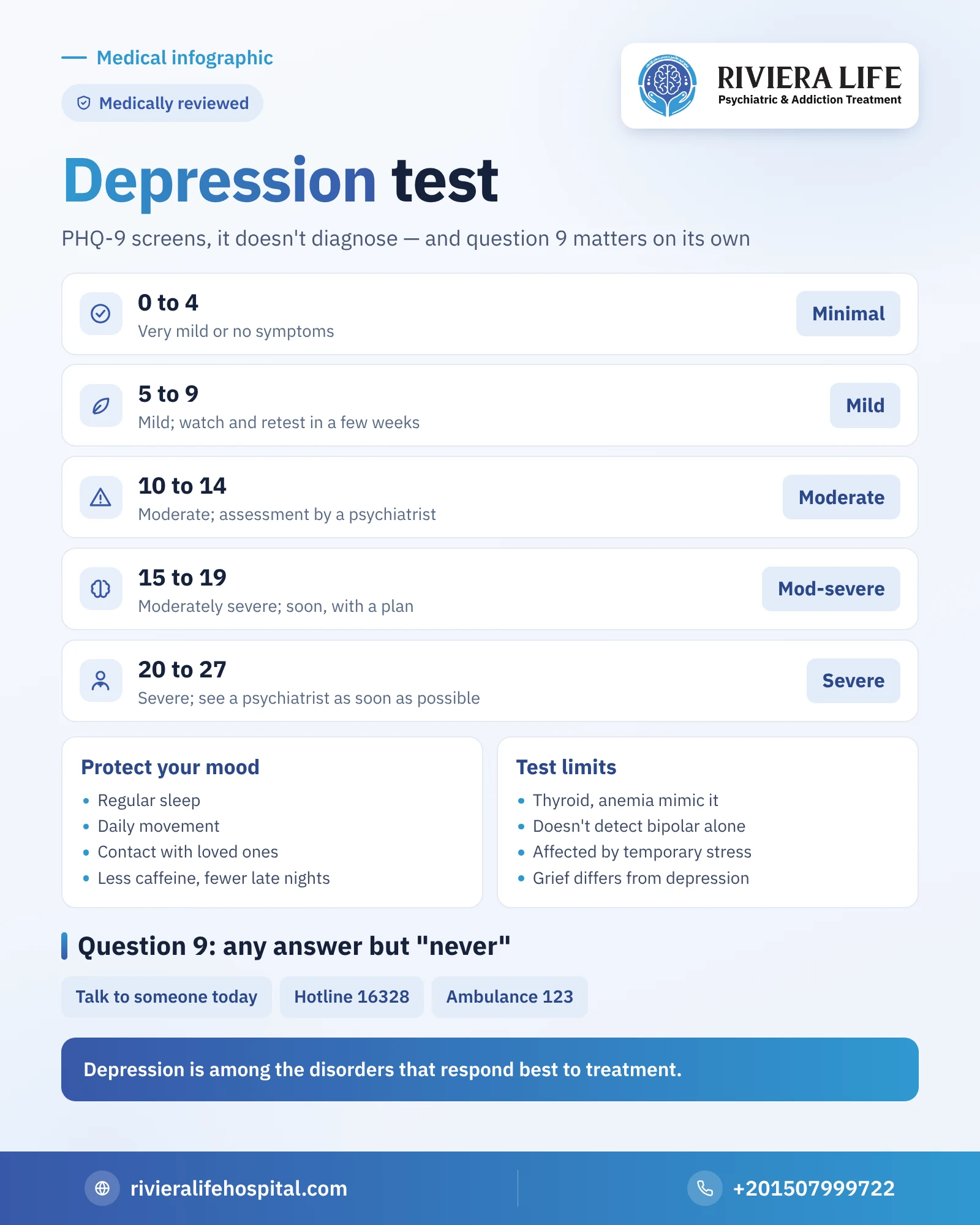
Each question has four answers scoring from 0 to 3, and the scores of the nine questions are added together:
| Score | Meaning | Suggested step |
|---|---|---|
| 0 to 4 | Very mild or no symptoms | Usually no action needed |
| 5 to 9 | Mild symptoms | Watch and retake the test after a few weeks |
| 10 to 14 | Moderate symptoms | Assessment by a psychiatrist |
| 15 to 19 | Moderately severe | A prompt assessment and a treatment plan |
| 20 to 27 | Severe symptoms | See a psychiatrist as soon as possible |
What does your result mean in practice?
If your score was mild, this is a good time to attend to the basics that protect mood: regular sleep, daily movement even if just walking, contact with people you love, and cutting down caffeine and late nights. If symptoms continue for more than two weeks or increase, don’t wait.
A moderate or severe score means the symptoms are probably affecting your work, studies or relationships, and that a medical assessment will help you. Depression is among the psychological disorders that respond best to treatment, whether with psychotherapy, medicines or both. Details of the options are in depression treatment.
Why does the ninth question matter so much?
The last question asks about thoughts of death or self-harm. Its weight isn’t counted only through the total score, because someone may have a low score yet suffer these thoughts. That is why a special alert appears if you answer it with anything other than “not at all”. Having these thoughts doesn’t mean you will harm yourself, but it means the pain is great and deserves talking about today with someone you trust or with a specialist. Read suicidal thoughts: help is available now.
The limits of the test
- It doesn’t distinguish between depression and physical causes that produce similar symptoms, such as an underactive thyroid and anemia.
- It doesn’t detect bipolar disorder on its own, even though depressive episodes are part of it. Read bipolar disorder symptoms.
- Answers are affected by temporary states, such as exam stress or a recent loss. Normal sadness differs from depression, as our article on the difference between sadness and depression explains.
About the PHQ-9
It was developed by researchers Kurt Kroenke, Robert Spitzer and colleagues, and its validity study was published in 2001; today it is used in clinics around the world to detect depression and follow its severity with treatment. Its developers allow it to be used and translated without permission or charge. The version here is a simplified translation for awareness.
How can Riviera Life help you?
If your result pointed to moderate or severe symptoms, a psychiatrist at Riviera Life can review it with you as part of a full assessment, and set a plan that suits you. The first consultation is free and confidential on +201507999722.
Read also
- The psychological and physical symptoms of depression
- GAD-7 anxiety test
- Types of depression and levels of severity
- Psychological tests: the complete guide
Questions many people ask
A score of 10 or more points to moderate or more severe symptoms that deserve assessment by a psychiatrist, but a diagnosis isn't built on the test alone.
The PHQ-9 is one of the most widely used and reliable screening tools, but it guides rather than diagnoses, because other physical and psychological causes can produce similar symptoms.
No, the calculation is done on your device only and the answers aren't sent to anyone.