The short answer
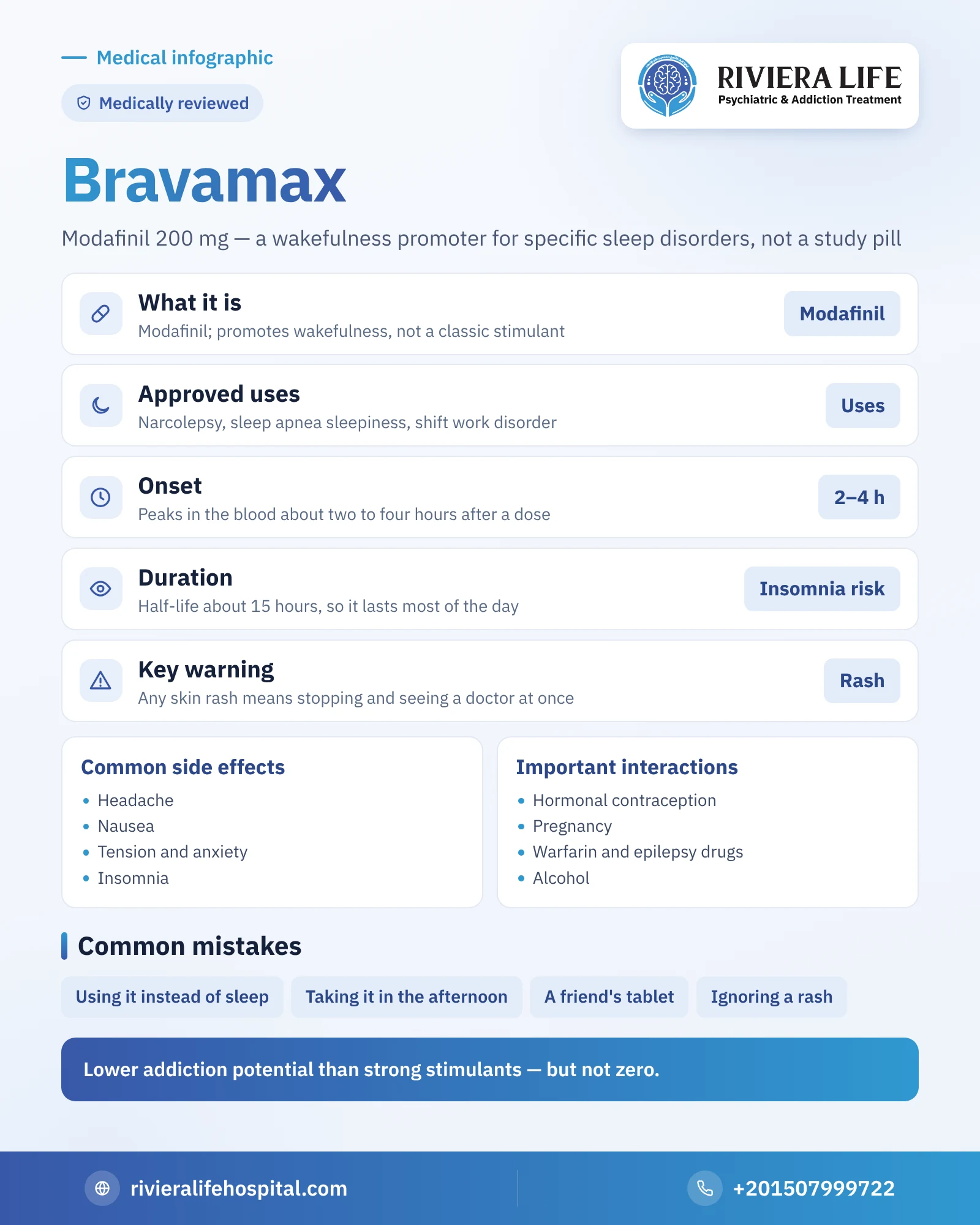
Bravamax is an Egyptian brand name for modafinil, dispensed as 200 mg tablets. It promotes wakefulness and is neither a sleeping pill nor a painkiller, and its approved uses are excessive sleepiness with narcolepsy, obstructive sleep apnea, and shift work sleep disorder. It reaches its highest blood level after roughly two to four hours, and its effect lasts most of the day, which is why it causes insomnia if taken late. Its most common effects are headache, nausea and tension, and the most serious is a severe skin rash, which requires stopping it immediately.
- Active substanceModafinil
- When it peaksAfter roughly two to four hours
- Key warningAny skin rash means stopping it and seeing the doctor at once
Bravamax is known among students and night-shift workers as “all-nighter pills” or “focus pills”, and this reputation mixes up what the medicine actually does with what is expected of it. In this guide we explain what it is, whom it is prescribed for, when it starts and wears off, its side effects and warnings, its relationship with depression, and whether it causes dependence.
What is Bravamax?
Bravamax is an Egyptian product containing modafinil, a medicine that promotes wakefulness and reduces pathological sleepiness. It differs from traditional stimulants such as amphetamine in how it works and in the strength of its effect; it doesn’t usually give the feeling of euphoria or rush those substances give, but it remains a medicine that affects brain chemistry and needs a prescription and follow-up.
Modafinil works mainly by raising dopamine levels in areas of the brain by slowing its reuptake, and it also affects other systems linked to wakefulness, such as histamine and orexin. The full mechanism is still not scientifically settled.
Uses of Bravamax
Drug authorities have approved modafinil for three conditions that share excessive daytime sleepiness:
Narcolepsy
A neurological disorder that makes the patient fall asleep suddenly during the day despite sleeping at night. Here the medicine helps him stay awake for longer hours, but it doesn’t treat the cause.
Obstructive sleep apnea
It is used for those who still have sleepiness despite regular use of a positive airway pressure machine during sleep. Here it is only a helping treatment for sleepiness, and it doesn’t replace the machine or treat the airway obstruction.
Shift work sleep disorder
For those who work at night or on changing shifts and suffer severe sleepiness at work and insomnia at sleep time.
In Europe, regulators have restricted its use since 2011 to narcolepsy alone, after a review found that its risks in the other conditions outweigh its benefit. As for using it to boost concentration for studying in healthy people, this isn’t one of its indications, and the evidence for benefit in this is limited.
When does Bravamax start working?
Modafinil is well absorbed from the stomach, and reaches its highest blood level roughly two to four hours after taking it. Many feel reduced sleepiness within the first hour or two, but this varies from person to person. Taking it with a fatty meal may slightly delay its peak without reducing the total amount in the body.
When does Bravamax wear off?
Modafinil’s half-life, meaning the time the body needs to get rid of half the amount, is roughly fifteen hours. That is why its effect lasts most hours of the day, and part of it remains in the body until night.
This explains the most common complaint about it: insomnia. Someone who takes it late in the day may find himself unable to sleep at night, then wakes tired and looks for another tablet, and a cycle begins that is hard to get out of. That is why the doctor sets the timing precisely, usually in the morning, and before the shift starts for those who work at night.
Side effects of Bravamax
The most common side effects, usually mild to moderate:
- Headache, the most common.
- Nausea and indigestion or diarrhea.
- Tension, anxiety and irritability.
- Insomnia.
- Dizziness, nasal congestion and back pain.
Rare but serious effects
- Severe skin rash: rare cases of serious, potentially life-threatening skin reactions have been recorded, most in the first weeks. Any skin rash, mouth ulcers or peeling skin means stopping the medicine and seeing the doctor immediately.
- Swelling of the face, lips or throat and difficulty breathing: an emergency that needs an ambulance.
- Psychiatric symptoms: such as agitation, mania, hallucinations or suicidal thoughts, with a higher risk in those with a history of a psychiatric disorder.
- Heart symptoms: chest pain, palpitations or shortness of breath; it isn’t advised for those with certain heart valve diseases or left ventricular enlargement except by the doctor’s decision.
Important warnings and drug interactions
- Contraceptive pills: modafinil reduces the effectiveness of hormonal contraception during use and for a month after stopping, so an additional or alternative method is needed.
- Pregnancy: there have been reports of birth defects in children of mothers who used it during pregnancy, so it isn’t used in pregnancy except by a clear medical decision.
- Other medicines: it may change the blood level of some medicines, including some sedatives, epilepsy medicines and anticoagulants such as warfarin, so tell the doctor everything you take.
- Driving: feeling alert doesn’t mean attention has returned completely to normal in narcolepsy patients, so don’t drive before the doctor assesses your response.
- Alcohol: it is best avoided during use, because its effect on the brain mixes with the medicine’s effect and the result is hard to predict.
Bravamax and depression
Modafinil isn’t an antidepressant and isn’t approved to treat depression. But some doctors are studying its use as an add-on to an antidepressant in patients who still have severe fatigue and sleepiness despite improved mood, and results in this use are mixed.
On the other hand, it may increase anxiety and insomnia, and may push a bipolar patient toward a manic episode. So someone with depression who is thinking of Bravamax to regain his energy first needs an assessment that determines whether the fatigue is part of the depression itself, of a medicine he is taking, or of an undiagnosed sleep disorder. You will find the approved options in our article on depression treatment.
Is Bravamax a controlled drug?
Bravamax is a prescription medicine and not a drug in the common sense, but its active substance, modafinil, is controlled in a number of countries because of its potential for misuse; in the United States, for example, it is classified in Schedule IV of controlled substances, the category of medicines with a relatively low potential for misuse. In Egypt, the schedules of controlled medicines are updated by decisions of the Egyptian Drug Authority, so its current status and how it is dispensed can be found from the pharmacist or directly from the authority. The safe rule in all cases is that it is only used with a prescription and for a medical reason.
Does Bravamax show up in a drug test?
Modafinil doesn’t usually show up in the common rapid strip drug test, because the test doesn’t look for it, and it doesn’t belong chemically to the amphetamines the test detects. But it can be detected with specialized laboratory tests if it is specifically requested, as in some sports competition testing. If you are taking it on prescription and are asked for a test, it is best to mention this to the lab or doctor and keep the prescription.
Is Bravamax addictive?
The chance of addiction to modafinil is lower than with strong stimulants, but it isn’t zero, which is why it is classified in some countries among controlled medicines. The biggest risk doesn’t come from disciplined medical use, but from using it for all-nighters and studying without a prescription, from raising the amount when its effect seems to lessen, and from combining it with stimulants, energy drinks or other substances.
If you find yourself unable to study or work without it, increasing the amount without the doctor’s opinion, or sleeping very few hours for days in a row, these are signs worth stopping for. We have explained the signs of dependence and a safe stopping plan in our article on stopping Bravamax and treating dependence on it, and the difference between it and other medicines used for focus in Adderall and modafinil.
Common mistakes with Bravamax
- Treating it as a substitute for sleep: the medicine hides sleepiness but doesn’t make up for the brain’s need for sleep, and accumulated deprivation shows in mood, memory and immunity.
- Taking it in the afternoon to finish studying at night: insomnia comes the same night.
- Taking a tablet from a friend: missing the doctor’s assessment for heart disease, psychiatric disorders and drug interactions.
- Continuing despite a “minor” skin rash: this is exactly what must not happen.
- Thinking it is a treatment for addiction or a substitute for tramadol: modafinil doesn’t treat painkiller addiction or ease its withdrawal symptoms.
How can Riviera Life help you?
If Bravamax is part of an attempt to overcome sleepiness whose cause you don’t know, it is more correct to start with an assessment of sleep and mood. And if its use has turned into dependence, or come together with other substances, Riviera Life’s psychiatry team can assess the condition, set a safe stopping plan and follow up afterward. The first consultation is free and confidential on +201507999722.
More from our psychiatric medicines guide
- Stopping Bravamax and treating dependence on it
- Adderall and modafinil: the difference
- Ritalin (methylphenidate)
- Psychiatric medicines: their types and what they treat
Questions many people ask
Modafinil, a medicine that promotes wakefulness and is dispensed in Egypt under the name Bravamax at a strength of 200 mg.
Modafinil's half-life is about fifteen hours, so its effect lasts most of the day, which is why it causes insomnia if taken late.
No. It isn't approved for treating depression, and it may sometimes be used as an add-on to treatment by the doctor's decision to ease fatigue, with caution in bipolar patients.