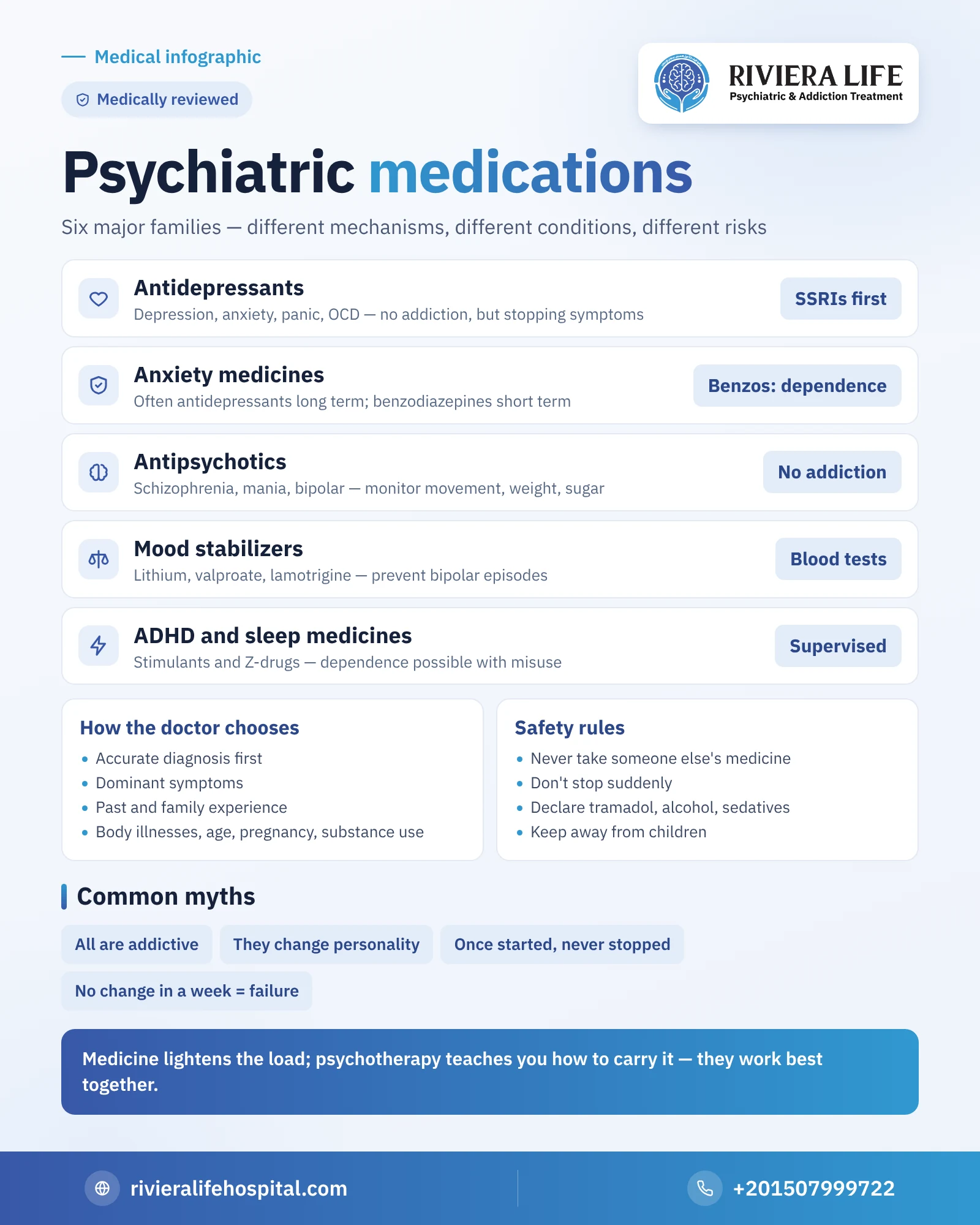
Psychiatric medicines aren’t a single type, but at least six large families: antidepressants, anxiety medicines, antipsychotics, mood stabilizers, ADHD medicines and sleep medicines. Each family has a different mechanism, disorders it treats and risks of its own; some carry a risk of dependence and most don’t. This article is a general map that helps you understand the medicine your doctor prescribed and where it sits among these families, then directs you to the detailed article on each medicine. You won’t find doses here, because starting, changing or stopping any psychiatric medicine is a decision made by the psychiatrist alone.
What do we mean by psychiatric medicines?
They are medicines that affect the brain’s chemistry, meaning neurotransmitters such as serotonin, noradrenaline, dopamine and GABA, in order to ease the symptoms of a specific mental disorder. A medicine doesn’t change your personality or “program” your thinking; it restores balance to disturbed nerve circuits so that thinking, sleep and emotion become closer to normal. That is why medicine works best alongside psychotherapy that teaches the patient new skills: the medicine lightens the load, and psychotherapy teaches how to carry it.
It is important to distinguish between a “psychiatric medicine” and a “sedative”. Many people think every medicine a psychiatrist prescribes is a sleeping pill or a narcotic, but the truth is that most of these medicines don’t cause noticeable sleepiness or give any high.
The first family: antidepressants
These are the most prescribed psychiatric medicines, and they aren’t limited to depression; they also treat anxiety disorders, panic, OCD and post-traumatic stress disorder. They fall into main classes:
- Selective serotonin reuptake inhibitors (SSRIs): usually the first choice because they are easy to tolerate, including sertraline, escitalopram and paroxetine.
- Serotonin and noradrenaline reuptake inhibitors (SNRIs): such as venlafaxine and duloxetine, sometimes useful when depression comes with physical pain.
- Tricyclics (TCAs): the older generation, effective but with clearer side effects and an overdose that is dangerous to the heart, including Anafranil and Tryptizol.
- Medicines with other mechanisms: such as mirtazapine, which helps sleep and appetite, bupropion and trazodone.
We explain this family in detail, from how it works to when its effect appears, in our article on antidepressants.
The second family: anxiety medicines
The surprise for many is that long-term treatment of generalized anxiety and panic usually relies on antidepressants themselves, not on sedatives. Sedatives from the benzodiazepine class, such as alprazolam, clonazepam and diazepam, work within minutes but carry a risk of dependence and tolerance, so the doctor usually uses them for short periods or in crises. Other options include buspirone, which doesn’t cause dependence, some antihistamines with a sedating effect, and beta-blockers that ease tremor and palpitations in performance anxiety. Pregabalin may be used for anxiety in some countries, a medicine with another side that we know well in Egypt.
The third family: antipsychotics
They treat psychosis and its symptoms such as hallucinations and delusions, as in schizophrenia, and are used in manic episodes and bipolar disorder, and sometimes to help an antidepressant that wasn’t enough on its own. They are divided into an older first generation, such as haloperidol, and a newer second generation that includes olanzapine, risperidone and quetiapine. The most important things to monitor with them are movement effects, weight, sugar and lipids, and the hormone prolactin. The details are in our article on antipsychotics.
The fourth family: mood stabilizers
Their aim is to prevent sharp swings between mania and depression, and they are the cornerstone of treating bipolar disorder. The best known is lithium, one of the oldest and most studied psychiatric medicines, which needs regular blood tests to measure its level and monitor the kidneys and thyroid. They also include medicines originally developed for epilepsy, such as valproate, carbamazepine and lamotrigine. Valproate has an important warning for women of childbearing age, because it may harm the baby, so the doctor discusses contraception before prescribing it. Our article on bipolar disorder treatment explains how these medicines work together with psychotherapy.
The fifth family: ADHD medicines
The best known are stimulants such as methylphenidate, which improve concentration and reduce impulsivity in people actually diagnosed with the disorder; sleep, appetite, weight, blood pressure and heart rate are monitored with them. There are also non-stimulant medicines such as atomoxetine, and clonidine, which doctors also use in other situations. Stimulants carry a possibility of misuse, especially among students who take them without a diagnosis to stay up and study, so they are dispensed under control. You can learn more about the disorder itself in our guide to attention deficit hyperactivity disorder.
The sixth family: sleep medicines
The first treatment for chronic insomnia is a cognitive behavioral program for sleep, not pills. When the doctor needs a medicine, they may choose “Z-drug” sleeping pills such as zolpidem for a short period, an antidepressant with a sleep-inducing effect, or melatonin in specific cases. Z-drugs and benzodiazepines can cause dependence if used for long, and can cause complex behaviors during sleep in some people. See our guide to insomnia to understand its causes before thinking about a sleeping pill.
A quick table: the family, what it treats and the risk of dependence
| Family | Main conditions treated | Risk of dependence |
|---|---|---|
| Antidepressants | Depression, anxiety, panic, OCD | No addiction, but discontinuation symptoms on stopping suddenly |
| Benzodiazepines | Acute anxiety attacks, crises | High with long-term use |
| Antipsychotics | Schizophrenia, mania, bipolar disorder | No addiction |
| Mood stabilizers | Bipolar disorder and preventing episodes | No addiction |
| Stimulants | ADHD | Present with misuse |
| Z-drugs | Short-term insomnia | Present with long-term use |
And if your main question is about addiction, we have a dedicated article: are psychiatric medications addictive?
How does the psychiatrist choose the medicine?
There is no “strongest medicine” that suits everyone. The doctor puts together the full picture before writing the prescription:
- An accurate diagnosis first, since depression within bipolar disorder is treated differently from depression on its own.
- The dominant symptoms: insomnia or oversleeping, loss of appetite or overeating, anxiety or lethargy.
- The patient’s previous experiences, and those of first-degree relatives, with medicines.
- Physical illnesses such as heart disease, diabetes and liver disease, and the other medicines they take.
- Age, pregnancy or the wish to become pregnant, and breastfeeding.
- A history of drug or alcohol use, because it changes the choice of medicine and rules some medicines out.
- The side effects the patient accepts and those they can’t tolerate, such as weight gain or sexual effects.
For a practical comparison of the options for depression and anxiety specifically, see our article on choosing medication for depression and anxiety.
How long does treatment with medicine last?
The duration varies with the disorder and its history. A first episode of depression is usually treated until the patient improves, then the medicine continues for several months after improvement to consolidate the result, while recurrent episodes may need longer preventive treatment. In bipolar disorder and schizophrenia, treatment is usually long-term because the aim is to prevent future episodes, not only treat the current one. Sedatives and sleeping pills are, as a rule, for short-term use. In all cases the journey has three stages: a start in which the doctor closely monitors side effects, then a consolidation phase, then a shared decision to continue or reduce gradually.
Common myths about psychiatric medicines
- “They’re all addictive”: most aren’t, and the families that carry a risk of dependence are specific and well known.
- “Psychiatric medicine changes your personality”: the right medicine brings you back to yourself; feeling emotionally blunted is a side effect handled by adjusting the plan.
- “Whoever starts it never stops”: many patients stop after a sufficient period of treatment, with a gradual reduction set by the doctor.
- “Medicine is a sign of weak faith or willpower”: mental disorders have a biological basis, and treating them is no different morally from treating diabetes.
- “If I don’t improve in a week, the medicine has failed”: most of these medicines need weeks.
Safety rules with any psychiatric medicine
- Don’t take a medicine prescribed for someone else, even if the symptoms are similar.
- Don’t stop the medicine suddenly; learn what may happen in our article on antidepressant withdrawal symptoms.
- Tell the doctor about everything you take, as combining with tramadol, alcohol or another sedative can be dangerous.
- Keep medicines away from children, and let the family keep the pack if the patient is going through suicidal thoughts.
- Don’t drive in the first days before you know how the medicine affects your attention.
- Ask how long the medicine stays in the body before any test or surgery, as we explain in our article on how long psychiatric medications take to leave the body.
When do you need supervision in hospital?
Some situations can’t be managed from the clinic: dependence on a sedative, sleeping pill or pregabalin needs monitored gradual withdrawal, combining a psychiatric medicine with drugs needs careful assessment, and an acute episode of psychosis or mania or suicidal thoughts needs a safe environment. In these cases, our article on benzodiazepine addiction treatment is a useful starting point for understanding what happens.
How can Riviera Life help you?
At Riviera Life, a consultant psychiatrist reviews your diagnosis and all your current medicines in the free first consultation, then sets a clear plan combining the right medicine and psychotherapy, with monitoring of side effects and the tests required. And if you depend on a medicine that no longer suits you, reducing or replacing it is done under round-the-clock medical supervision and in complete confidentiality.
More from our psychiatric medicines guide
- Depression: the complete guide
- Antidepressants: types, how they work and side effects
- Antipsychotics: first and second generation and monitoring
- Are psychiatric medications addictive?
- Lamotrigine (Lamictal): bipolar disorder, skin rash and interactions
- Carbamazepine (Tegretol): uses, tests and interactions
- Buspirone (Buspar): an anxiety medicine without addiction, and when it works
- Propranolol (Inderal): physical anxiety, performance nerves and warnings
- Clozapine: uses, blood tests and side effects
- Aripiprazole (Abilify): uses, restlessness and impulsive urges
- Side effects of psychiatric medications: what’s normal and when to worry
- Cariprazine (Reagila): uses, side effects and motor restlessness
Questions many people ask
They shouldn't be. A psychiatric medicine needs a diagnosis and follow-up of side effects and interactions, and some families carry a risk of dependence, so they are dispensed on a psychiatrist's prescription.
Most are safe with monitoring, but some need regular tests, such as lithium for the kidneys and thyroid, and valproate for the liver. The doctor decides the tests suitable for your medicine.
Yes, in many cases, such as an antidepressant with an antipsychotic or a mood stabilizer, but combining is the doctor's decision alone because it takes interactions and side effects into account.
Newer ones are usually easier to tolerate and safer in overdose, but some older medicines are still the strongest option in particular cases, and the choice depends on the patient.
Some may cause sleepiness or slowness at first, but the aim of treatment is to improve performance, not weaken it. If the medicine affects your work, tell your doctor so they can adjust the plan.