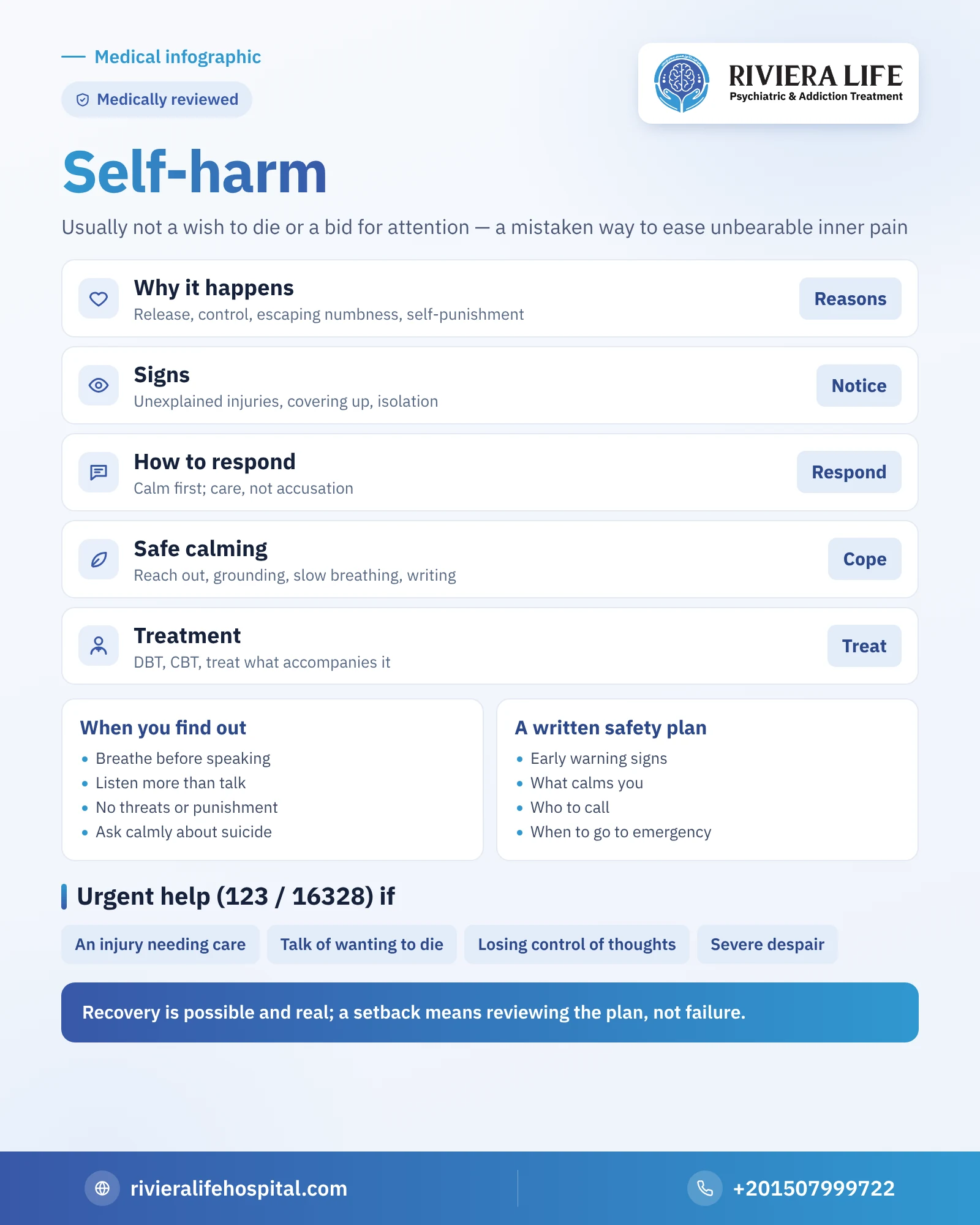
Self-harm is when a person deliberately hurts their body to cope with psychological pain for which they find no words or other way out. It is usually neither an attempt to end life nor a bid for attention, but a temporary and mistaken way to ease a suffocating inner pressure, usually followed by shame and guilt. It happens at all ages, is more common in adolescence, and can be treated effectively. In this article we explain why some people turn to it, the signs the family may notice, how to respond calmly without anger, safe calming alternatives, what treatment looks like, and where to ask for help immediately.
Seek urgent help immediately if you see
If you are thinking of harming yourself now or fear for someone close, you are not alone. Call the ambulance on 123, or the mental health hotline on 16328, or go to the nearest emergency department.
- An injury that needs urgent medical care
- Talk of wanting to die or end life
- A feeling that control over harmful thoughts has been lost
- Severe despair with complete withdrawal from people
What is self-harm?
Doctors mean by self-harm any act by which a person deliberately hurts their body, regardless of the apparent motive. Recent British guidelines define it broadly so that no form of it is underestimated. What matters here isn’t the form, but the message it carries: there is an inner pain that has gone beyond the person’s ability to bear it.
Self-harm isn’t an independent diagnosis in itself, but a sign of severe psychological distress that may accompany depression, anxiety, post-traumatic stress disorder, borderline personality disorder or drug use, and may also appear in someone without any clear diagnosis who is going through a harsh period.
Why do some people harm themselves?
The question that usually baffles families: how can a person hurt themselves willingly? The answer is that psychological pain is sometimes heavier than any other pain, so the person looks for anything that stops it, even for minutes. Among the motives mentioned by those who have been through it:
- Releasing pent-up feelings such as anger, sadness or loneliness when they don’t know how to express them in words.
- A sense of some control in a life that seems out of control.
- Getting out of a state of numbness or inner emptiness, and wanting to feel anything.
- Punishing oneself because of an exaggerated feeling of guilt or self-hatred.
- Coping with memories of trauma, bullying or abuse that no one has talked about.
The relief the person feels after harming is very short, then the distress returns along with shame, so it repeats in a closed circle. This is exactly what treatment targets: breaking the circle and replacing it with real skills.
Self-harm in anger
Some families notice that the harm happens in a moment of anger: punching the wall, hitting the head, or scratching the skin after a fight. This pattern is common especially in teenagers and those who find it hard to express anger in words, and usually happens when feelings go beyond the person’s ability to bear them, so they direct them at their body instead of at others. This falls under what is medically called non-suicidal self-injury, meaning the person doesn’t intend death, but it remains a sign of real distress that needs attention, and may escalate over time.
Treatment here isn’t limited to preventing the behavior, but teaches the person how to catch the signs of anger early and lower them before they explode, and how to express it in a way that harms neither themselves nor others. You will find practical steps in the article on treating excessive irritability, and if the outbursts of anger themselves are severe and repeated, read about intermittent explosive disorder.
Not attention-seeking: correcting the most dangerous common idea
What hurts someone who harms themselves most is hearing the phrase “he’s doing it to get attention”. The truth is that most of them hide what they do carefully, are ashamed of it, and fear being found out. And even if the harm is a way of saying “I’m not okay”, that message deserves to be heard, not mocked.
And it isn’t weak faith, bad upbringing or “being spoiled”. It is an indicator of a need for specialist support, just as fever points to an infection that needs treatment. We explained how biological, psychological and social factors interlink in the article on the causes of mental illness.
Signs the family may notice
There is no single definitive sign, but several changes coming together deserve a calm conversation. Among the signs mentioned in medical references:
- Repeated injuries without a convincing explanation, or explanations that change each time.
- Insisting on covering the whole body even in the heat, and avoiding the pool or medical examination.
- Long isolation in the room or bathroom, and avoiding family activities.
- A clear change in mood, sleep or eating, or a sudden decline at school.
- Phrases carrying self-hatred such as “I’m a burden” or “I deserve what happens to me”.
- Following online content that glorifies self-harm or talks about it a lot.
If your son is a teenager, remember that adolescence alone doesn’t explain every change. And if you notice sharp swings in relationships, outbursts of anger and intense fear of abandonment, the article on borderline personality symptoms may help you understand the picture without diagnosing yourself.
How do you respond calmly if you find out?
The first moment after finding out determines much of what follows. Shock and fear are natural, but exploding pushes the person to hide more. Try these steps:
- Breathe before you speak: don’t start the conversation while angry or panicking; take a few minutes to calm down.
- Start with care, not accusation: say, for example, “I’ve noticed you’re struggling, and I’m here with you”, instead of “how could you do this?”.
- Listen more than you talk: don’t interrupt, don’t belittle their feelings, and don’t start with advice.
- Don’t threaten or punish: punishment and suffocating monitoring increase shame and secrecy.
- Don’t ask for a promise to stop immediately: forced promises are usually broken and then the feeling of failure grows.
- Ask clearly and calmly about thoughts of suicide: asking directly doesn’t plant the idea, but opens the door to talking.
- Agree on a next step: an appointment with a psychiatrist or therapist, and if any injury needs medical care, don’t postpone it.
And because families need support too, we recommend reading the article on how the family deals with someone with a mental illness, as an exhausted family finds it hard to hold others.
Safe alternatives for calming when feelings intensify
The goal isn’t to replace one harm with a lighter one, but to learn ways that don’t harm the body at all, through which the wave passes until it calms. Intense feelings reach a peak and then fall, if left enough minutes. Among the alternatives therapists work on:
- Connecting with a person: a message to a trusted friend or a parent, or a call to the hotline, even if you don’t tell everything.
- Grounding through the senses without pain: name five things you see, four you touch, three you hear, two you smell and one you taste.
- Slow breathing: a calm in-breath and a longer out-breath for several minutes sends the body a signal of safety.
- Writing: write what you feel without editing, or write a letter you won’t send to whoever hurt you.
- Changing place: leaving the room and sitting with the family, or walking in an open space.
- Something that occupies the hands and mind: drawing, tidying, a game that needs concentration, or a soothing sound.
A safety plan with a specialist
The most important tool of all is a written safety plan the person sets with the psychiatrist or therapist: what early signs precede a crisis, what calms them, who they call, how to make the home safer in difficult periods, and when to go to the emergency department. The plan is written at a calm time, kept on the phone, and known by someone close.
How is self-harm treated?
Treatment goes to the roots of the pain, not the behavior alone, and starts with a comprehensive assessment by a psychiatrist to understand what lies behind the harm and the level of risk. Among its most important components:
- Dialectical behavior therapy (DBT): designed mainly for those with intense, changeable emotions, it teaches skills of distress tolerance, emotion regulation, dealing with relationships and mindfulness.
- Cognitive behavioral therapy (CBT): helps understand the thoughts and situations that ignite the urge to harm and change the response to them, as we explained in the article on cognitive behavioral therapy.
- Treating the accompanying condition: if there is depression, anxiety, trauma or addiction, treating it is an essential part of the plan, and the doctor may prescribe medicine for the accompanying condition, not for the harm itself.
- Involving the family: especially with teenagers, to learn a way of communicating that reduces tension at home.
- Safe admission when needed: when risk rises or crises repeat, a period of admission under continuous medical supervision may be the safest option.
Recovery is possible and real. Many who harmed themselves at some stage learned new skills, stopped and lived stable lives. And a setback, if it happens, doesn’t mean failure, but a signal to review the plan.
If you are the one harming yourself
If you are reading this about yourself, thank you for getting this far. What you are going through doesn’t make you a bad or mad person, and you deserve help as much as anyone in pain. Start with a small step: choose one person you trust and tell them you are going through a hard time. If talking face to face is hard, write them a message.
And if you feel the harmful thoughts intensifying or turning into thoughts of death, this is a moment for immediate help, not for waiting. You can learn when you need a specialist and how to prepare for the first visit in the article on when you need a psychiatrist.
Where do you ask for help in Egypt?
- Ambulance: 123, or the nearest emergency department when there is danger or injury.
- The hotline of the General Secretariat of Mental Health and Addiction Treatment: 16328.
- The treating psychiatrist, if there already is one.
- Riviera Life for psychiatry and addiction treatment: +201507999722 around the clock.
How can Riviera Life help you?
At Riviera Life in Sheikh Zayed, the road starts with a calm assessment by consultant psychiatrists in complete confidentiality, without blame or judgment, then a plan that combines psychotherapy, treatment of any accompanying condition and involving the family. For cases that need more safety, round-the-clock medical supervision is available. The first consultation is free.
Read also
- Mental illness: symptoms, types and treatment
- OCD and suicide: warning signs and asking for help
- Mental illness in children
- Depression symptoms
Questions many people ask
Not necessarily; many harm themselves to cope with psychological pain, not to end their lives. But it raises the future risk of suicide, so it is taken seriously and the person is asked calmly about thoughts of death.
No. Asking calmly and directly doesn't plant the idea; it makes him feel someone cares and opens the door to talking and seeking help.
Dialectical behavior therapy is among the most effective treatments, especially with intense, changeable emotions, along with cognitive behavioral therapy and treatment of any accompanying condition.
It may lessen for some over time, but the pain behind it usually remains untreated. Asking for help early teaches alternative skills and reduces the risk of it repeating.
Call the ambulance on 123 or the General Secretariat of Mental Health hotline on 16328, or go to the nearest emergency department.