Self-confidence after addiction recovery is one of the hardest things a person in recovery faces: many come out of treatment clean of the substance but weighed down by a harsh feeling: “I no longer trust myself, and no one trusts me”. This feeling is common and understandable; addiction leaves behind lies, losses and shame, and confidence needs to be rebuilt, not waited for. Here we explain why it drops, how it is rebuilt in small measurable steps, what shame does to recovery, and when it needs a specialist’s help.
Why does self-confidence drop after addiction recovery?
The reasons overlap, and knowing them eases the sense that the fault lies in you:
- A memory of failures: promises not kept, money lost and relationships damaged, all of which leave a mark on how you see your ability.
- Shame: the feeling that what you did defines who you are, not that it was behavior from a period of illness.
- Lost skills: years of preoccupation with the substance may mean a halt in study, work or relationships.
- Other people’s looks: the caution you see in your family’s eyes you may interpret as a final verdict.
- Accompanying disorders: depression and anxiety are among the most common companions of addiction and lower self-esteem.
Guilt and shame: not the same thing
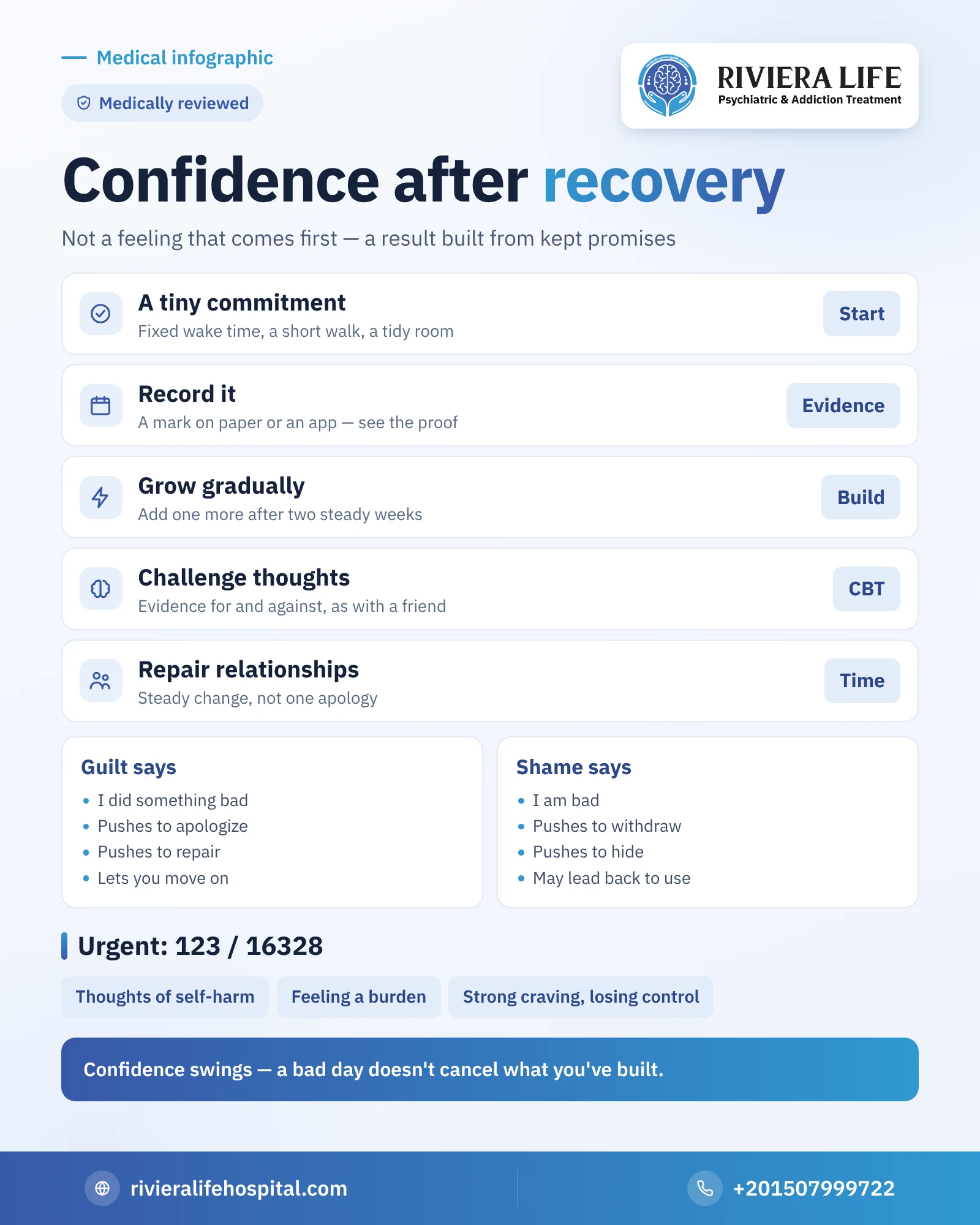
Guilt says: “I did something bad”. Shame says: “I am bad”. The first can push you to apologize and make amends, while the second pushes you to withdraw and hide, and often takes its owner back to the substance to escape it.
The goal, then, isn’t to get rid of all regret, but to turn it into actions: apologize to those who deserve an apology, repair what can be repaired, then allow yourself to move on. Someone who can’t forgive themselves keeps paying the same price over and over.
After recovery, the self-esteem test helps you follow the improvement in how you see yourself step by step.
How do you build confidence in small steps?
Self-confidence isn’t a feeling that comes first and then you act on it. It is a result that accumulates from small promises you keep. Here is a practical method:
- Choose a very small commitment: waking at a fixed time, walking for a quarter of an hour, or tidying your room.
- Record that you did it: a mark on paper or in an app lets you see the evidence.
- Increase the size gradually: after two steady weeks, add another commitment.
- Celebrate ordinary days: a calm day without the substance and without lies is an achievement worth recognizing.
- Don’t make yourself big promises: huge promises that break reopen the wound of confidence.
In the time of using you presented yourself through promises, and now you present yourself through repeated actions. This is slower but sturdier.
Rebuilding the inner image
Psychotherapists use methods from cognitive behavioral therapy to modify the thoughts that tear down confidence, such as “I’ll always fail” or “I’m an addict forever”. You are asked to write down the thought and then ask: what is the evidence for it and what is the evidence against it? And would I say this to a friend in my position?
And there is another important thing: change your language. “Addict” is a noun that signals a fixed identity, while “a person recovering from addiction” is an expression that signals a process. This isn’t cosmetic; language affects how you live your self.
Work, study and money
Confidence needs a field in which to prove itself. A gradual return to work or study, even with simple tasks or part-time hours, gives meaning, standing and routine. And don’t compare yourself to colleagues who got ahead of you; they didn’t go through what you went through, and what you achieved in your recovery is no less than their achievements.
As for money, start with a transparent plan with the family to repay what can be repaid gradually. Sticking to a small repayment plan restores trust between both sides faster than any verbal apology.
The body, sleep and movement
An exhausted body produces dark thoughts. Regular sleep, good food and movement improve mood and increase the sense of ability, and the brain gradually regains its chemical balance over weeks and months. Regular walking, for example, is among the simplest things that can change how you feel within two weeks, and it also fills the empty hours linked to the urge to use.
Relationships: who to keep company with and whose relationship to repair?
Make sure you have a circle that supports your recovery: other people in recovery, old friends who weren’t part of the using, or support groups such as the twelve-step program. Having someone who knows your story and accepts you despite it is among the strongest things that restore confidence.
As for repairing damaged relationships, it doesn’t happen with a single apology. The family needs time to see steady change, and the article on dealing with a recovering addict explains how trust returns from the family’s side.
Confidence in marriage and romantic relationships
A person in recovery may ask themselves: do I deserve a partner? Will anyone accept me if they knew? Caution here is useful; big emotional decisions aren’t advised in the first year of recovery, because the brain is still readjusting its emotions. And when the time for a relationship comes, early honesty protects you from the constant fear of being exposed. You will find questions that help both sides in the article on marrying a recovered addict.
What do I tell others about my past?
You aren’t required to tell your story to everyone. You have the right to privacy, and it is enough that those with a real need know. Prepare a short, calm sentence such as: “I went through a difficult period, I recovered from it and I’m currently following up with a specialist”. You may be asked at work about a gap in your CV, and it is enough to say you were treating a health problem and have finished with it, with no need for more detail.
When do you need a specialist’s help?
Low confidence is natural at the start, but seek a psychological assessment if your feeling of inferiority lasts for long weeks, or is accompanied by symptoms of depression such as loss of interest and disturbed sleep and appetite, or thoughts appear that you are a burden on those around you. These symptoms need treatment and aren’t a weakness of character, and they are among the causes of relapse that shouldn’t be left. For accompanying disorders, the dual diagnosis program provides treatment for addiction and mental illness together.
Seek urgent help if
These signs mean you shouldn't stay alone:
- Thoughts of harming yourself or ending your life
- A feeling that nothing is worth it and that everyone would be better off without you
- A strong urge to use with a feeling of losing control
Call an ambulance on 123 or the mental health hotline 16328, and tell someone you trust now.
What tears confidence down again?
There are small habits that quickly bring back the feeling of failure: comparing your recovery with someone else’s, expecting perfection from the first month, ignoring the good days and treating a bad day as a final verdict, long hours of isolation with the phone and your thoughts, and hiding a small slip until it grows. Things improve when you talk about the difficulty on the day it happens, and when you learn to answer the inner critic with a kinder voice.
And remember that confidence swings; there will be days when you feel you are back to zero, and this doesn’t cancel what you have built. A person in recovery who knows this doesn’t abandon the plan at the first setback, but returns to it the next day as if nothing happened. At the end of each week, write down three things you achieved however small they seem, and review the list when dark thoughts press on you.
How does Riviera Life help you?
Our support extends beyond the end of the first period of treatment; the consultants in psychiatry and addiction treatment assess the psychological state of the person in recovery, and support continues through aftercare and the family program, in complete confidentiality. The first consultation is free; to get in touch: +201507999722, and we are based in Sheikh Zayed, Giza.
Read also
- The stages of addiction recovery
- Does an addict return to normal after treatment?
- The aftercare program after treatment
- How does a drug addict think?
Questions many people ask
Because addiction leaves a memory of failures, shame and losses, and may be accompanied by depression or anxiety. This is common and improves with gradual rebuilding and treatment.
Guilt is the feeling that you did something bad and pushes you to make amends, while shame is the feeling that you are bad and pushes you to withdraw, and may lead back to using.
By choosing a very small commitment you keep every day, recording that you did it, increasing it gradually, and celebrating ordinary days.
You don't have to tell everyone. Those with a real need to know are enough, and you can prepare a short, calm sentence about a difficult period that has ended.
If your feeling of inferiority lasts for weeks, or symptoms of depression or thoughts that you are a burden on those around you appear, seek a psychological assessment.