Drug-induced psychosis is an episode in which a user loses touch with reality because of a substance they took or its withdrawal: they hear voices, become convinced someone is following them, or see insects crawling under their skin, and don’t realize that what they are experiencing isn’t real. The substances that most often cause it are high-potency hashish, strox, shabu, cocaine and hallucinogens, as well as severe alcohol withdrawal. It usually settles within days to weeks of stopping, but in some people it may reveal a predisposition to chronic psychosis. In this article we explain the causative substances, the signs, the expected duration, how to deal with emergencies, and treatment.
What is drug-induced psychosis?
Many drugs change perception while they are acting, which is well known to their users. The difference in psychosis is that the user loses the ability to tell the difference: someone who takes a hallucinogen, sees colors moving and knows it is the drug’s effect isn’t psychotic, but someone convinced that the neighbors have planted cameras in their room, who locks the door and carries a knife to defend themselves, is psychotic. Doctors call it “substance-induced psychotic disorder”, and it happens during intoxication with the substance, during withdrawal from it, or shortly after stopping.
The substances that most often cause psychosis
Hashish and bango
A large dose of high-potency hashish can cause temporary suspicion and hallucinations even in a new user, and daily use, especially if it started in adolescence, is linked to a higher risk of repeated psychotic episodes. Details of the substance are in our guide to hashish.
Strox and synthetic cannabinoids
Chemicals sprayed on herbs, many times stronger than natural hashish and varying in composition from bag to bag, which is why they cause acute psychotic episodes with agitation and sometimes seizures, possibly from the first try. Read about them in our guide to strox.
Shabu (ice) and stimulants
One of the best-known causes of psychosis in emergency departments. It usually begins after days of continuous use and sleeplessness: intense suspicion, repeatedly looking out of the window, hearing footsteps or voices, and a sensation of insects under the skin that drives the user to scratch their skin. A similar pattern occurs with Captagon and amphetamines. The details are in our guide to methamphetamine.
Cocaine
It causes suspicion and hallucinations, especially with repeated doses in a single session or with crack, and the psychosis may be accompanied by a dangerous rise in temperature and blood pressure. See our guide to cocaine.
Hallucinogens and ketamine
Paper, magic mushrooms and ketamine distort perception by their nature, and the experience turns into psychosis when the user loses the ability to recognize that it is the drug’s effect, or when symptoms continue after the effect has worn off.
Alcohol and sedative withdrawal
After long, heavy use, stopping alcohol suddenly can lead to withdrawal delirium: confusion, tremor, sweating and terrifying hallucinations. Something similar can happen when sedatives are stopped suddenly. This is a serious medical condition that isn’t treated at home; its details are in our article on alcohol withdrawal symptoms.
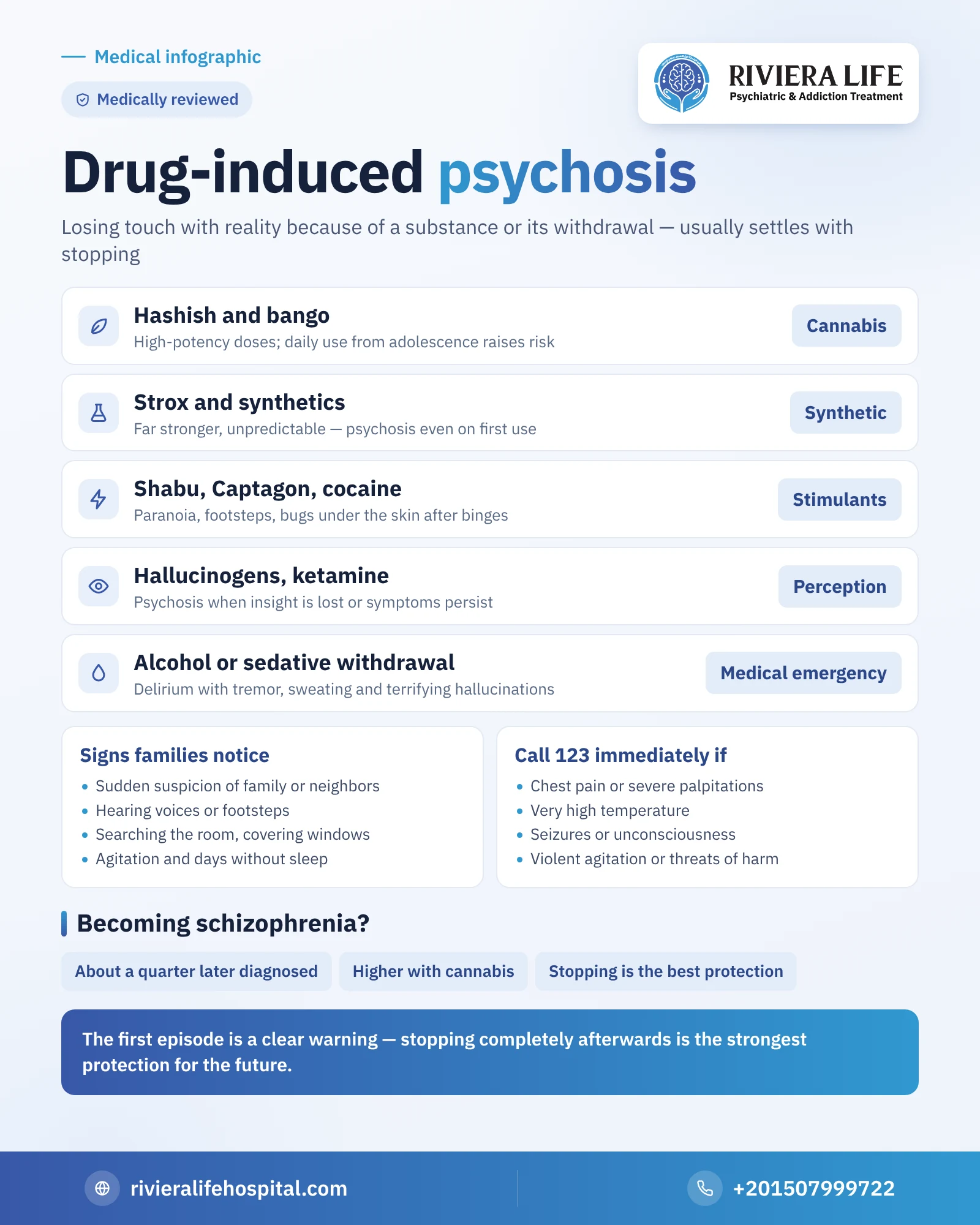
Signs of drug-induced psychosis
What the family usually notices:
- Sudden suspicion: accusing family or neighbors of watching them or trying to poison them.
- Hearing voices or footsteps that aren’t there, or talking to an invisible person.
- A sensation of insects crawling on or under the skin, with scratch wounds, especially with stimulants.
- Repeatedly searching the room, covering windows or taking devices apart looking for bugs.
- Severe agitation and irritability or visible fear, and being unable to sleep for days.
- Incoherent speech or strange ideas they hold onto despite every attempt at persuasion.
What suggests the drug is the cause is that the symptoms began right after use or during withdrawal, and that they carry the character of the substance, such as insects under the skin with stimulants. But confirmation needs a medical assessment and a drug test.
How long does drug-induced psychosis last?
It depends on the substance, the amount and the duration of use. Psychosis linked to intoxication may clear within hours to days, and stimulant psychosis after long use usually settles within days to weeks of stopping. Doctors use an approximate limit: if symptoms continue for more than about a month after stopping completely and after withdrawal, the doctor starts to consider an independent psychotic disorder that appeared at the same time as the substance use. Some shabu users may be left for a long time with a tendency to suspicion that returns quickly with any new dose or severe stress.
Does it turn into schizophrenia?
This is what worries families most, and the honest answer is: not always, but the possibility is real. Reviews of studies suggest that roughly a quarter of people who go through a substance-induced psychosis are later diagnosed with schizophrenia or bipolar disorder, and the proportion is higher with cannabis than with other substances. This doesn’t necessarily mean the drug “created” the schizophrenia; it may have revealed an existing predisposition and hastened its appearance.
The likelihood is higher in young people, those with psychosis or bipolar disorder in the family, those whose episode lasted longer, and most importantly, those who continued to use afterwards. That is why the first episode is a clear warning, and stopping completely afterwards is the strongest thing that can be done to protect the future. It may also help to read the causes of psychosis to understand how predisposition combines with a trigger.
The difference between drug-induced psychosis and schizophrenia
| Point of comparison | Drug-induced psychosis | Schizophrenia |
|---|---|---|
| Onset | Right after use or during withdrawal | Usually gradual after a prodromal phase |
| Duration | Days to weeks after stopping | At least six months |
| Hallucinations | More visual and tactile, especially with stimulants | Mostly auditory |
| Negative symptoms | Usually few | Withdrawal and apathy that increase over time |
| After stopping | Clear improvement | Symptoms continue without treatment |
This table is for understanding only; overlap is possible, and the diagnosis is the psychiatrist’s after follow-up that may last weeks.
Dealing with an episode in an emergency
If your relative is in an episode now, everyone’s safety comes first. Speak calmly in short sentences, don’t argue with their ideas or mock them, move sharp tools and car keys away, and give them space and a way out rather than cornering them. Don’t try to restrain them yourself, and don’t give them sedatives from home, as mixing them with the drug can be dangerous. Keep any information about the substance they took, the amount and the time, as it helps the emergency team.
Call an ambulance on 123 immediately if you see
Some drug-induced psychotic episodes carry a life-threatening physical danger — don't wait for them to settle on their own.
- Chest pain or severe palpitations after a stimulant
- A very high temperature with heavy sweating, or hot, dry skin
- Seizures or loss of consciousness
- Confusion, tremor and hallucinations after stopping alcohol or sedatives
- Violent agitation or threats to harm themselves or others
Guidance can also be requested from the hotline of the General Secretariat of Mental Health and Addiction Treatment on 16328.
What happens in hospital?
The team starts with a physical examination and vital signs, then a drug test and blood tests, because some episodes carry complications for the heart, kidneys and temperature. The patient is placed somewhere quiet under constant observation, and the doctor may prescribe a temporary sedative or an antipsychotic for a short period to ease agitation and hallucinations; we explain these medicines in our article on antipsychotics. With alcohol or sedative withdrawal, the withdrawal itself is treated medically to prevent seizures and delirium. As the episode clears, the doctor reassesses to determine whether the psychosis was caused by the substance alone, or whether there is another disorder that needs longer treatment.
Treatment after the episode clears
The voices fading isn’t the end of treatment, but its real beginning. If the patient returns to using, the episode usually comes back faster and more severely. Afterwards they need treatment for the addiction itself: safe withdrawal from the drug, then psychotherapy that addresses the reasons for and triggers of use, then a relapse prevention plan involving the family. When psychosis and addiction occur in the same person, they need a single plan that treats both together, as in our dual diagnosis program. If the psychosis continues despite stopping, the path becomes what is explained in our article on psychosis treatment.
How can Riviera Life help you?
At Riviera Life, consultants in psychiatry and addiction receive drug-induced psychotic episodes under round-the-clock medical supervision, then continue with the patient through addiction treatment, the family program and aftercare, in complete confidentiality. The first consultation is free on +201507999722. And if the suspicion started with hashish specifically, also read hashish addiction and suspicion.
More from our psychosis guide
- Psychosis: the complete guide
- The causes of psychosis: predisposition and triggers
- Psychosis treatment: from the first episode to relapse prevention
- Hashish addiction and suspicion
- Delirium vs psychosis: a medical emergency or a mental disorder?
Questions many people ask
It usually settles within days to weeks of stopping completely, and can return quickly with any new dose or long sleepless nights.
It usually goes away with stopping, but continuing to use raises the risk of repeated episodes and the likelihood of a later diagnosis of chronic psychosis.
It is better to have it assessed medically first, because some episodes carry physical complications or danger to the patient and those around them, and alcohol withdrawal needs medical supervision.
Onset after use or during withdrawal, and improvement with stopping, suggest the substance is the cause, but confirmation needs a doctor's assessment and a drug test.
Yes, in many cases, and often faster and more severely than the first time, which is why addiction treatment is an essential part of treating the psychosis.