“Megalomania” is the popular name for what doctors call grandiose delusions: a fixed conviction that the person has exceptional abilities, status, wealth or a mission that reality doesn’t support, and doesn’t back down from however much evidence confronts them. It isn’t excessive self-confidence or ordinary vanity, but a psychotic symptom that usually appears in manic episodes, in schizophrenia and delusional disorder, and with stimulant use. Here we explain how to tell the delusion from high confidence and from narcissistic personality, real examples of it, how the family should act, and the treatment.
What are delusions of grandeur?
The colloquial expression is sometimes used for someone arrogant or boastful, but its medical meaning is narrower and more serious. A grandiose delusion is a fixed belief that its owner is a unique person: a genius who discovered what scientists couldn’t, chosen for a cosmic mission, the owner of an enormous fortune no one knows about, or a close friend of a celebrity they have never met. The deciding factor isn’t the strangeness of the idea alone, but how fixed it is, the person’s inability to reconsider it, and that it isn’t consistent with their culture and environment.
In grandiose delusions the person sees themselves at the center of the universe, while in paranoia they see themselves as a target of harm. The two pictures sometimes come together: “They’re chasing me because I know a great secret”. We explained the second picture in the article on paranoia.
High confidence, narcissism or delusion?
These are three different conditions that people often confuse:
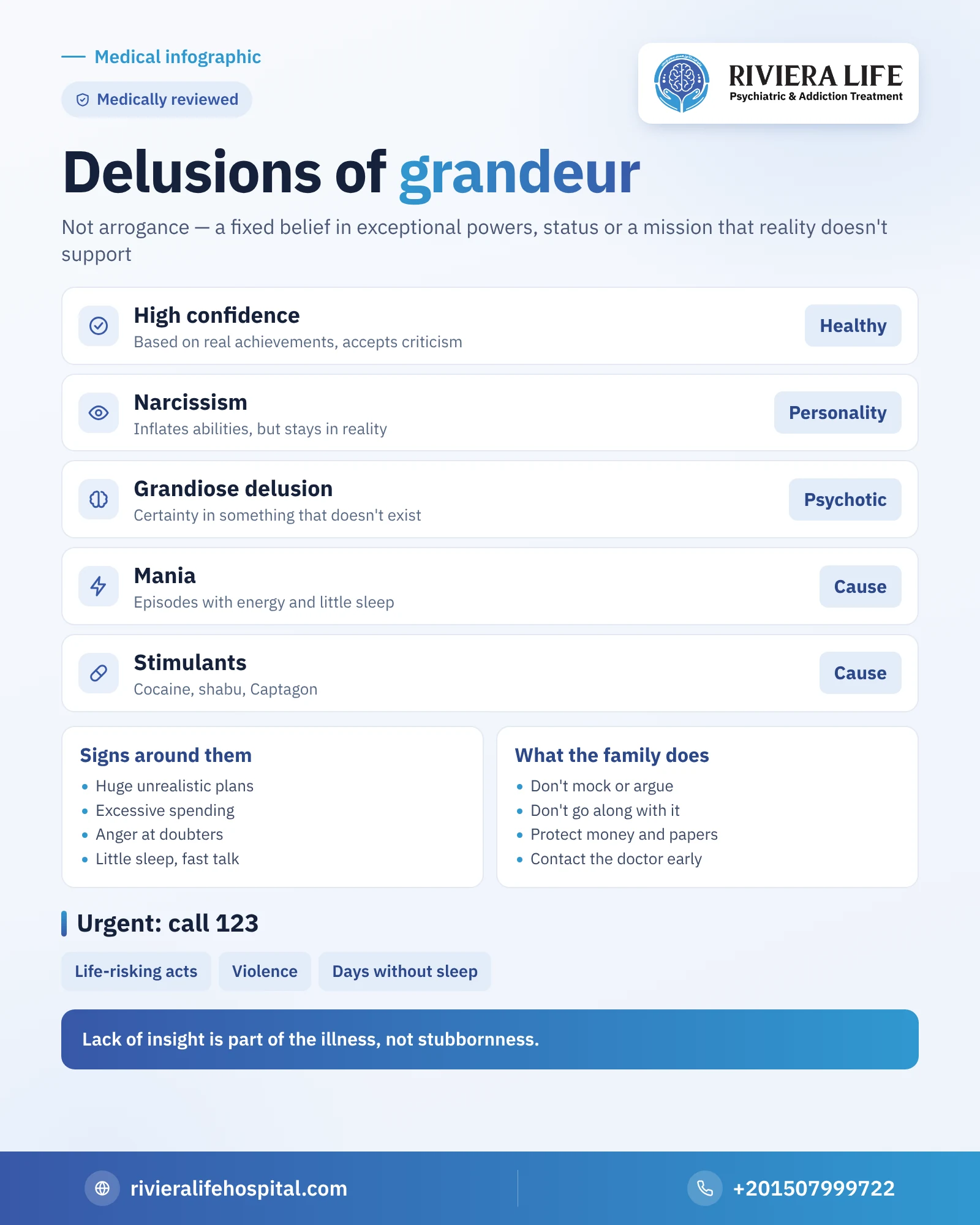
- High self-confidence: high self-esteem based on real achievements, with the ability to accept criticism and admit mistakes.
- Narcissistic personality disorder: a stable pattern since youth of feeling special, needing admiration and weak empathy. The person exaggerates and inflates their abilities, but stays connected to reality, and knows they aren’t a prophet or a billionaire. The details are in narcissistic personality disorder.
- Grandiose delusion: a break from reality; the exaggeration here turns into certainty about something that doesn’t exist, and usually appears in an episode with a clear onset and a sudden change from their usual personality.
Put simply: the narcissist says “I’m smarter than my manager”, while the person with the delusion says “I’m the one secretly running the company, and the manager is just a front”.
Examples of grandiose delusions
- A student leaves university because he “discovered a cure for cancer” and sends repeated letters to ministries.
- An employee spends all the family’s savings because he is certain of a deal that will make him the richest man in the country.
- A person announces that he is charged with a special religious mission and demands that people follow him.
- A young man convinced that a famous singer loves him and sends him signals through her songs.
- A man who believes he is immune to harm, so he drives at insane speed or stands on the edge of a height.
The last example shows why grandiose delusions aren’t just strange talk; the sense of absolute power may push towards life-threatening acts.
Signs noticed by those around them
- Repeated talk of huge unrealistic plans whose focus changes quickly.
- Excessive spending, loans or donations out of proportion to their income.
- Intense anger at or contempt for anyone who doubts their abilities.
- Little sleep without feeling tired, with fast speech and excess activity.
- Leaving work or study because “the mission is bigger than that”.
- A sudden change in appearance, clothing or behavior in public.
Delusions of grandeur in a manic episode
Manic episodes in bipolar disorder are among the best-known causes of grandiose delusions. They usually start with inflated self-esteem, inexhaustible energy and less need for sleep, then escalate in severe episodes to psychotic grandiose ideas. What distinguishes them is that they come in an episode with a beginning and an end, are accompanied by elevated or irritable mood, and usually disappear with treatment of the episode. For the other signs of mania, see bipolar disorder symptoms and the bipolar disorder guide.
In schizophrenia and delusional disorder
In schizophrenia, grandiose delusions may come with voices that confirm them, such as a voice telling the patient they are chosen, and with other symptoms such as withdrawal and disorganized thinking, without a clear rise in mood. In the grandiose type of delusional disorder, one idea dominates, such as an invention or an exceptional talent, while the person seems organized in the other aspects of their life. This distinction is made by the doctor through interview and follow-up, not from a single idea.
Stimulants and illusions of power
Cocaine, shabu (ice) and Captagon raise dopamine strongly, giving the user an artificial sense of power, intelligence and the ability to do anything. With repeated doses and staying up for days, this feeling may turn into outright grandiose delusions, often mixed with suspicion and aggression. These symptoms usually calm within days of stopping, but they call for assessment because they may reveal an underlying mood or psychotic disorder. You will find more on the methamphetamine page.
Why is it more dangerous than it seems?
The real danger isn’t in the idea itself, but in the decisions built on it: debts that burden the family for years, a sudden resignation, relationships that collapse because of contempt and clashes, or physical risk-taking built on the illusion of immunity. And when the manic episode ends, the patient may face the scale of the losses and fall into severe depression, a stage that needs close follow-up.
Does the patient realize they are ill?
During the episode, usually not. The sense of grandeur is pleasant and comfortable, and seems to its owner clearer than ever before, which is why they see the family’s efforts as jealousy or an inability to understand them. Doctors call this poor insight, and it is part of the illness, not stubbornness on the patient’s part. The good news is that insight returns in most cases as the episode improves, and many patients can then identify for themselves the first thing that changed in them: less sleep, more plans, or spending. These memories are valuable, as they are what a written plan is built on to catch the next episode early, before the ideas grow and turn into decisions.
How should the family act?
- Don’t mock or challenge: mockery pushes towards stubbornness, and arguing raises tension without benefit.
- Don’t go along with the idea: avoid phrases that confirm it, and focus on what you actually notice: “You haven’t slept for three days, and that worries me”.
- Protect money and papers: keep bank cards and important documents temporarily, as impulsive spending is one of the most common harms.
- Keep them away from driving and dangerous situations as long as they are in an active episode.
- Contact the doctor early: if bipolar disorder has been diagnosed before, the appearance of grandiose ideas is a signal to adjust the plan immediately.
Treatment of delusions of grandeur
Treatment is directed at the cause. In a manic episode the doctor uses mood stabilizers, antipsychotics or both, and hospital admission may be needed to protect the patient from their decisions. In schizophrenia and delusional disorder, antipsychotics are the basis of treatment, with cognitive behavioral therapy that helps review the ideas and deal with them. In cases linked to stimulants, treatment starts with stopping completely and safe withdrawal under medical supervision, then rehabilitation to prevent relapse. Only the doctor determines the type and duration of medicine, and no medicine is stopped without consulting them.
When should you seek urgent help?
Seek urgent help immediately if you see
Call the ambulance on 123 or go to the nearest emergency department when grandiose ideas come with clear danger.
- Acts that endanger their life on the claim that they are immune or superhuman
- Agitation or violence when contradicted
- Not sleeping for several days with escalating talk and activity
- Grandiose ideas after using a stimulant, with chest pain or very high temperature
- Talk of self-harm after the episode ends
At Riviera Life our consultant psychiatrists assess the episode and determine its cause, with round-the-clock medical supervision when admission is needed, complete confidentiality, and a free first consultation on +201507999722.
More from the psychosis guide
- Psychosis: the complete guide
- Paranoia: from suspicion to persecutory delusion
- Bipolar disorder symptoms
- Schizophrenia symptoms and early signs
- Treating narcissistic personality: psychotherapy approaches and realistic goals
- Delusional disorder: types of delusions, the difference from schizophrenia and treatment
- Psychosis and marriage: when is it possible, and what about disclosure, pregnancy and children?
Questions many people ask
No. A narcissist inflates their abilities but stays connected to reality, while delusions of grandeur in the medical sense are a fixed belief in something unreal, often appearing in an episode with a clear onset.
The best known are manic episodes in bipolar disorder, then schizophrenia and delusional disorder, and use of stimulants such as cocaine and shabu.
Usually they don't realize it during the episode because the ideas seem real to them, and in most cases awareness returns with treatment and improvement of the episode.
Keep bank cards and important documents temporarily, keep them away from driving and risk-taking, and contact the doctor early, because impulsive spending is one of the most common harms.
Yes in most cases, especially when they are part of a manic episode or linked to stimulants, with follow-up needed to prevent episodes recurring.