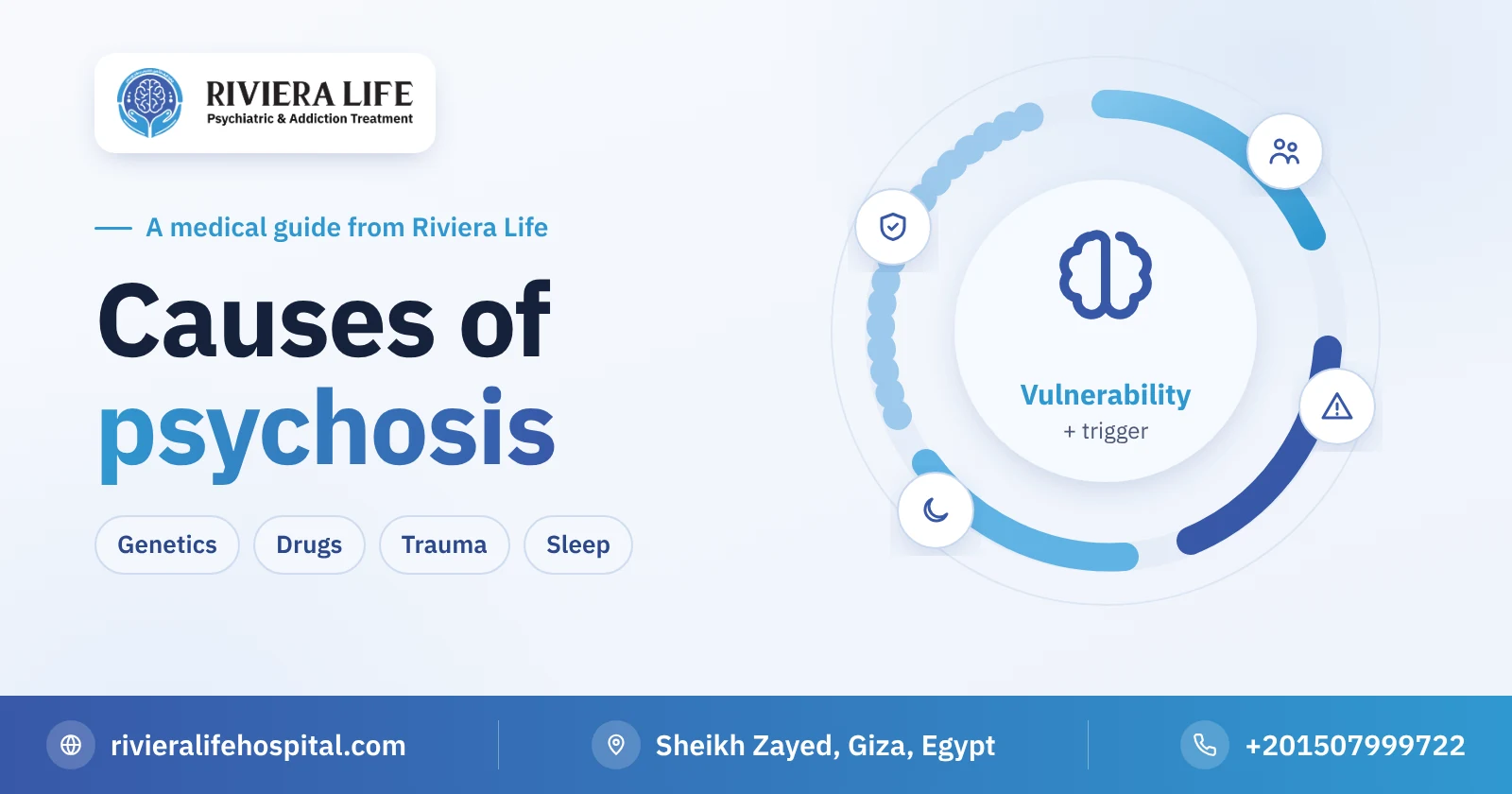
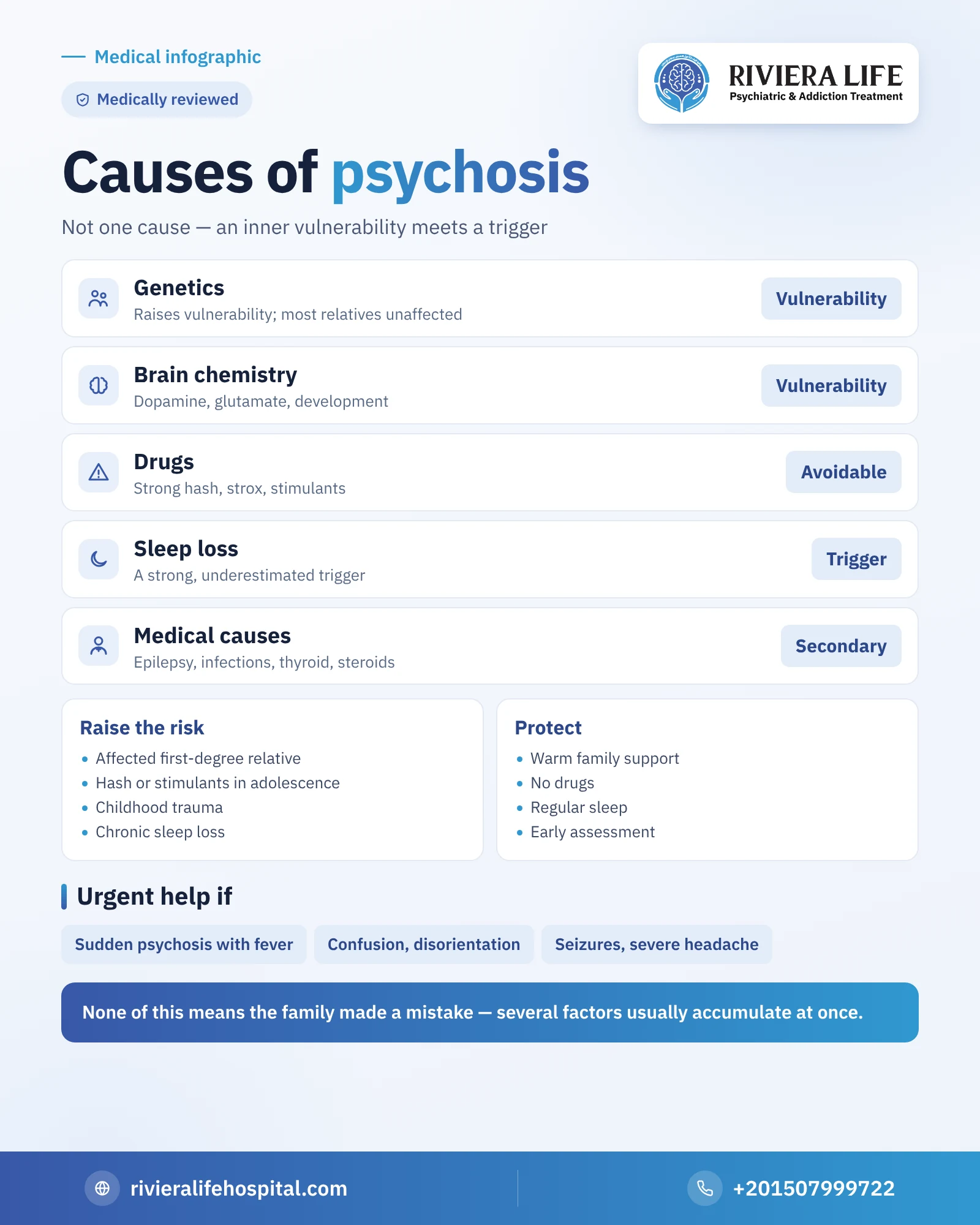
The causes of psychosis can’t be reduced to one factor that can be pointed to; rather they are the meeting of an inner vulnerability with a factor that sets off the episode. The vulnerability may be genetic or the result of how the brain developed, and the trigger may be a drug, a trauma, long nights without sleep, a physical illness or childbirth.
That is why one person has a psychotic episode after an experience that others go through without effect. In this article we explain the causes of psychosis as psychiatry sees them today: genetics and brain chemistry, stress and trauma, drugs, medical and neurological causes, sleep deprivation and the postpartum period, then we put risk factors on one side of the scale and protective factors on the other.
Why is there no single cause of psychosis?
Doctors usually explain psychosis with a model called “vulnerability and stress”. Imagine a cup that gradually fills: genes and the circumstances of pregnancy and childhood determine how much is in it from the start, then life adds other drops, such as using hash at a young age, a violent trauma, or weeks of insomnia before exams. And when the cup overflows the episode appears. Someone with high vulnerability may need only a few drops, and someone with low vulnerability may need enormous pressure, such as repeated doses of a strong stimulant, to go through the experience.
This model explains two things that puzzle families: why this son was affected and not his siblings even though they grew up in the same house, and why the episode appeared now in particular. The answer is usually that several factors accumulated at the same time, not that someone made a single mistake.
Genetics: what does it mean that there is a patient in the family?
Genetics is among the strongest vulnerability factors. Having a father, mother or sibling with schizophrenia or bipolar disorder clearly raises the likelihood of illness compared with the general population, and it rises further if both father and mother are affected or the relative is an identical twin. But the reassuring picture the family should know is that most patients’ relatives are never affected.
There is no “psychosis gene”. What a person inherits is a large group of small genetic differences, each adding a tiny amount of vulnerability, and this vulnerability only turns into illness together with other factors. That is why there is today no genetic test that predicts the illness of a particular person. And if the family history worries you, the article on the causes of mental illness explains the role of genetics in mental disorders in general.
Brain chemistry and how it develops
Psychosis is linked to increased dopamine activity in particular pathways of the brain, the pathways that help us determine what deserves attention. When they are disturbed, ordinary things acquire exaggerated importance: a passing glance seems a message, and a sound in the street seems directed at the person. That is why most antipsychotics work to calm this activity. Another transmitter, glutamate, also takes part in the picture, which explains the ability of substances such as ketamine to produce psychotic symptoms.
Researchers believe part of the vulnerability forms before birth and in early childhood. Complications of pregnancy and birth, such as lack of oxygen, very premature birth or some types of infection during pregnancy, have been linked to a slight rise in risk later. Then comes adolescence, in which the brain intensely rearranges its connections, the period in which the first episode appears in many. None of this means the mother is responsible for what happened; these are probabilistic factors no one controls.
Stress and trauma: when the burden accumulates
Harsh experiences in childhood recur in the history of many patients: physical or psychological abuse, neglect, long bullying at school, or early loss of a parent. Studies indicate that these experiences are linked to a higher risk of developing psychosis later, as if they make the brain’s alarm system more sensitive to threat.
In adulthood, acute stress usually works as a trigger, not as a cause on its own: the death of a loved one, a separation, losing a job, emigrating to a strange country, or severe social isolation. After a violent trauma what is called brief psychotic disorder may appear, which lasts days to less than a month and then goes away. It is also noted that living in crowded cities and feeling marginalized are linked to higher risk, perhaps because they raise the level of chronic tension.
Drugs: the strongest avoidable cause
Of all the causes of psychosis, drugs remain the factor a person can control. The clearest in effect:
- High-potency hash: daily use, especially if it started in adolescence, is linked to a clear rise in the risk of psychosis, and the risk increases with strong types.
- Strox and synthetic cannabinoids: stronger in effect and less predictable than natural hash, and they may cause an episode from the first try.
- Stimulants: shabu (ice), captagon and cocaine, especially with staying awake for consecutive days.
- Hallucinogens and ketamine: they produce a disturbance in perception that may persist after their effect wears off in those with a vulnerability.
- Withdrawal from alcohol or sedatives: after long use, sudden stopping may cause delirium with hallucinations.
We explain the pictures of these episodes, their duration and how to deal with them in the article on drug-induced psychosis, while the suspicion linked to hash in particular is in the article on the hash addict and suspicion.
Medical and neurological causes: secondary psychosis
Sometimes psychosis isn’t a mental disorder at all, but a sign of an illness in the body or brain, which doctors call secondary psychosis. Examples include:
- Epilepsy, especially temporal lobe seizures, head injuries and brain tumors.
- Brain inflammation, including immune inflammation that may begin with purely psychiatric symptoms in healthy young people.
- Thyroid and adrenal disorders, lupus, and vitamin B12 deficiency.
- Dementia, Parkinson’s disease and some of its medicines.
- Medicines such as cortisone in high doses.
The doctor suspects an organic cause if psychosis began for the first time after the age of forty, appeared suddenly within hours or days, or was accompanied by clouding of consciousness, fever, severe headache, seizures or weakness in a limb. These cases need urgent medical assessment before any psychiatric treatment.
Seek urgent help immediately if there appear
Call an ambulance on 123 or go to the nearest emergency department, as a serious organic cause may be behind the symptoms.
- Strange ideas or hallucinations that appeared suddenly with a high fever
- Clouding of consciousness or not knowing place and time
- Seizures or an unusual severe headache with a change in behavior
- Psychosis after using a stimulant with chest pain or severe agitation
- Talk of harming oneself or others
Guidance can also be sought from the hotline of the General Secretariat of Mental Health on 16328.
Sleep deprivation: an underestimated trigger
Lack of sleep doesn’t create psychosis on its own in most people, but it is one of the strongest triggers in those with a vulnerability. After two or three nights with almost no sleep even healthy people may go through mild perceptual distortions, and in those predisposed these may develop into clear delusions. Families often relate that the son stayed up for weeks before exams or with stimulants before the episode exploded. The same thing happens in manic episodes, where sleep decreases so mania increases so sleep decreases further. That is why the doctor treats persistent insomnia as a warning sign, and the reader will find its details in the guide to insomnia.
Postpartum psychosis: who is most at risk?
After giving birth the mother goes through sharp hormonal changes, severe sleep deprivation and great psychological pressure, three factors that come together at one time. That is why the likelihood of psychosis rises in the first weeks after birth, especially in someone previously diagnosed with bipolar disorder, who had psychosis after a previous birth, or in whose family someone was affected. This differs from passing sadness and from postpartum depression, as it is an emergency that needs assessment the same day. A pregnant woman who carries one of these factors benefits from planning with her psychiatrist before birth.
Risk factors and protective factors
Risk factors don’t mean illness is inevitable, and protective factors don’t mean complete immunity, but they help in understanding where intervention is possible:
| Factors that raise the risk | Factors that protect or reduce the risk |
|---|---|
| A first-degree relative with psychosis or bipolar disorder | Warm family relationships and steady social support |
| Using hash or stimulants, especially in adolescence | Abstaining from drugs or delaying any experiment until after the brain has finished developing |
| Trauma, abuse or bullying in childhood | Regular, sufficient sleep |
| Social isolation and accumulated acute stress | Skills for dealing with stress and asking for help early |
| Complications during pregnancy or birth | Psychiatric follow-up for the at-risk pregnant woman before and after birth |
| Chronic sleep deprivation | Quick assessment when early signs such as withdrawal and new suspicion appear |
What doesn’t cause psychosis?
Explanations spread that increase the family’s burden without helping it. Psychosis isn’t the result of weakness of personality or lack of faith, a “wrong” upbringing alone doesn’t create it, and it doesn’t happen because the student studied too much, even though staying up and pressure may set off an episode in someone predisposed. And delaying taking the patient to a doctor in search of other explanations prolongs the duration of untreated psychosis, a duration linked to weaker long-term outcomes.
Causes of psychosis and causes of hallucinations: what’s the difference?
A hallucination is a symptom that may happen without psychosis, as in fever, poor eyesight or the moments before sleep, so the list of its causes widens to include things unrelated to losing touch with reality, explained in the article on the causes of hallucinations. This article, however, deals with what makes a person lose the ability to distinguish between reality and what goes on in their mind, with or without hallucinations. And if psychosis is part of schizophrenia in particular, the details of its causes are in the article on the causes of schizophrenia.
How does Riviera Life help you?
Knowing the cause is what determines the treatment: stopping the drug, treating the thyroid, a mood stabilizer, or an antipsychotic. The psychiatry consultants at Riviera Life carry out a comprehensive assessment that looks into family history, substance use, sleep and physical health, with the necessary tests, in complete confidentiality. The first consultation is free, and you can get in touch at any time via +201507999722. And when the cause becomes clear, the article on psychosis treatment explains the next steps.
More from the psychosis guide
- Psychosis: the complete guide
- Drug-induced psychosis: signs, duration and treatment
- Psychosis treatment: from the first episode to preventing relapse
- Causes of hallucinations
- The difference between psychosis and schizophrenia: a symptom or an illness, and how does the doctor determine the cause?
- The difference between delirium and psychosis: a medical emergency or a mental disorder?
Questions many people ask
Genetics plays an important role in vulnerability, and having an affected relative raises the likelihood, but most patients' relatives are not affected, and the illness usually needs other factors with it.
Yes, it may cause a temporary episode, and daily use of strong types, especially in adolescence, is linked to a higher risk of recurrent psychosis.
Acute stress usually works as a trigger in someone who has a vulnerability, and after violent trauma it may cause a short episode that goes away within less than a month.
It doesn't cause it on its own in most people, but it is one of the strongest triggers in those predisposed, and persistent insomnia is a warning sign that deserves assessment.
The doctor favors an organic cause if psychosis appeared suddenly or for the first time after forty, or was accompanied by confusion, fever, seizures or a severe headache.