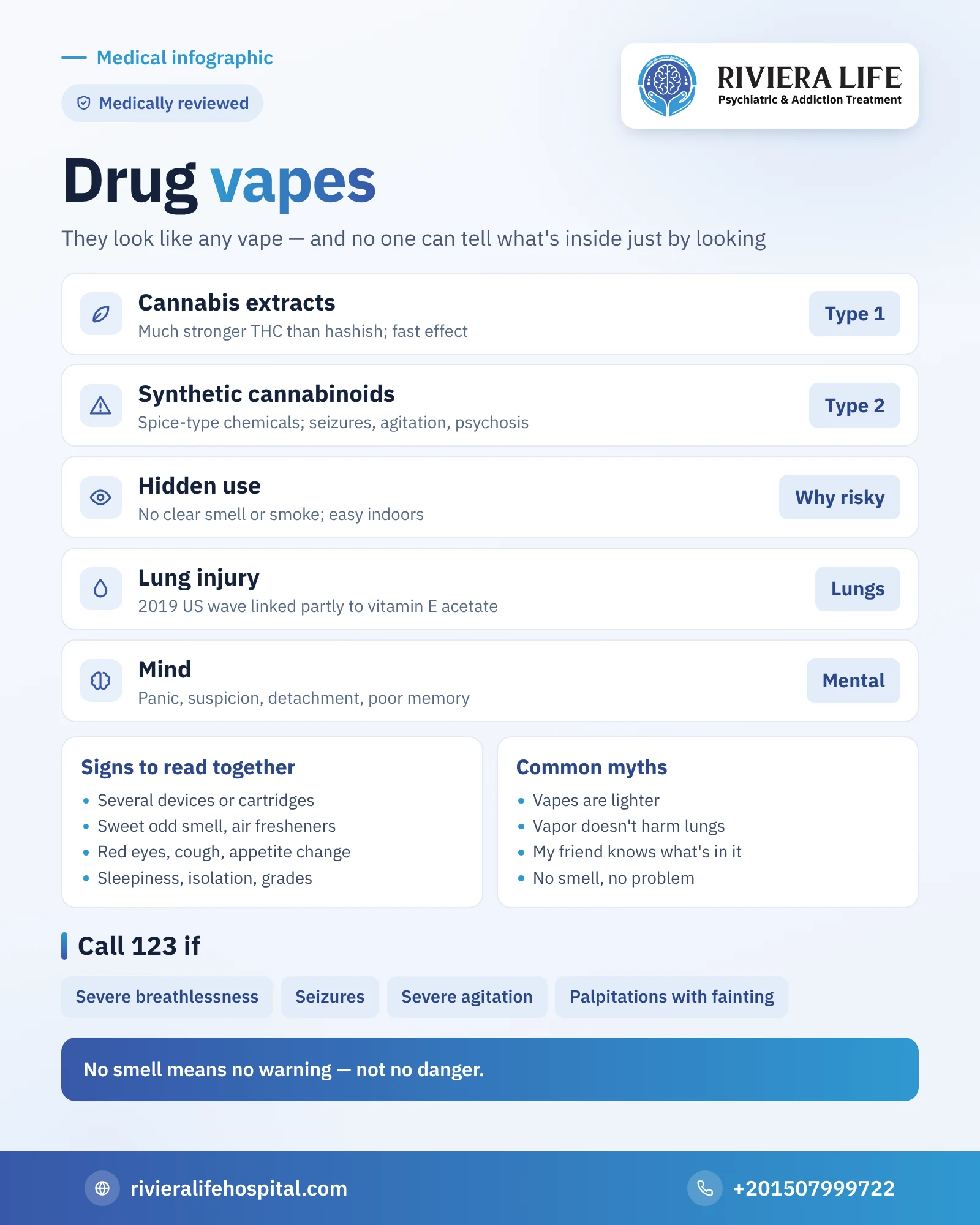
Drug vapes are liquids and cartridges used in electronic vaping devices that contain substances other than nicotine, the best known being high-strength cannabis extracts (hashish and marijuana) and products soaked in synthetic cannabinoids from the spice family. Their danger is that they look like any ordinary vape device, without the known hashish smell or thick smoke, so a father, a teacher or even the device’s owner can’t be sure what is inside just by looking. In this article we explain their types, why they differ from traditional smoking, their harms to the lungs and mind, and how the family can notice the problem without spying.
What is meant by drug vapes?
A vape device heats a liquid and turns it into vapor that the user inhales. This device was designed for nicotine, and we explained its harms in our article on e-cigarettes. But the device itself can take other substances, which is what happens when cartridges or liquids are filled with cannabis extract or synthetic substances that mimic its effect. The user usually doesn’t know their source or composition. And the word “vape” alone isn’t enough to know what is inside the device, as it may contain nicotine alone, a drug alone, or a mixture.
The first type: high-strength cannabis extracts
The extracts used in vapes are much stronger than ordinary hashish or marijuana in terms of the concentration of the active substance (tetrahydrocannabinol). And they are inhaled in a way that gives a fast effect. This high concentration raises the risk of dependence and increases the likelihood of anxiety, panic and psychotic symptoms, especially in teenagers and those with a psychological predisposition. To learn about the harms of cannabis in general, read the harms of marijuana.
The second type: synthetic cannabinoids in liquids
Synthetic cannabinoids, known on the street as spice, strox and others, are chemicals sprayed on herbs or dissolved in liquids to mimic the effect of cannabis, but they are stronger and less predictable. Health authorities have reported their presence in liquids sold as ordinary vapes or cannabis. This type carries the known risks of spice: seizures, agitation, palpitations, psychosis and sometimes coma. Our article on the harms of spice addiction explains these effects in detail, and our article on the joker drug discussed a common name close to it in Egypt.
Why is it different from traditional smoking?
- Concealment: the absence of a clear smell and smoke allows use in closed places without anyone noticing.
- Concentration: it reaches the brain quickly and at a higher concentration than a cannabis cigarette gives.
- Not knowing the content: no reliable list of ingredients, and the liquid may be mixed with substances added to improve appearance or taste.
- Continuous use: the ease of repeated inhaling makes the user take more without feeling it.
- Hiding among peers: young people swap devices so no one knows what he inhaled.
Lung damage: what has been recorded?
In 2019 the United States saw a wave of serious lung injuries called “e-cigarette or vaping use-associated lung injury”, for which thousands of patients were admitted to hospital and a number died. Health investigations linked a large part of it to unofficial cannabis products to which a compound called vitamin E acetate had been added, a substance used to thicken the liquid that isn’t fit for inhaling. Patients began with cough, shortness of breath, chest pain, nausea and fever, and in some the condition developed into respiratory failure. This doesn’t mean every product causes this, but it shows what happens when people inhale a liquid whose composition they don’t know.
The psychological and neurological effect
High-strength cannabis can cause panic attacks, suspicion, detachment from reality and weak concentration and memory. In teenagers, whose brains are still maturing, concerns about achievement and mood increase. Synthetic cannabinoids may produce acute psychosis that may need hospital treatment, and you will find details in our article on drug-induced psychosis. And someone who uses vapes habitually may find it hard to stop, and show insomnia, irritability, loss of appetite and anxiety on abstaining.
What about the nicotine inside the device?
Many teenagers start with ordinary vapes looking for a “flavor” or to keep up with friends, then move to other products out of curiosity or at a classmate’s offer. Nicotine itself creates fast dependence that makes the person used to having the device in his hand, and someone used to the device becomes closer to trying whatever is put in it. This doesn’t mean every vape user will move to drugs, but the device in a teenager’s hand removes the barrier that the smell and smoke of hashish used to impose. Some parents are surprised that their son has been using cannabis for months while they thought he was using a fruit flavor.
Common misconceptions
- “Vapes are lighter than cigarettes”: nicotine alone may be less harmful than smoking for adult smokers, but this doesn’t apply to cannabis and synthetic cannabinoid liquids, nor to teenagers.
- “Vapor doesn’t harm the lungs”: unknown liquids may carry substances not fit for inhaling, which is what appeared in the wave of lung injuries.
- “I know what’s in the device because I bought it from a friend”: the friend himself usually doesn’t know, and it can’t be judged by appearance or taste.
- “No smell, so no problem”: the absence of smell means the absence of a warning, not the absence of danger.
How can the family notice?
There is no conclusive evidence, but there are indicators that deserve attention, all of which are read together, not separately:
- Several devices, cartridges or liquids that don’t match what the person says.
- A sweet or strange smell in the room or clothes, or heavy use of air fresheners.
- Red eyes, repeated cough, dry mouth and a change in appetite.
- Sudden sleepiness or anxiety and distraction, or isolation and academic decline.
- Repeated unexplained spending or insistent requests for money.
Don’t search his belongings and confront him in a moment of anger. Start by calmly asking about the devices and liquids, where they came from, and their effect on his sleep and concentration, and tell him his safety matters more to you than punishment.
When does use become dependence?
The line between trying and dependence isn’t a fixed number, but there are signs that bring the picture closer: the person thinking about the device more than about his studies, getting upset or angry if deprived of it for hours, increasing the amount to get the same effect, hiding it and lying about it, and continuing despite cough, insomnia and declining performance. If these signs appear, what is needed is an assessment, not blame, because dependence is a health condition that can be treated like any other.
Is stopping possible?
Yes, but the method depends on what the person uses. Someone using nicotine alone needs a quitting plan. Someone using high-strength cannabis may need psychotherapy and support for withdrawal symptoms. And someone using synthetic cannabinoids may need closer medical supervision because of the risk of seizures and psychosis. In all cases the family doesn’t make the decision to stop suddenly for someone dependent on a strong substance without consultation. You will find an outline of the steps of recovery in our articles on spice addiction treatment and marijuana addiction treatment.
Call an ambulance on 123 immediately if you see
After inhaling vapor from a device of unknown content, these signs can't wait.
- Severe shortness of breath or chest pain
- Seizures or loss of consciousness
- Severe agitation, hallucinations or dangerous behavior
- Strong palpitations with fainting or pallor
- Continuous vomiting with fever and severe cough
How can Riviera Life help you?
At Riviera Life, psychiatry and addiction consultants assess what the person is actually using, and set a plan that suits his condition, with round-the-clock medical supervision, complete confidentiality, a family program and follow-up after treatment. The first consultation is free on +201507999722 in Sheikh Zayed, Giza, and the hospital is licensed by the Ministry of Health.
More from our spice guide
- Spice: the complete guide
- E-cigarettes: nicotine and harms
- The harms of spice addiction
- The harms of marijuana
Questions many people ask
Liquids or cartridges in vaping devices that contain a drug such as high-strength cannabis extracts or synthetic cannabinoids instead of only nicotine.
No, the shape, taste and smell don't reveal the content, and the device may contain nicotine, a drug or a mixture.
Because they look like ordinary vape devices and usually have no distinctive hashish smell and no thick smoke.
In a wave of lung injuries in 2019 in the United States, they were partly linked to unofficial cannabis products containing vitamin E acetate, with symptoms of cough, shortness of breath and chest pain.
Yes, treatment depends on the substance used, and includes a medical and psychological assessment, support for withdrawal symptoms and a relapse prevention program.