To understand how a drug addict thinks, start from the fact that his mind’s priorities have changed: the brain has learned that the substance is the fastest route to relief, so thinking has come to revolve around it, and the ability of the inner brakes to stop the craving has weakened. That is why many deny their need for treatment, not because they don’t always see the problem, but because admitting it means facing fear and shame and losing something that has come to make them feel safe. In this article we explain what goes on in the addict’s head before the dose, during it and after it, why he denies, lies, promises and then returns, and how treatment changes this pattern of thinking.
How does a drug addict think? What happens in the brain
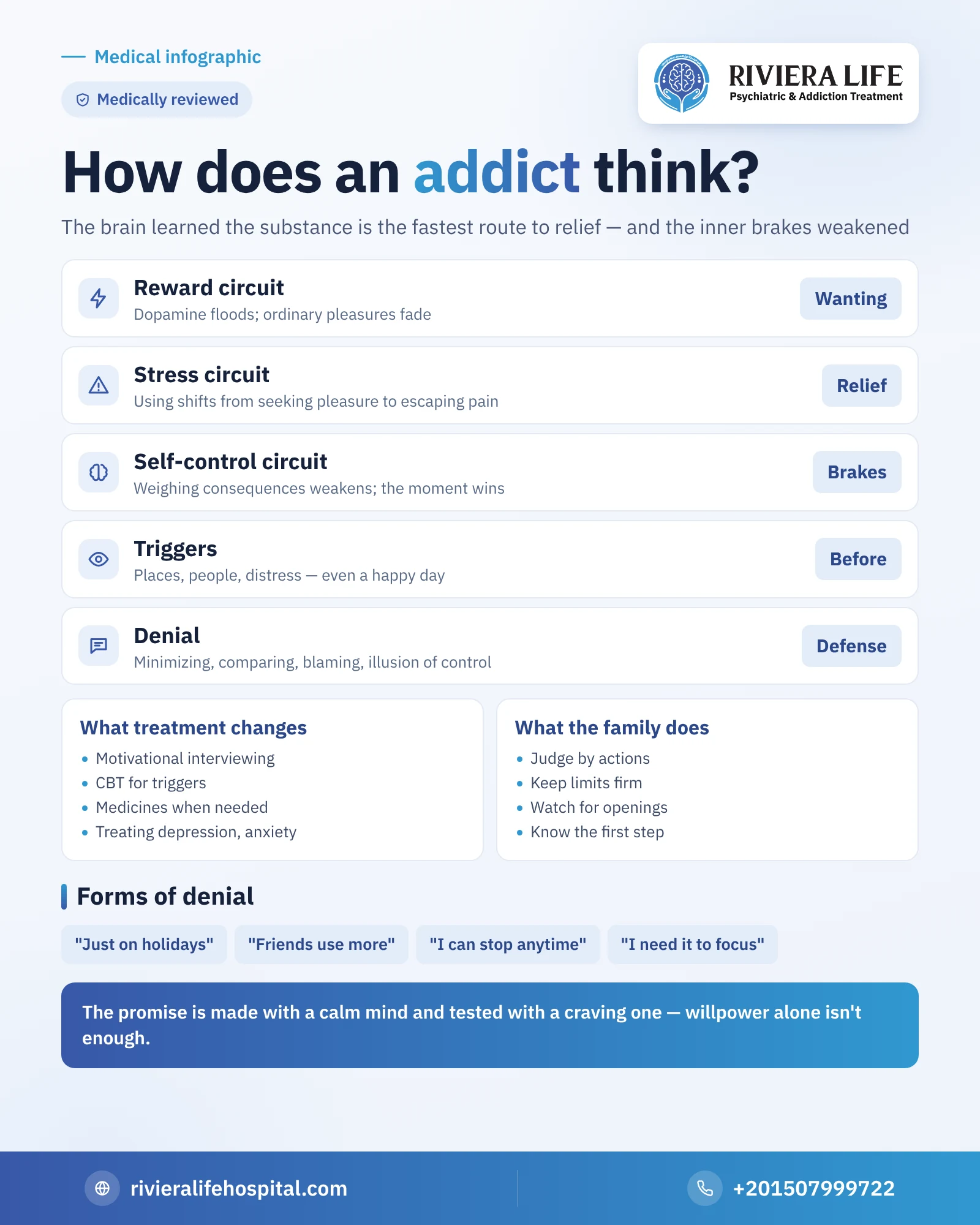
Addiction touches three main circuits in the brain, and each one explains part of the way of thinking:
- The reward circuit: the substance releases large amounts of dopamine, so the brain learns that this behavior is “very important”. With repetition, ordinary activities become dull, and nothing gives the same feeling.
- The stress circuit: over time, anxiety, tension and discomfort rise in the substance’s absence, so using turns from a search for pleasure into an escape from pain.
- The self-control circuit: the front region of the brain responsible for planning and weighing consequences weakens in performance, so the momentary craving becomes stronger than long-term calculations.
If you want to go deeper into the chemical side, our article on dopamine and addiction explains how drugs hijack the reward system.
Before the dose: when the world narrows
The craving usually starts with a trigger: a place, a person, distress, or even a smell. Suddenly the addict’s attention narrows, and he no longer sees anything but one goal. At this moment it seems to him that the nearby relief is more important than any coming price, and that “just once” won’t hurt. And the mind starts making quick justifications: “My day was hard”, “I deserve this”, “I’ll stop tomorrow”.
The trigger isn’t always negative: it may be a salary that arrived, a happy occasion, or a meeting with an old friend. The brain has linked the substance with many feelings, not with sadness alone, which is why families are sometimes surprised by a relapse on a day that seemed lovely. And the longer the use continues, the shorter and less conscious the path from trigger to action becomes.
During the effect and after it
During the effect the sense of danger recedes, so he may drive his car, mix substances, or say what he doesn’t mean. After the effect wears off comes a completely different stage: regret, shame, tiredness, and sometimes sincere promises to stop. But these promises collide hours or days later with intense craving and withdrawal symptoms, so the cycle starts again.
Why does he deny there is a problem?
Denial isn’t always deliberate lying. It is often a psychological defense that protects the person from a painful image of himself. It takes recurring forms:
| Form of denial | How it sounds in speech |
|---|---|
| Minimizing | “Just a joint on holidays” |
| Comparing | “My friends use several times what I use” |
| Blaming | “If you’d left me alone I wouldn’t have needed it” |
| Illusion of control | “I can stop whenever I want” |
| Justifying | “I need it to focus at work” |
Does the addict know he is an addict?
Awareness varies. Some know inside but can’t say it out loud. Others don’t see the full picture, because the change happened gradually, and because the substance itself may weaken the ability to assess oneself. And awareness changes from day to day: on the morning after a crisis he may admit it, then deny it in the evening. These fluctuating moments are what the family should pay attention to.
Why does he lie and hide the truth?
Lying in an addict has reasons that can be understood without being justified: shame at his loved ones seeing him like this, fear of punishment or scandal, a wish to protect his access to the substance, and sometimes a real weakness of memory about the details of what happened under the influence. Understanding these reasons doesn’t mean believing everything he says, but means building your decisions on actions and facts, not on words.
And is the manipulation deliberate?
You may feel he knows exactly how to press on your weak points: he cries, threatens, pleads, or sows discord between father and mother. Sometimes this is calculated behavior to get money or avoid confrontation, and sometimes it is real distress expressed in a distorted way. You don’t need to settle which it is; it is enough for the boundaries to be clear and firm in both cases.
How does he see his family?
Many addicts love their families genuinely, and feel heavy guilt towards them. But the illness makes this love recede behind the need for the substance at moments of craving. He may sometimes see the family as an obstacle or a watchman, so he moves away from them and closer to those who share his use. This contradiction between what he feels and what he does is among the things that hurt him most himself. He may interpret the family’s worry about him as control, and respond with stubbornness, while in reality he needs someone to tell him that the door is still open.
He promises, then returns: why?
The promise is usually sincere in its moment, but it is made with a calm mind and tested with a mind at the peak of craving. Willpower alone isn’t enough against a brain that has learned for years that the substance is the solution, which is why the addict needs new skills, a supportive environment and sometimes medicine, not mere determination.
Does the addict lose his intelligence? And why does he become irritable?
Intelligence itself doesn’t disappear, and many addicts are very clever at hiding their use and arranging money. What is affected is impulse control, decision-making and weighing consequences. As for irritability and aggression, they have different causes: the effect of stimulants such as ice and cocaine, withdrawal symptoms, sleep deprivation, or an accompanying psychiatric disorder that needs a separate diagnosis.
When does the addict start thinking about stopping?
Change rarely happens suddenly. The addict usually passes through stages: he sees no problem, then wavers between “maybe” and “no”, then starts planning, then acts. In the wavering stage specifically he is more open to hearing a different opinion, because part of him wants to stop and another part is afraid of it.
The moment of change often comes after a situation that shakes his image of himself: losing a job, an accident, a look of disappointment in his child’s eyes, or realizing that the substance no longer gives him even the relief it used to. These moments are short, and it helps for the family to be ready for them with clear information about the first step of treatment instead of blame.
How does a hashish addict think? What sets his mind apart
Hashish deceives its user in a different way from stimulants and opioids. It is a plant, using it looks calm, and it doesn’t cause violent withdrawal like alcohol, so the user forms a firm belief that it is “the lightest kind” and that he can leave it whenever he wants. This belief is the first thing that protects him from admitting the problem.
Among the thoughts that recur in many of them:
- “It calms me and helps me think”, while those around him notice weak concentration and frequent forgetting.
- Explaining loss of enthusiasm and laziness as a personal trait unrelated to the substance.
- Understanding insomnia and distress on stopping as meaning the substance “was a treatment”, not as the effect of stopping.
- Suspicion of people’s intentions and sudden anxiety in some, which may develop in a few into psychosis.
The irony is that these thoughts seem logical from the inside, as each one gives its owner an acceptable reason to continue. That is why treatment deals with the belief itself, not with the behavior alone.
Arguing against these thoughts with evidence during a quarrel doesn’t work. What opens dialogue more is understanding what puts him off, which is explained in our article on what a hashish user hates, and you will find the details of growing suspicion in the hashish addict and suspicion.
How does treatment change the way of thinking?
Treatment isn’t limited to getting the substance out of the body, but works on the thoughts themselves:
- Motivational interviewing: helps him discover his own reasons for change instead of having them imposed on him.
- Cognitive behavioral therapy: teaches him to recognize the triggers and automatic thoughts that precede use, and replace them with other choices.
- Medicines when needed: some medicines such as naltrexone may reduce craving with certain substances, and the doctor determines them.
- Treating accompanying problems: such as depression and anxiety, which feed addictive thinking if left untreated.
How does the family benefit from this understanding?
When you understand that denial is a defense and not just stubbornness, you stop trying to break it by force, and look for the right way in. The practical steps of dialogue, persuasion and boundaries are in our article on how to help an addict and convince him of treatment, and each substance has its own guide, such as dealing with an ice addict and dealing with a cocaine addict.
How can Riviera Life help you?
At Riviera Life, psychiatry and addiction treatment consultants work on both sides together: the body and the thinking. The patient or his family can start with a free, confidential first consultation in Sheikh Zayed, or by phone around the clock: +201507999722.
Read also
- How do I help an addict and convince my son of treatment?
- Can a drug addict quit on his own?
- What does a hashish user hate?
- The Matrix program for addiction treatment
- Involuntary addiction treatment: when is it justified and how is it done safely and legally?
- Defense mechanisms: their types, examples and when they become an obstacle
Questions many people ask
He often knows and feels real guilt, but the intense craving for the substance overpowers this feeling in the moment, and this is the nature of the illness, not a lack of love.
Because the promise is made in a moment of calm, while it is tested at the peak of craving or withdrawal, and willpower alone isn't enough without skills and treatment.
Not always; denial is often a psychological defense that protects the person from a painful image of himself, and his awareness of the size of the problem may truly be limited.
With abstinence and psychotherapy, control over impulses and decision-making improve gradually in many, but this needs time and follow-up.
The cause may be the effect of a stimulant, withdrawal symptoms, lack of sleep, or an accompanying psychiatric disorder, and a medical assessment determines the cause.
Most addicts aren't violent by nature, but the risk increases under the influence of alcohol, stimulants and synthetic substances, and in cases of psychosis and severe withdrawal episodes. Aggression here is an acute state, not a fixed trait, and needs a safety plan and medical assessment, not confrontation.