Discovering that someone you love uses heroin turns the house upside down. Fear mixes with anger, and two questions fight inside you: do I confront him now or wait? And do I pressure him or leave him to decide for himself? In how to deal with a heroin addict there is no magic sentence that makes him agree to treatment the first time, but there are ways that greatly increase the chances of him accepting help, and other ways that push him away and lengthen the road. This guide is for the family: what to do step by step, what to say, which limits protect you and him, and how to act if he refuses or relapses.
Before the confrontation: put the house in order from inside
The most failed attempts at talking are those that start with an outburst at the moment of discovery, or in which each family member says something different. So start with two steps before you talk with him:
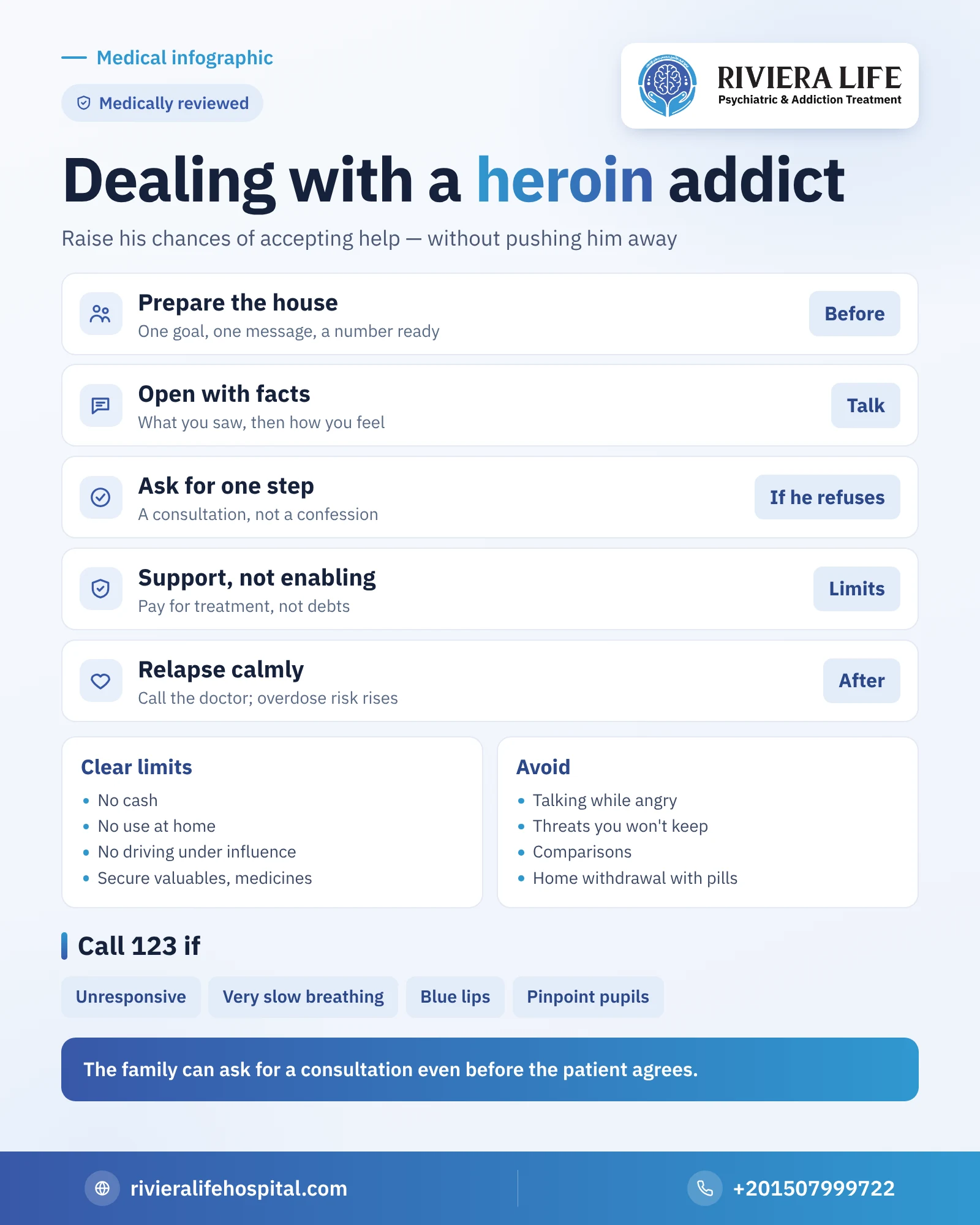
- Meet as a family first: agree on one goal, which is reaching a medical assessment, on who will talk, and on what you will no longer do from today, such as giving him money without asking.
- Gather information calmly: find out what he uses, how and since when as far as possible, and have the number of a reliable treatment provider ready before the talk, so that if he says “OK” the moment isn’t lost in searching.
And if you aren’t yet sure that what you see is heroin use, the article on heroin addiction symptoms helps you read the signs before any confrontation.
How do you open the conversation?
Choose a time when he is calm, not under the influence of the substance and not in withdrawal symptoms, and a private place away from guests and children. Don’t turn the session into a trial with everyone sitting around him; one or two people he trusts are enough.
Start with what you actually saw, not with judgments. “I noticed you didn’t go to work three days this week, and that money disappeared from the drawer” is much stronger than “you’re an addict and you’ve destroyed our life”. Facts are hard to deny, while labels call up defense. Then express your own feelings: “I’m afraid for you, and I can’t sleep thinking something might happen to you”.
After that, be quiet and listen. Many users carry a real fear of the treatment itself: of the pain of withdrawal, of people finding out, or of losing their job. Hearing this fear is the real way in to persuading him, because then you can answer it with information, not pressure.
What do you say and what do you avoid?
| Instead of saying | Try saying |
|---|---|
| You’re a liar and can’t be trusted | It’s hard for me to believe right now, and I want us to rebuild trust step by step |
| Because of you the whole family is suffering | We’re all worried about you, and we want to go through this with you |
| If you were a man you’d stop by yourself | Addiction is a medical condition, and stopping needs help, not just willpower |
| Either treatment or you leave the house now | We’re ready to support treatment, and we won’t support continued use |
| I’ll shame you in front of everyone | What’s happening will stay between us, and treatment is confidential |
Also avoid talking while you are angry, threatening what you won’t carry out, and comparing him with a brother or friend who “succeeded”. Every threat not carried out teaches him that your words carry no consequences.
If he denies or refuses treatment
Denial in the first conversation is expected, and doesn’t mean the attempt failed. Don’t get into an argument over the word “addict”, and don’t try to extract a confession. The goal is smaller than that: for him to agree to one step, such as consulting a doctor or a call with a specialist just to ask.
There is a studied method for helping families in this situation known as Community Reinforcement and Family Training (CRAFT), and its idea is simply: to make life without the drug warmer and more rewarding, to let the consequences of use fall on him and not on you, and to wait for the moments when he is more ready, such as the morning after a bad incident, to offer help again. Studies indicate that this approach is more successful at getting the user into treatment than harsh group confrontation.
The difference between support and enabling
Many families protect the user from the results of his use out of love, so they pay his debts, justify his absence to his work, and give him money “so he doesn’t steal”. This is what is called enabling, and it makes continuing to use easier. Real support is to stand by the person, not the addiction: to pay the cost of treatment, not the debts, to take him to the doctor, not the dealer, and to stand beside him on the hard days, not to hide the results of what he does from him.
Clear limits that protect everyone
Limits aren’t a punishment, but rules that protect the house and make the picture clear. Set them calmly, say them once, and stick to them:
- Money: no cash. His basic needs are bought or paid directly.
- The house: no using, no equipment and no using friends inside the home.
- Driving: no driving the car under the influence or on withdrawal days.
- Children: children aren’t left in his care alone as long as he is using.
- Belongings: keep valuables and medicines in a safe place.
When he asks for money or things disappear
These are among the hardest moments. Don’t get into a long discussion and don’t accept new promises. Say clearly: “I won’t give you money, but I’ll pay for treatment today if you agree”. And if theft is repeated, protect what you own and ask a specialist for advice on how to act, without daily life turning into a constant battle.
Can he be admitted to treatment without his consent?
In principle, treatment is more successful when the patient takes part in it willingly. But the Mental Health Care Law in Egypt regulates compulsory admission in specific cases decided by a psychiatrist, such as the presence of a severe psychiatric disorder that poses a serious danger to the person’s life or to others. Judging whether the case meets these conditions is a medical and legal decision, not the family’s decision alone. This is only resorted to after a medical assessment, and it is always preferable for the road to start with trying to persuade him first. The specialist team can explain to the family the options available for its particular case.
When he agrees: how do you make the most of the moment?
Agreement may be a short window, so don’t postpone. Call on the same day, and prepare what he will need: his ID card, a list of any medicines he takes, information about the substances he uses and the approximate amount, and any chronic illnesses. And don’t try to manage a withdrawal for him at home with painkillers and sleeping pills, as this may be dangerous. You will find the details of what happens at this stage in the article on heroin withdrawal symptoms, and what comes after in the article on heroin addiction treatment.
If he goes back to using after treatment
Relapse is common in addiction like other chronic illnesses, and doesn’t mean the treatment was useless. The most important thing is that it is discovered early and that the person goes back to their plan quickly. Avoid the phrase “I knew you wouldn’t change”, and replace it with “what happened happened, and what matters now is that we call the doctor”. And remember that the period after abstinence is the most dangerous for overdose, because the body’s tolerance falls.
In emergencies: what do you do?
Call an ambulance on 123 immediately if you see
Stay beside him until help arrives, and if he is breathing put him on his side so he doesn't choke if he vomits.
- Loss of consciousness and no response to calling or shaking
- Very slow or irregular breathing or a strange snoring sound
- Blue lips and nails
- Very narrow pupils
Don’t forget yourself
Living with someone who uses drains the family psychologically and physically, and this may show as insomnia, constant anxiety and tension in relationships between the other members. Ask for support for yourself from a specialist or from family support groups, and keep part of your normal life. A cohesive and relatively rested family is more able to help than a completely exhausted one. And don’t carry guilt for what is happening, as the causes of addiction are many and most of them are outside your control, as the article on the causes of heroin addiction explains.
How does Riviera Life help you?
The family can start by contacting us even before the patient agrees, to get a free consultation on how to talk with him and the steps to get him to assessment. The Riviera Life team in Sheikh Zayed City offers a confidential assessment, treatment programs that include the family, and follow-up after discharge. To contact us around the clock: +201507999722.
More from the heroin guide
- Heroin: the complete guide
- The harms of heroin on the body and brain
- How long heroin stays in the body and testing
- Heroin and sex
- The difference between heroin and hash: which is more dangerous, and is hash a gateway to heroin?
Questions many people ask
It is better to postpone the talk until you calm down and the family agrees on one goal and one message, and to choose a time when he isn't under the influence of the substance, with the number of a treatment provider ready before the talk.
No, giving money makes continued use easier. It is better to buy his basic needs directly, and to be ready to pay the cost of treatment instead of debts.
Don't get into an argument over the word addict, ask for a small step such as one consultation, keep the limits, and repeat the offer of help at moments when he is more ready. The family can ask for a consultation for itself even before he agrees.
Managing withdrawal at home with painkillers and sleeping pills isn't advised, because it may be dangerous and raises the likelihood of relapse and overdose. Medical assessment determines the suitable type of treatment.
Deal with relapse calmly and without blame, contact the treatment team quickly, and be aware that the risk of overdose rises after the period of abstinence.