A hashish user’s behavior doesn’t change suddenly in one day, but drifts slowly until his family find themselves facing a different person: he wakes up late, closes his bedroom door, sometimes laughs for no reason, then flares up over the smallest things on other days. This article doesn’t deal with medical diagnosis, but with what the family sees with its own eyes inside the home and in study, work and relationships. Here you will find the most frequent behaviors, how to tell them apart from ordinary teenage ups and downs, and how to use your observations without turning into an investigator in your own home.
Why does a hashish user’s behavior change?
The active substance in hashish affects the brain areas responsible for short-term memory, attention, motivation and the sense of time. With repetition the brain adapts, so normal mood becomes less pleasurable, and smoking becomes what restores apparent balance. So his behaviors fall into three types: what appears under the influence, what appears when he needs the substance and can’t find it, and what accumulates slowly over months and changes his daily personality. Understanding this division saves you from confusing a passing outburst with a fixed pattern.
Behavior under the influence
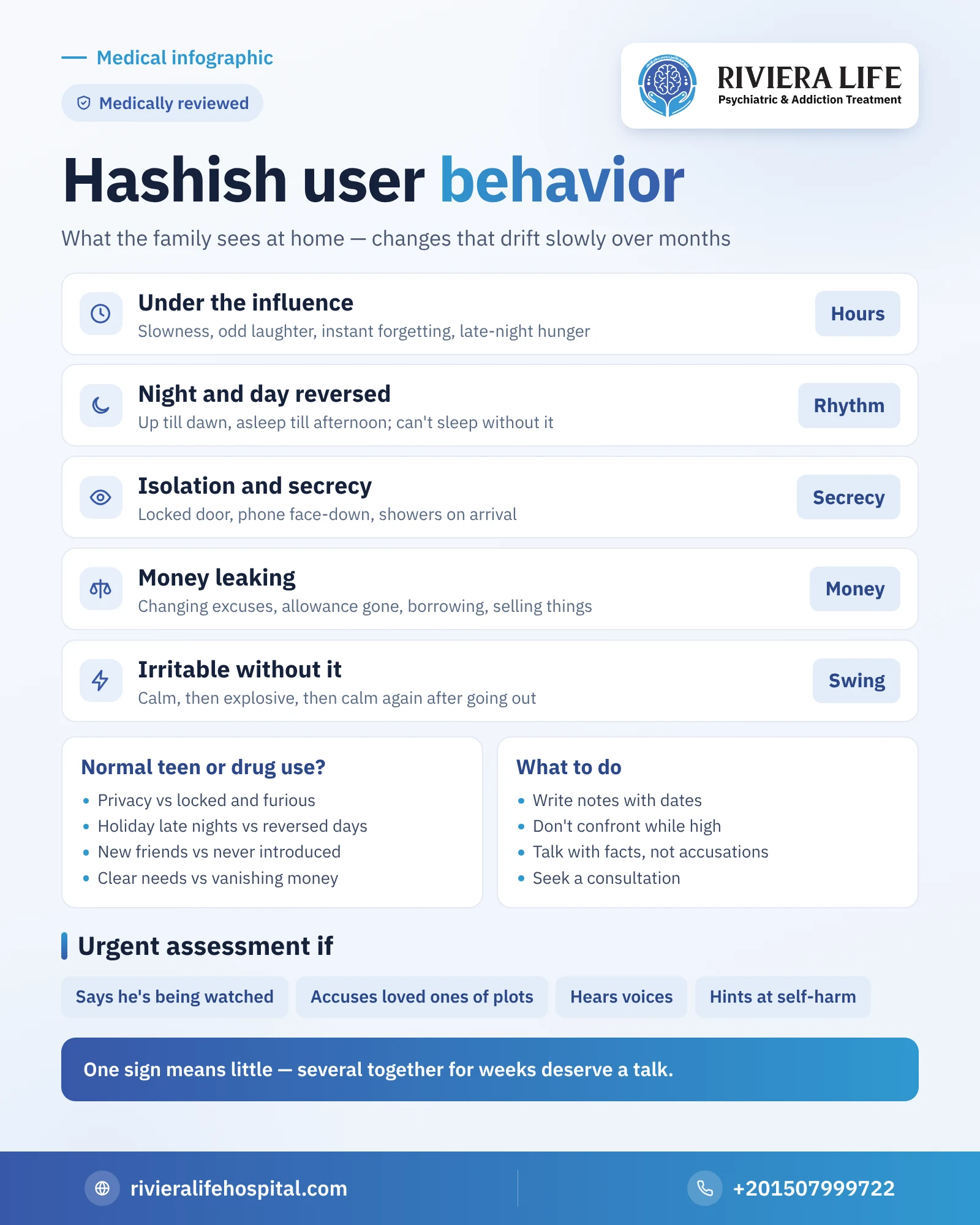
- Noticeable slowness: in speech, movement and answering questions, as if he needs extra seconds to understand what is said.
- Inappropriate laughter: at things that make no one laugh, or strange calm and long drifting off in front of a screen.
- Instant forgetting: he asks you the same question twice, or forgets what he was saying in the middle of a sentence.
- Sudden hunger: especially for sweets and fast food late at night.
- Avoiding eye contact: because red eyes give him away, so he wears glasses or goes straight to his room.
Night and day reversed
One of the clearest changes is that his day shifts into the night. He stays up until dawn, then sleeps until the afternoon, and waking him for study or work becomes a daily battle. Many users smoke right before sleeping because they can no longer sleep without it, so if the substance runs out for a single night, insomnia and tossing and turning appear. This link between hashish and sleep is one of the things parents most often notice, even before they suspect anything.
Isolation and exaggerated privacy
An ordinary teenager likes his privacy, but what stands out here is the exaggeration: a door locked with a key all the time, intense anger if anyone enters the room, a phone that never leaves his hand and is always face down, and withdrawal from family meals and family occasions. You may also notice he spends a long time on the roof, the balcony or in the car, places where it is easy to smoke out of sight.
Some parents notice that their son now showers or changes his clothes as soon as he gets home, chews gum constantly, or opens the window in the depths of the cold. These are attempts to hide the smell rather than new hygiene habits, especially if they appear suddenly and weren’t part of his nature before.
New friends and mysterious places
He gradually drifts away from the old friends you knew, and people appear in his life who don’t come to the house and whom he doesn’t introduce to you. Sudden short errands multiply: “I’m going out for five minutes” is repeated in the evening, and short calls after which he rushes out. And if you ask where he was, the answers come back general and inconsistent. This pattern is usually linked to the need to obtain the substance, not necessarily just to bad company.
Money leaking away
- Repeated requests with changing excuses: a book, a subscription, a phone repair, a gift for a friend.
- Pocket money that runs out before the middle of the month without you seeing what he bought.
- Borrowing from siblings or relatives, and sometimes selling personal things he used to treasure.
- At advanced stages, small sums may disappear from the home.
Loss of drive and interest
This change is harder to notice because it is quiet, but it has the deepest effect. A young man who used to train, play music or plan his future becomes content with very little. He doesn’t reject things violently, but postpones them endlessly: “tomorrow”, “it doesn’t matter”. Some doctors describe this pattern in regular users as a loss of motivation, which usually improves after stopping, but during use it makes the family think it is laziness or bad manners.
A change in appearance and self-care
Over time he may neglect his appearance: clothes worn for days, untidy hair, and a room where plates and leftover food pile up. His attention to appointments and small promises declines, so he forgets his sister’s birthday or a doctor’s appointment, then apologizes with apparent sincerity and repeats the same forgetting a few days later.
Irritability when he can’t find the substance
The other side of the apparent calm is quick explosions on the days he is cut off. He becomes sharp, impatient with questions, complains that noises bother him, and his appetite and sleep are disturbed. Then he suddenly becomes calm again after going out and coming back, and this swing between two extremes is an important sign. If you want to know more about this stage, our article on hashish withdrawal symptoms explains what happens to the body and mood in detail.
Traces in the space
The observation often comes from things rather than behaviors: a pungent herbal smell different from cigarette smoke that he tries to cover with a lot of incense or air freshener, eye drops with no medical reason, many lighters, thin rolling papers, tobacco emptied out of cigarettes, and small burn holes in clothes or car seats. One item alone proves nothing, but several signs together with behavioral changes deserve attention.
In study and work
Grades fall gradually, not all at once, absences and lateness increase, and teachers or managers complain of drifting off and postponing tasks. He may justify it by the difficulty of the subject or an unfair manager, and he may change his job or major more than once. At work specifically, some avoid jobs that require periodic testing, which connects to families’ questions about how long hashish stays in the body.
Normal change or a sign of drug use?
| Usually normal ups and downs | Deserves attention |
|---|---|
| Likes privacy and sometimes closes the door | Gets intensely angry if anyone approaches his room and always locks it |
| Stays up late in the holidays | His day has completely reversed, even on study and work days |
| Some of his friends have changed | Friends he never introduces you to, and mysterious short errands |
| Mood varies from day to day | Strange calm followed by an explosion, then calm after going out |
| Asks for money for clear purposes | Repeated requests with changing excuses, and pocket money vanishing |
The practical rule: a single sign doesn’t mean much, but several changes together lasting for weeks deserve a calm conversation and an assessment. The full medical picture, including diagnostic criteria, is in our article on hashish addiction symptoms.
Behaviors that call for an urgent assessment
Some changes can’t wait: talking about being watched or followed, accusing those closest to him of plotting, hearing voices others don’t hear, going without sleep for days, or hinting at harming himself. These signs may point to a psychotic disorder that needs a psychiatrist as soon as possible.
What do you do with what you’ve noticed?
Write your observations down with dates instead of keeping them in your head, and avoid confronting him while he is under the influence or at the peak of his irritability. Don’t search in a hostile way or set traps for him, as this turns the home into a surveillance zone and pushes him into more concealment. Then talk with him about what you have seen using facts, not accusations. You will find steps for talking and persuading in our article on how to deal with a hashish addict. And if you need an opinion before taking any step, the Riviera Life team offers families a free, confidential first consultation on +201507999722.
More from our hashish guide
- Hashish: the complete guide
- What does a hashish user hate?
- The hashish addict and suspicion
- The harms of hashish on the body and mind
Questions many people ask
No, red eyes have many causes, such as allergies and staying up late. A single sign isn't enough; what matters is several changes together that last for weeks.
Because many of them smoke at night to be able to sleep, so their day gradually reverses and waking in the morning becomes difficult and comes with a heavy mood.
He may seem calm under the influence, then become sharp and quick-tempered when he can't find the substance, and this swing between the two states is one of the notable signs.
Adolescence brings moderate ups and downs, whereas exaggerated secrecy, a completely reversed day and repeated money requests with changing excuses deserve attention.
Write down what you notice with dates, avoid confronting him while he is under the influence, then talk with him using facts and seek a specialist consultation if you need to.